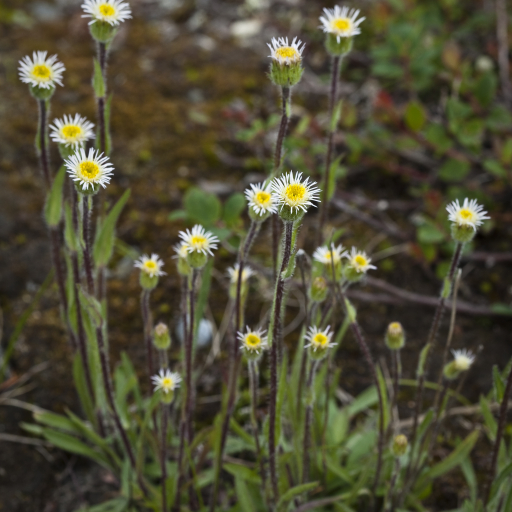
Plant Overview
Often referred to as the Spearleaf Fleabane or Short-rayed Fleabane, this delicate wildflower is a resilient gem of the North American wetlands and mountain meadows. While it might look like a modest daisy at first glance, its ability to thrive in alkaline, "salty" soils where other plants wither makes it a true specialist of the wild. It gets its curious common name from the ancient folk belief that dried bundles of the plant could drive away pesky fleas.
🔍 How to Identify
- 🌼 The Flowers: Look for small, daisy-like heads featuring numerous thin, white to pale lilac petals (ray florets) that are notably short, sometimes barely extending past the green base of the flower.
- 🗡️ The Foliage: True to its name, the leaves are "spear-shaped" (lanceolate)—narrow and pointed. Most leaves cluster at the base, while smaller ones alternate up the stem.
- 🌵 The Texture: The entire plant is covered in stiff, spreading hairs, giving the stem and leaves a slightly rough or "bristly" feel when touched.
🏡 In Your Garden
- 💧 Moisture Lover: Unlike many of its drought-tolerant cousins, the Spearleaf Fleabane craves "wet feet." In a garden setting, it performs best near pond edges, in bog gardens, or in areas with consistently moist, poorly drained soil.
- 🧂 Alkaline Specialist: This plant is an excellent choice for difficult landscapes with high pH or mineral-heavy soils. It acts as a natural "pioneer," stabilizing soil in damp, salty flats where few other ornamental flowers can survive.
⚠️ Safety & Toxicity
- ✅ Status: Generally considered non-toxic to humans and common household pets.
- 🌿 Skin Sensitivity: While not poisonous, the stiff hairs on the stems can cause mild mechanical irritation (itchiness) for those with very sensitive skin. It is always a good idea to wear gloves when handling wild asters in bulk.
✨ Fun Fact
The genus name Erigeron translates from Greek to "Old Man in the Spring." This refers to the white, fuzzy seed heads that appear shortly after blooming, looking like a tiny patch of grey hair on the landscape.

Detailed Care Instructions

Place in a bright room that is sun drenched almost all day. Or directly in a south-facing window.

Some plants require more regular watering than others, which should be done every few days. It's critical to maintain the soil moist all of the time. The water requirements of the same plant placed in pots with varying sizes will differ. Because the water in the smaller pot evaporates faster than the water in the larger pot, it will require more watering. Regardless of pot size, the surface should constantly be maintained moist.








