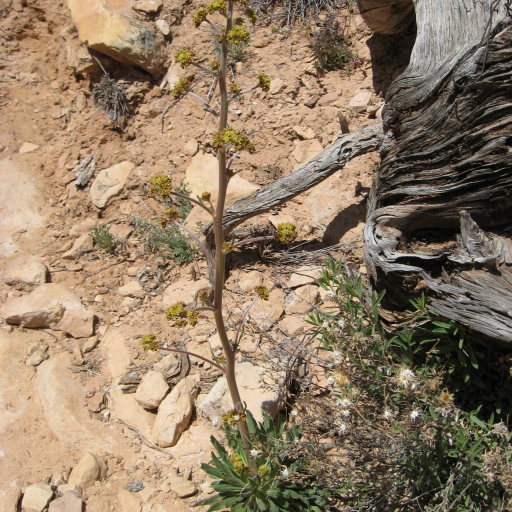
Plant Overview
Known to many as the Winged Buckwheat, this plant is an architectural standout of the American Southwest and Great Plains. It spends its early life as a quiet, fuzzy rosette before suddenly launching a towering, multi-branched flowering stalk that looks like a delicate piece of desert lace. In Navajo (Diné) tradition, it has been valued for generations as a medicinal remedy for various internal ailments, earning it a respected place in ethnobotanical history.
🔍 How to Identify
- 🍃 Basal Rosette: The plant starts as a ground-hugging circle of long, lance-shaped leaves, often covered in fine, silvery hairs that help it reflect the intense desert sun.
- 🗼 The Stalk: A sturdy, highly branched flowering stem that can reach up to five feet tall, giving it a skeletal, airy appearance compared to more "leafy" garden plants.
- 🕊️ Winged Seeds: Its most defining feature is the three-winged fruit (achenes) that follow the tiny yellow flowers. These "wings" are designed to catch the wind, helping the plant scout for new territory.
🏡 In Your Garden
- 🌵 The Deep Taproot: This buckwheat anchors itself with a massive, woody taproot to find moisture deep underground. Because of this, it is exceptionally drought-tolerant but nearly impossible to transplant once established. Choose its "forever home" wisely!
- 🐝 Pollinator Highway: While the tiny, yellowish-green flowers are subtle to the human eye, they are a high-energy nectar source for native bees, wasps, and butterflies, making it a "must-have" for a restoration or habitat garden.
- 🏜️ Lean Soil Lover: This species thrives in "poor" soil—rocky, sandy, and fast-draining. Adding too much fertilizer or rich compost will actually cause the plant to grow too fast and flop over.
⚠️ Safety & Toxicity
- ✅ Non-Toxic: Eriogonum alatum is generally considered non-toxic to humans, dogs, and cats.
- 🐑 Livestock Note: While safe for most, some species of buckwheat contain compounds that can cause photosensitivity in light-skinned livestock if eaten in massive quantities, though this is rarely an issue with Winged Buckwheat specifically.
- 🧤 Skin Protection: The fine, bristly hairs on the leaves and stems can be a minor skin irritant for people with sensitive skin. Wearing gloves during pruning is recommended.
✨ Fun Fact
The species name alatum is Latin for "winged." If you look closely at the seeds after the flowers fade, they look like tiny, three-sided propellers—a perfect engineering feat for wind dispersal across the open prairies.

Detailed Care Instructions
To grow Eriogonum alatum, also known as winged buckwheat, you can follow these steps:
- Choose a suitable location: Eriogonum alatum prefers full sun and well-draining soil. Make sure the chosen spot receives at least 6-8 hours of direct sunlight each day.
- Prepare the soil: Amend the soil with organic matter, such as compost or well-rotted manure, to improve drainage and fertility. Eriogonum alatum can tolerate various soil types but prefers slightly alkaline conditions.
- Planting: Dig a hole in the prepared soil that is slightly larger than the plant's root ball. Gently place the plant in the hole, making sure it is at the same depth as it was in its previous container. Fill the hole with soil and lightly firm it around the plant.
- Watering: Water the newly planted Eriogonum alatum thoroughly to settle the soil and help the plant establish its roots. After that, water deeply but infrequently, allowing the soil to dry out slightly between waterings.
- Mulching: Apply a layer of organic mulch, such as wood chips or straw, around the base of the plant to conserve soil moisture, suppress weeds, and regulate soil temperature. Keep the mulch away from the stem to prevent rotting.
- Pruning: Eriogonum alatum generally requires minimal pruning. However, you can trim back any dead or damaged branches to maintain a neat appearance. Pruning can be done in early spring before new growth emerges.
- Fertilizing: Since Eriogonum alatum grows naturally in nutrient-poor soils, it usually doesn't require much fertilizer. A light application of a balanced, slow-release fertilizer in early spring can provide some extra nutrients if desired.
- Maintenance: Regularly monitor the plant for pests and diseases. Eriogonum alatum is generally quite resistant to these issues, but occasional problems may arise. Remove any weeds growing nearby to prevent competition for resources.
- Propagation: Eriogonum alatum can be propagated by seeds or division. Seeds can be collected from the plant or purchased from reputable sources. Division can be done in early spring by digging up the plant and separating it into smaller sections, making sure each section has roots attached.
By following these steps, you can successfully grow Eriogonum alatum and enjoy its beautiful flowers and unique growth habit.

Place in a bright room that is sun drenched almost all day. Or directly in a south-facing window.

Eriogonum Alatum plant prefers moderate watering, which means that it should be watered regularly but not excessively. It is best to water the plant deeply once a week or every two weeks, depending on the weather conditions.
It is important to keep the soil moist but not soggy, as this can lead to root rot. Therefore, it is recommended to water the plant slowly and deeply, allowing the water to penetrate the soil and reach the roots.
In hot and dry climates, it is crucial to monitor the soil moisture levels and increase the frequency of watering if necessary. However, it is essential to avoid watering the plant during the hottest part of the day, as this can cause the water to evaporate quickly and not reach the roots.
During the winter months, the Eriogonum Alatum plant goes through a dormant period and requires less water. Therefore, it is recommended to reduce the watering frequency and only water the plant when the soil is completely dry.
Overall, it is essential to provide adequate and consistent water to the Eriogonum Alatum plant to ensure healthy growth and development.
- Choose a balanced fertilizer with equal amounts of nitrogen, phosphorus, and potassium.
- Apply the fertilizer evenly around the base of the plant.
- Water the fertilizer in thoroughly to ensure it reaches the roots.
- Avoid over-fertilizing, as this can cause damage to the plant.
- Fertilize once in early spring and again in late summer to promote healthy growth and blooms.
Eriogonum alatum plant prefers well-draining soils that are rich in organic matter. It can tolerate a wide range of soil textures, from sandy to clayey. It is important to ensure that the soil pH ranges from neutral to slightly alkaline. Adding a layer of mulch on the top surface of the soil can help to retain moisture and also provides an additional source of organic matter for the plant. Avoid planting it in soil that is constantly waterlogged or too dry, as it will lead to poor growth and development. Adding a slow-release fertilizer to the soil during planting helps to provide the necessary nutrients for the plant to establish and grow.
To propagate this plant, you can take stem cuttings during the growing season. Choose healthy stems and make a clean, angled cut just below a leaf node. Remove any lower leaves and dip the cut end of the stem in rooting hormone. Plant the stem in a pot filled with well-draining soil and keep it moist but not waterlogged. Place the pot in a bright, but indirect light and cover with a plastic bag to create a humid environment. After a few weeks, the stem should start to grow roots and new growth. Once it has established a root system, it can be gradually acclimated to direct sunlight and then transplanted into a larger pot or into the ground.








