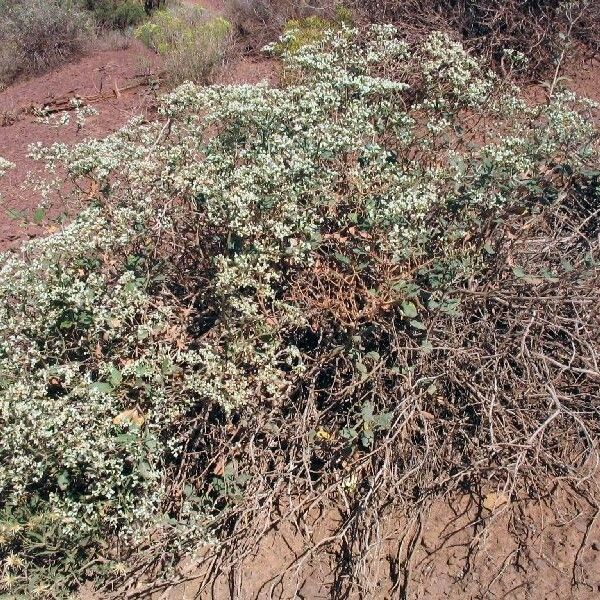
Plant Overview
Often called the Crisp-leaf Buckwheat, this desert native is a master of survival in the rugged landscapes of the American Southwest. It transforms arid, rocky hillsides into a sea of delicate, lace-like white and yellow blooms during the late summer and fall. While it might look like a simple shrub, it acts as a vital "pollinator gas station" when other desert flora has finished blooming for the season.
🔍 How to Identify
- 🌿 Ruffled Foliage: The small, oblong leaves are notably "crisped" or wavy along the margins. They are often covered in a fine, silvery-white fuzz (tomentum) that helps the plant reflect intense sunlight.
- ☁️ Cloud-like Blooms: Tiny flowers are held in dense, flat-topped clusters known as corymbs. These clusters can range from snowy white and cream to a soft buttery yellow, sometimes blushing pink as they age.
- 🪵 Woody Skeleton: It grows as a low, mounding perennial shrub with a tough, woody base that keeps it anchored against high desert winds.
🏡 In Your Garden
- 🏜️ The Ultimate Xeriscape: This plant is the definition of "tough love." It thrives in poor, rocky, or sandy soil where most garden plants would wither. It is exceptionally drought-tolerant once established and requires almost no supplemental water.
- 🦋 Late-Season Lifeline: Because it blooms later than many other species, it is a magnet for native bees and hairstreak butterflies. It provides a critical nectar source just as these insects are preparing for winter or migration.
- 🛑 Root Sensitivity: Like many desert shrubs, it develops a deep taproot to find water. This makes it very difficult to transplant, so it is best to start it from seed or a small nursery pot in its "forever home."
⚠️ Safety & Toxicity
- ✅ Safe Status: Eriogonum corymbosum is generally considered non-toxic to humans, dogs, and cats. It does not possess any known stinging hairs or caustic saps.
- 🧤 Physical Irritation: While not chemically toxic, the dried, woody stems and "crisped" leaves can be somewhat scratchy. If you are pruning a large patch, wearing light garden gloves will prevent minor skin abrasions.
✨ Fun Fact
Native American tribes, including the Zuni and Hopi, historically used various parts of the Corymb Buckwheat for medicinal purposes. The roots were often boiled to create a tea used to treat stomach aches, proving that this "weed" was actually a highly valued pharmacy in the wild.

Detailed Care Instructions
To grow Eriogonum corymbosum, also known as the "Bushy Buckwheat," you can follow these steps:
- Choose the right location: Eriogonum corymbosum prefers full sun exposure, so select a location in your garden or yard that receives direct sunlight for at least 6-8 hours a day.
- Prepare the soil: This plant thrives in well-draining soil. If your soil is heavy or clayey, amend it by adding organic matter like compost or well-rotted manure to improve drainage.
- Sow the seeds: You can start Eriogonum corymbosum from seeds. Sow the seeds in the prepared soil, ensuring they are placed around 1/4 inch deep. Space the seeds about 12-18 inches apart to allow room for the plant to spread.
- Watering: Water the seeds lightly after planting to keep the soil moist. Once the plant is established, it is drought-tolerant and only requires occasional watering during extended dry spells.
- Mulching: Apply a layer of organic mulch around the plant to help retain soil moisture and suppress weed growth. Leave a small space around the stem to prevent rotting.
- Maintenance: Eriogonum corymbosum is relatively low-maintenance. Keep an eye out for any pest or disease issues and address them promptly.
- Pruning: Once the plant finishes flowering, you can prune it back to promote bushier growth and maintain its compact shape. Wait until late winter or early spring to perform any major pruning.
- Propagation: Eriogonum corymbosum can also be propagated by division. Divide the plant in early spring by digging up the clump and separating it into smaller sections. Replant the divisions in suitable locations.
By following these steps, you should be able to successfully grow Eriogonum corymbosum in your garden or landscape.

Eriogonum Corymbosum is a perennial plant that requires moist soil to thrive. When watering this plant, it is important to water it deeply but infrequently to encourage deep root growth. The plant should be watered once every 7-10 days during the growing season while allowing the top layer of soil to dry out between each watering. It is also important to make sure the plant is not waterlogged as this can cause root rot and damage to the plant. During the winter months, watering should be reduced to once every 2-3 weeks depending on the climate and soil conditions. It is recommended to water this plant in the early morning or late evening to reduce water stress on the plant during the hottest part of the day. Overall, consistent and proper watering is essential for the health and growth of Eriogonum Corymbosum.
- Begin fertilizing the plant in late winter or early spring before it starts actively growing.
- Choose a balanced, slow-release fertilizer with a nitrogen-phosphorus-potassium (N-P-K) ratio of 10-10-10 or similar.
- Apply the fertilizer at a rate of 1 tablespoon per square foot of soil around the base of the plant.
- Mix the fertilizer into the soil with a garden fork or cultivator.
- Water the plant thoroughly after fertilizing to help distribute the nutrients evenly in the soil.
- Repeat fertilization in early summer if necessary for optimal growth and blooming.
- Avoid fertilizing in the fall or winter, as this can stimulate new growth that is susceptible to frost damage.
Eriogonum corymbosum plant requires a well-draining soil that is on the sandy side, with a pH level that is slightly acidic to neutral. It needs a soil that is rich in organic matter and nutrients, but not overly fertile, as excessive nitrogen can lead to excessive leaf growth rather than flowering. The soil should be moisture-retentive but not waterlogged, as the plant is drought-tolerant but dislikes overly wet conditions. It grows well in soils that have good drainage and are not prone to waterlogging, such as those found in dry meadows, open grasslands, and rocky outcrops. The use of organic mulches can help to retain moisture in the soil and provide additional nutrients, but care must be taken not to suffocate the plant's shallow roots. Overall, a sandy, slightly acidic to neutral soil that is rich in organic matter and well-draining is ideal for Eriogonum corymbosum.
Eriogonum Corymbosum is a plant that can be propagated by root cuttings. To do this, select a healthy root from the parent plant and use a sharp cutting tool to cut it into pieces that are about an inch in length. Plant each piece in a pot or directly in the ground, making sure the cut end is pointing downward. Water the newly planted cuttings thoroughly and keep the soil moist but not saturated. It may take several weeks or even months for new growth to appear, but once it does, the new plants can be transplanted to a permanent location.








