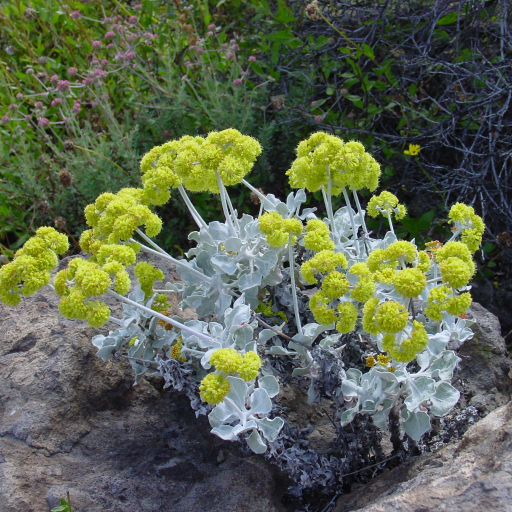
Plant Overview
Commonly known as Saffron Buckwheat or Conejo Buckwheat, this rare California native is a visual masterpiece of high-contrast colors. Growing naturally only in a tiny corner of Ventura County, it has become a "must-have" for drought-tolerant gardeners who want to bring a piece of the wild Conejo Valley into their own landscape.
🔍 How to Identify
- ☁️ Wooly Foliage: The leaves are round, crinkled, and covered in dense, silvery-white felt that helps the plant reflect intense sunlight.
- 🌟 Saffron Blooms: In late spring and summer, the plant is crowned with flat-topped clusters of tiny, neon sulfur-yellow flowers that eventually fade to a warm cinnamon-red.
- 🌱 Mound Shape: It maintains a low, spreading habit, typically staying under 2 feet tall while forming a soft, silver cushion on the ground.
🏡 In Your Garden
- 🪨 Drainage is King: In the wild, this plant clings to volcanic rock and shale. In your garden, it will "pout" or rot if planted in heavy clay. It thrives in rock gardens or raised beds where water can move away quickly.
- 🦋 Pollinator Party: While it is a tough, drought-hardy shrub, it is a massive magnet for local butterflies and beneficial predatory wasps, making it a cornerstone for a living, breathing backyard ecosystem.
- ✂️ Low Maintenance: Once established, it requires almost zero supplemental water. To keep it looking tidy, simply "deadhead" the dried flower stalks once they turn brown in late autumn.
⚠️ Safety & Toxicity
- ✅ Safe Status: Saffron Buckwheat is considered non-toxic to humans, dogs, and cats.
- 👅 Texture Note: While not poisonous, the "wooly" hairs on the leaves can be slightly irritating to the throat if a curious pet or toddler decides to take a bite, so it’s best kept as an ornamental feature.
✨ Fun Fact
This plant is a "narrow endemic," meaning it is found naturally in only one specific place on Earth—the volcanic hillsides of the Santa Monica Mountains. When you grow one, you are helping to preserve a species with a very tiny global footprint!

Detailed Care Instructions
To grow Eriogonum crocatum, also known as saffron buckwheat, you can follow these steps:
- Choose a suitable location: Eriogonum crocatum plants prefer full sun exposure and well-draining soil. Make sure the area has good air circulation as well.
- Prepare the soil: The soil should be sandy and slightly acidic to neutral. If your soil is heavy or clay-based, you can improve drainage by adding compost or sand.
- Planting: Dig a hole that is slightly larger than the root ball of the plant. Place the root ball into the hole and backfill with soil. Lightly tamp down the soil around the plant to remove any air pockets.
- Watering: Provide enough water to keep the soil consistently moist but not waterlogged. During hot weather or dry periods, you may need to water more frequently.
- Mulching: Apply a layer of organic mulch around the plant, which will help retain moisture and suppress weeds. Leave some space around the stem to prevent rotting.
- Pruning: Eriogonum crocatum does not require much pruning. However, you can remove dead or damaged stems to maintain a tidy appearance. Pruning should be done after flowering.
- Fertilizing: Eriogonum crocatum generally does not require heavy fertilization. A light application of a balanced, slow-release fertilizer in spring can help promote growth. Be careful not to over-fertilize, as it may favor leaf growth over flower production.
- Propagation: Eriogonum crocatum can be propagated from seeds or by division. Seeds should be sown in the fall, and it may take some time for germination to occur. Division can be done by carefully dividing the plant's root ball and replanting the divisions.
- Pest and disease control: Eriogonum crocatum is generally not prone to severe pest or disease issues. However, it's always a good idea to keep an eye out for common garden pests such as aphids or spider mites. Treat any infestations accordingly using organic pest control methods.
- Enjoy the blooms: Eriogonum crocatum produces vibrant yellow flower clusters in the summer months, attracting pollinators like bees and butterflies. Enjoy the beauty of the plant's blooms and appreciate its contribution to the ecosystem.

Place in a bright room that is sun drenched almost all day. Or directly in a south-facing window.

Eriogonum Crocatum is a type of plant that requires a moderate amount of water. It is important to allow the soil to partially dry out between waterings, as overwatering can lead to root rot. When watering, aim to saturate the soil around the plant's roots, being careful not to splash water onto the leaves. It's best to water Eriogonum Crocatum in the morning or evening when the sun is not too strong, as watering during the hottest part of the day can cause stress to the plant. During hot, dry weather, it may be necessary to water more frequently to ensure that the plant remains hydrated.
- Choose a fertilizer that has a low nitrogen content, as excessive nitrogen can cause leafy growth at the expense of flowers and seeds.
- Apply the fertilizer in early spring, just before new growth emerges.
- Sprinkle the fertilizer evenly around the base of the plant, avoiding direct contact with the foliage.
- Water the plant immediately after fertilizing to distribute the nutrients throughout the soil.
- Repeat the fertilization once or twice per growing season, if desired, following the same application procedure.
The best soil for Eriogonum Crocatum plant is well-draining soil with a sandy or rocky texture. It should have a slightly acidic to neutral pH and be rich in organic matter. Avoid using soil with high clay content as it can lead to poor drainage and root rot. Addition of sand and perlite to improve drainage and aerate the soil can be helpful. It also grows best in full sun exposure and requires moderate watering.
- Select a healthy and mature Eriogonum Crocatum plant that has numerous stems.
- Cut off one of the stems from the main plant, using a clean and sharp pair of pruning scissors or shears.
- Trim the selected stem at an angle, making sure the cut is smooth and not jagged.
- Remove any leaves or small branches from the bottom of the stem, leaving only a few leaves at the top.
- Dip the cut end of the stem into a rooting hormone, which will help stimulate root growth.
- Insert the stem into a small container filled with moist, well-draining soil.
- Cover the container with a plastic bag or a clear plastic lid to create a humid environment.
- Place the container in a warm, bright spot, but away from direct sunlight.
- Keep the soil moist by watering lightly every few days or whenever it feels dry to the touch.
- After a few weeks, check for signs of new growth and roots, indicating that the stem has successfully rooted and is ready to be transplanted into a larger pot or outside in the garden.








