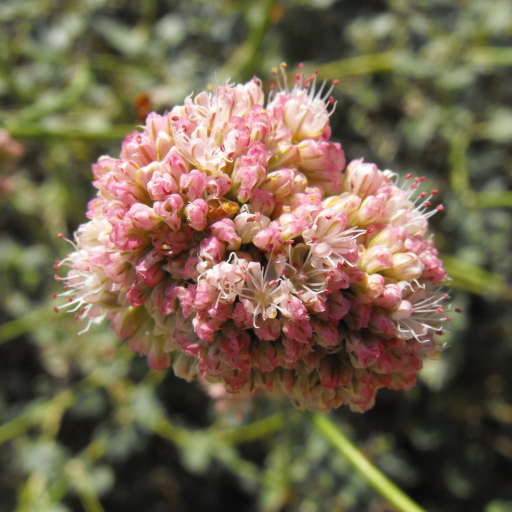
Plant Overview
Often called the Red Buckwheat or San Miguel Island Buckwheat, this coastal gem hails from the rugged Channel Islands of California. It is a hardy, mounding perennial that has moved from rocky island cliffs into modern "water-wise" gardens. Known for its striking "pom-pom" flower clusters that transition from soft pink to deep rusty red, it acts as a magnet for every butterfly in the neighborhood.
🔍 How to Identify
- 🌸 The Blooms: Tiny, star-shaped flowers are packed into dense, spherical clusters that sit atop long, leafless stalks. As they age, they dry into a beautiful cinnamon-brown.
- 🍃 The Foliage: The leaves are wavy-edged and spoon-shaped. They are a deep, leathery green on top but have a distinctively fuzzy, silver-white underside to help reflect the sun.
- 📏 Growth Habit: It forms a low-growing, sprawling mound, typically reaching about 1 foot tall and 2 to 3 feet wide, making it an excellent groundcover for slopes.
🏡 In Your Garden
- 🦋 Pollinator Party: This is one of the single best plants for supporting local biodiversity. It is a critical nectar source for the rare Avalon Scrub-Hairstreak butterfly and various honeybees.
- 💧 The Drainage Rule: Because it evolved on rocky island slopes, it hates "wet feet." If your soil is heavy clay, plant it on a mound or in a raised bed to ensure water drains away from the crown quickly.
- ☀️ Sun Seeker: It thrives in full sun and salty air. While it is incredibly drought-tolerant once established, a little occasional summer water will keep the foliage looking lush rather than "dormant."
⚠️ Safety & Toxicity
- ✅ Status: Non-toxic and safe.
- 🐾 Details: This plant is generally considered safe for dogs, cats, and humans. In fact, many birds enjoy snacking on the tiny seeds once the flower heads dry out in the late summer and fall.
✨ Fun Fact
The Eriogonum genus is one of the most diverse in North America, but Eriogonum grande is a true "Island Endemic." This means that before humans began planting it in mainland gardens, it existed nowhere else on Earth except for a few tiny islands off the California coast!

Detailed Care Instructions
To grow Eriogonum grande, also known as wild buckwheat, follow these steps:
- Select a location: Choose a sunny spot in your garden with well-drained soil. Eriogonum grande prefers sandy or gravelly soils.
- Planting: Dig a hole that is slightly larger than the container the plant came in. Gently remove the plant from its container and place it in the hole. Position the plant so that the top of the root ball is level with or slightly above the surrounding soil. Backfill the hole with soil and gently firm it around the plant.
- Watering: Water the plant thoroughly after planting to help settle the soil and provide initial hydration. Eriogonum grande is drought-tolerant but will benefit from occasional deep watering during dry periods, particularly in its first year. After maturity, it will require very little watering.
- Mulching: Apply a layer of mulch around the plant to help retain moisture, suppress weeds, and protect the roots. Use organic mulch, such as wood chips or straw, and apply it to a depth of 2-3 inches. Avoid piling mulch against the stem to prevent rot.
- Pruning: Eriogonum grande does not require regular pruning but can be pruned lightly after flowering to promote a bushier habit and remove any dead or damaged branches. If desired, trim back the plant by about one-third in late winter or early spring to rejuvenate it.
- Fertilizing: Eriogonum grande typically does not need fertilization unless the soil is extremely poor. If necessary, apply a balanced slow-release fertilizer in early spring according to the package instructions, being careful not to overfertilize.
- Pests and diseases: Eriogonum grande is generally resistant to pests and diseases. However, watch out for aphids, spider mites, or powdery mildew. If any issues arise, treat them with appropriate organic insecticidal soap or fungicide.
- Propagation: Eriogonum grande can be propagated through seeds or stem cuttings. Seeds can be sown in early spring or fall, while stem cuttings can be taken in summer and rooted in well-draining soil.
Remember to check the specific planting and care requirements for your region, as they may vary slightly based on your climate.

Place in a bright room that is sun drenched almost all day. Or directly in a south-facing window.

To water this plant, you should first check its soil moisture level by inserting a finger into the soil up to the second knuckle. If the soil feels dry at that depth, it's time to water. Use a watering can or hose with a gentle stream to water the plant's root zone, being careful not to splash the foliage. Give the plant enough water to thoroughly saturate the soil, but avoid overwatering to prevent root rot. Allow the top inch or two of soil to dry out before watering again. During the plant's dormant period, reduce watering frequency.
For best results, fertilize this plant in the spring before new growth appears. Use a balanced fertilizer with equal amounts of nitrogen, phosphorus, and potassium. Apply the fertilizer at a rate of 1 tablespoon per square foot around the base of the plant. Water the plant immediately after fertilizing to help the nutrients soak into the soil. Avoid fertilizing this plant in the fall or winter, as it may promote new growth that could be damaged by cold weather.
Eriogonum grande, a perennial plant belonging to the Buckwheat family, prefers well-draining soils that are rich in organic matter. It thrives in a soil pH range of 5.5 to 7.5 and can tolerate rocky or sandy soils, as long as they are not too compacted. The plant requires good drainage as it is susceptible to root rot and fungal diseases. Therefore, it is recommended to plant it in raised beds or on slopes to ensure proper drainage. The addition of compost or organic fertilizer to the soil before planting can provide the necessary nutrients for healthy growth. The soil should be kept moist but not waterlogged. This plant is adapted to drought so it is important to avoid overwatering. In areas with high rainfall, it may be necessary to improve drainage to prevent root rot. Overall, a well-draining soil that is rich in organic matter and kept moist but not waterlogged is ideal for the healthy growth of Eriogonum Grande.
To propagate this plant, you will need to collect seeds from the mature plant. Place the seeds in a container with moist soil and cover lightly. Keep the container in a warm and well-lit area for a few weeks until germination occurs. Once the seedlings have grown large enough, transplant them into individual pots or into a larger garden area. Make sure to water regularly and provide adequate sunlight for growth.








