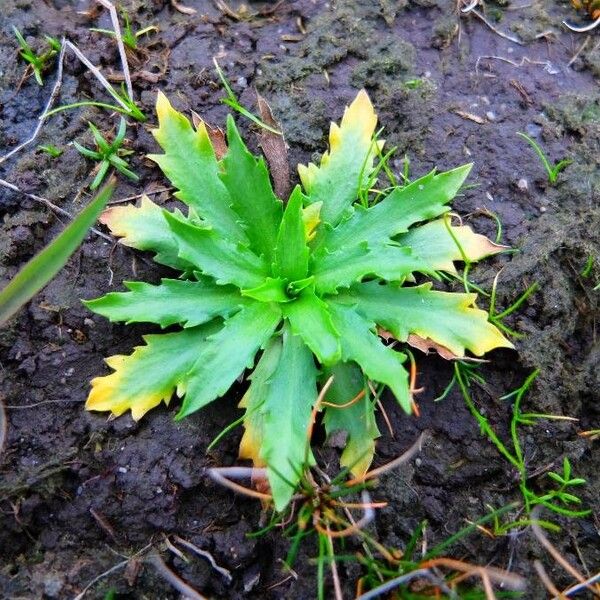
Plant Overview
Often called the Little Sea Holly or Pyrenean Eryngo, Eryngium viviparum is one of Europe’s rarest and most intriguing botanical treasures. Unlike its tall, architectural cousins often seen in cottage gardens, this tiny perennial is a "creeper" that thrives in the dramatic transition zones between water and land. It is a true survivor, specifically adapted to survive in areas that are completely flooded in winter and bone-dry by mid-summer.
🔍 How to Identify
- 🌵 The Rosette: It begins as a low-lying cluster of narrow, lance-shaped leaves that are slightly stiff and often have small, prickly teeth along the edges.
- 💎 Jewel-like Flowers: In late summer, it produces tiny, globe-like flower heads that shimmer with a metallic blue or silvery-grey hue, surrounded by a crown of very sharp, star-shaped bracts.
- 🏃 Creeping Habit: Its most distinctive feature is its "viviparous" nature—it sends out long, horizontal stems (stolons) that crawl along the mud and sprout new baby plants at the tips.
🏡 In Your Garden
- 💧 The Amphibious Life: This plant is an "extremophile" regarding water. It dislikes consistency; it actually craves a period of being submerged under shallow water during its dormant winter phase, followed by a sunny, drying-out period to trigger blooming.
- 🏔️ Soil Preferences: It is not a fan of rich, loamy garden soil. In the wild, it sticks to poor, acidic, and sandy substrates where other aggressive plants struggle to compete. If you are lucky enough to grow a cultivated specimen, think "bog garden" edges rather than a standard flower bed.
⚠️ Safety & Toxicity
- 🛡️ Status: Generally non-toxic to humans and pets, but it comes with a built-in defense system.
- ⚔️ Physical Hazard: The leaves and flower bracts are incredibly sharp and rigid. They can easily prick skin or small paws, so it is best handled with thick gardening gloves and kept away from high-traffic paths where a barefoot step could be painful.
✨ Fun Fact
The name viviparum literally means "giving birth to live young." While most plants rely on seeds to spread, this Eryngium specializes in "cloning" itself by growing fully-formed plantlets on its stems that take root as soon as they touch the mud, ensuring its survival even when the weather is too harsh for seeds to germinate.

Detailed Care Instructions

Place in a bright room that is sun drenched almost all day. Or directly in a south-facing window.

Water the plant thoroughly, ensuring that the soil is evenly moist. Allow the soil to dry partially between waterings, but do not let it completely dry out. Overwatering can lead to root rot, so it is important to allow excess water to drain away from the plant. Consider watering early in the day to allow foliage to dry before nighttime, which can help prevent fungal diseases. Additionally, avoid watering the foliage directly, as this can also contribute to fungal infections.








