Plant Overview
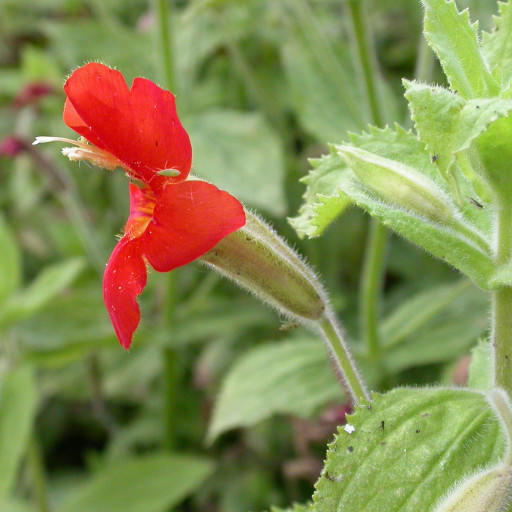
Known as the "Scarlet Monkeyflower," this vibrant beauty gets its name from its gaping, lipped flowers that look a bit like a grinning monkey's face. Native to the stream banks and seeps of Western North America, it is a high-drama perennial that acts as a primary "gas station" for migrating hummingbirds. In the wild, it is the undisputed queen of the creek, turning shaded wet areas into a sea of fiery red.
🔍 How to Identify
- 🌺 Snapdragon-like Blooms: The flowers are a brilliant scarlet red with a yellow-orange throat. They feature two "lips"—one that curls up and one that hangs down—revealing prominent golden stamens.
- 🍃 Toothed Foliage: The leaves are bright green, ovate, and have sharply serrated (toothed) edges. They grow in opposite pairs directly along the stem.
- 💧 Sticky Texture: If you touch the stems or leaves, you might notice they feel slightly tacky or hairy. This "glandular" texture helps protect the plant from certain crawling insects.
🏡 In Your Garden
- ⛲ Wet Feet Required: This plant is a "riparian" species, meaning it naturally grows near water. In a garden setting, it hates drying out. It is the perfect choice for a rain garden, the edge of a pond, or any low spot in your yard where water tends to collect.
- 🐦 Hummingbird Magnet: While many red flowers attract birds, the Scarlet Monkeyflower is specifically evolved for them. The petals are reflexed (bent back) to stay out of the way while a hummingbird hovers and drinks nectar. If you plant this, expect feathered visitors daily!
⚠️ Safety & Toxicity
- 🟢 Generally Safe: Erythranthe cardinalis is not known to be toxic to humans, dogs, or cats.
- 🐾 Garden Friendly: It is a safe choice for family gardens. However, because it grows in very damp soil, keep an eye out for molds or fungi that might grow near the base of the plant, which could be irritating to sensitive pets.
✨ Fun Fact
Scientists often use the Scarlet Monkeyflower to study evolution. By cross-breeding it with its sister species, the Pink Monkeyflower (E. lewisii), researchers discovered that just a few specific genes determine whether a flower turns red to attract hummingbirds or pink to attract bees!

Detailed Care Instructions
Erythranthe cardinalis, also known as Scarlet monkeyflower, is a beautiful flowering plant native to western North America. Here are some tips on how to grow and care for Erythranthe cardinalis:
- Planting: Scarlet monkeyflower thrives in moist, well-drained soil and prefers partial shade to full sun. Plant them in a location that receives morning sun and afternoon shade to protect them from drying out.
- Watering: Keep the soil consistently moist, especially during the hot summer months. Water the plant regularly, but be careful not to overwater as this can lead to root rot.
- Fertilizing: Fertilize the plant with a balanced liquid fertilizer every 4-6 weeks during the growing season to promote healthy growth and flowering.
- Pruning: Trim back the plant after blooming to encourage new growth and keep the plant healthy and compact.
- Mulching: Mulch around the base of the plant to help retain moisture in the soil and suppress weeds.
- Propagation: Erythranthe cardinalis can be propagated by division or by taking cuttings. Dividing the plant in the spring or fall will help maintain the health and vigor of the plant.
- Pests and diseases: Keep an eye out for pests such as aphids or spider mites, and treat them promptly with insecticidal soap if necessary. Ensure good air circulation around the plant to prevent fungal diseases.
By following these tips, you can successfully grow and enjoy the vibrant blooms of Erythranthe cardinalis in your garden.

Place in a bright room that is sun drenched almost all day. Or directly in a south-facing window.

To water this plant, you should first check the soil moisture level by sticking your finger about 1-2 inches into the soil. If the top inch of soil is dry, it's time to water. When watering, pour water gently and slowly onto the soil until it starts to drain out of the bottom of the pot. Allow the excess water to drain completely before putting the plant back in a decorative container or saucer. Be careful not to let the plant sit in standing water, as this can lead to root rot. Watering frequency will depend on the environment the plant is in, so monitor the soil moisture level regularly and adjust as needed.
To fertilize the Erythranthe Cardinalis plant, use a balanced liquid fertilizer diluted to half strength. Apply the fertilizer every 4-6 weeks during the growing season, which is typically spring and summer. Make sure to water the plant before and after fertilizing to prevent burning the roots. Avoid over-fertilizing as it can damage the plant.
The ideal soil for this plant is a well-draining, moderately fertile soil mix that is rich in organic matter. It should have a pH range of 6.0 to 7.0, as this plant prefers slightly acidic to neutral soil. A mix of peat moss, perlite, and vermiculite can provide the necessary drainage, while compost or well-rotted manure can supply the nutrients. It is important to avoid heavy soils that retain too much moisture, as this can lead to root rot. Additionally, the soil should be kept consistently moist but not waterlogged, as this plant does not tolerate drought or overly soggy conditions.
Erythranthe Cardinalis plants can be propagated through both seed germination and stem cuttings. To propagate through seed germination, collect ripe seeds from the plant and sow them in a well-draining potting mix. Keep the soil consistently moist and place the pot in a bright, indirect light location. Seeds should germinate within a few weeks.
To propagate through stem cuttings, select a healthy and mature stem from the plant. Cut a section of the stem just below a leaf node and remove any leaves from the bottom half of the cutting. Dip the cut end of the stem in rooting hormone and plant it in a pot filled with a well-draining potting mix. Keep the soil consistently moist and place the pot in a warm, bright location. The cutting should root within a few weeks and can be transplanted into a larger pot once roots are established.








