Plant Overview
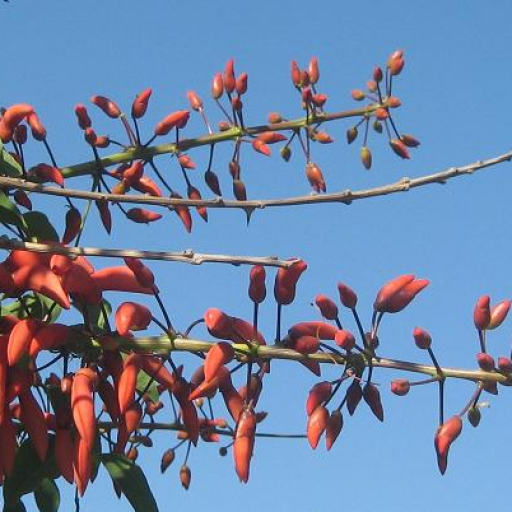
Known as the Brazilian Coral Tree or Ceibo de Monte, this spectacular South American native is famous for its "falcate" (sickle-shaped) crimson flowers that drape from the branches like fiery jewels. In the wild, it often lines the banks of rivers, turning the water's edge into a vibrant gallery of red. It is a favorite among landscape architects who want to add a dramatic, tropical architectural flair to large gardens.
🔍 How to Identify
- 🌺 The Flowers: The most striking feature is the pendulous clusters of bright red or deep coral blossoms. Each individual flower is curved and pointed, resembling a hawk's beak or a sickle.
- 🍃 The Foliage: It sports "trifoliate" leaves, meaning each leaf is composed of three distinct oval-shaped leaflets. These are a lush, glossy green that provides a sharp contrast to the red blooms.
- 🌳 The Bark: As the tree matures, the trunk becomes thick and woody, often developing a corky texture with small, protective prickles on younger branches and leaf stalks.
🏡 In Your Garden
- 💧 Water & Placement: While it is surprisingly drought-tolerant once established, it thrives best when it mimics its natural "riparian" (riverside) habitat. It prefers deep, infrequent watering rather than constant surface moisture.
- ☀️ Light & Space: This is not a "pot plant" for long; it is a fast-growing tree that demands full sun to produce its signature bloom. Give it plenty of room, as its root system and canopy like to spread wide.
- ✂️ Pruning Nuance: Because the wood can be somewhat brittle, it benefits from structural pruning when young to ensure it develops a strong central leader that can support the weight of its heavy flowering branches.
⚠️ Safety & Toxicity
- 🚫 Status: Toxic if Ingested.
- 🐾 Details: Like many members of the Erythrina genus, the seeds (which resemble small beans) contain erythraline and other alkaloids. These can cause muscle paralysis or respiratory distress if eaten by pets or curious children.
- 🌵 Physical Hazard: Keep an eye out for the small thorns on the stems and leaf midribs, which can catch on skin or clothing during maintenance.
✨ Fun Fact
The Erythrina falcata is a "Hummingbird Magnet." Because of the specific shape and downward orientation of its flowers, it has evolved specifically to be pollinated by birds with long beaks. In its native Brazil, it is common to see dozens of hummingbirds swarming a single tree during peak bloom!

Detailed Care Instructions
To grow Erythrina Falcata, also known as the Brazilian firetree, follow these steps:
- Climate and Soil Requirements: Erythrina Falcata thrives in tropical and subtropical regions. It prefers well-draining soil with a slightly acidic to neutral pH level.
- Seed Preparation: If you have fresh seeds, soak them in water for 24 hours before planting. Scarification (scratching the seed coat) may also help improve germination rates. If acquiring seeds from mature trees, use a file or sandpaper to gently scratch the seed coat.
- Planting: Fill a pot or seed tray with well-draining soil mix, leaving about 1 inch (2.5 cm) from the top. Plant the seeds 1 inch (2.5 cm) deep, spaced apart. Water the soil gently to moisten it, but avoid overwatering as it may cause rotting.
- Germination and Growth: Place the pot or tray in a warm and bright location, away from direct sunlight. The ideal temperature for germination is around 68-86°F (20-30°C). Keep the soil consistently moist but not waterlogged. Germination usually occurs within 2-3 weeks.
- Transplanting: Once the seedlings develop 2-3 true leaves and reach a height of around 6-8 inches (15-20 cm), they can be transplanted to larger pots or directly into the ground. Choose a sunny spot with enough space for the tree to grow. Ensure good drainage in the planting area and prepare the soil by adding organic matter.
- Care and Maintenance: Provide regular watering to keep the soil moist. As the tree grows, it may need staking for support. Erythrina Falcata prefers a medium amount of water, so avoid overwatering. Fertilize the tree periodically using a balanced fertilizer during the growing season.
- Pruning: To promote healthy growth, prune the plant during the dormant season, removing any dead or damaged branches. Regular pruning can also help maintain the desired shape and size of the tree.
- Pest and Disease Control: Monitor the plant regularly for pests like aphids, caterpillars, or snails. Remove any infected parts and use suitable insecticides or pesticides if necessary.
Remember that it may take a few years for the Erythrina Falcata plant to reach maturity and start flowering. Also, note that this tree can grow quite large, reaching heights of up to 30 feet (9 meters) when fully grown, so make sure to provide ample space for it to grow comfortably.
To adequately and effectively water the plant referred to as Erythrina Falcata, you should follow the below steps:
- Determine the watering needs of the plant: Observe the plant to know how much water it needs. Erythrina Falcata requires good drainage, and the soil should dry slightly between watering.
- Choose the right container: Pick a pot or container that has drainage holes at the bottom to ensure water is not stagnant in the soil.
- Watering schedule: Erythrina Falcata should be watered once a week, and the soil should be moist but not soggy.
- Watering method: Use a watering can or a garden hose with a gentle spray nozzle to avoid damaging the plant's leaves or stem. Water around the base of the plant and continue until water drains out of the drainage holes.
- Amount of water: Water the Erythrina Falcata plant until the soil is moist but not saturated. Overwatering can cause root rot.
- Avoid overhead watering: Avoid spraying water on the plant's leaves as it can lead to fungal diseases. Overall, proper watering technique and frequency will promote the healthy growth and survival of the Erythrina Falcata plant.
To fertilize this plant, use a balanced, slow-release fertilizer with a ratio of 10-10-10 or 20-20-20. Apply the fertilizer at the beginning of the growing season and then every 6-8 weeks throughout the season. Water the plant well after each application to ensure the fertilizer reaches the roots. Do not over-fertilize as excessive nutrients can lead to foliage burn and root damage.
The ideal soil for the Erythrina Falcata plant should be well-draining and have a pH level between 5.5 and 7.5. The soil should be slightly acidic to neutral. Additionally, it should be fertile and nutrient-rich to support healthy growth of the plant. A mix of loamy soil and organic matter such as compost or leaf mould is suggested to improve the soil structure and optimal growth. This will ensure that the Erythrina Falcata plant grows well and produces vibrant and beautiful blooms.
To propagate this plant, select healthy cuttings from the mother plant, using sterilized pruning shears. Cut 4- to 6-inch sections of stem that include at least two nodes, which are the points where leaves grow. Remove any lower leaves from the cutting, leaving only two or three at the top.
Dip the cut end of the stem in rooting hormone, following the package instructions. Then, plant the cutting in a container filled with a mixture of sterile potting mix and sand or perlite. Water the cutting well and cover it with a clear plastic bag to create a humid environment.
Place the container in a warm and bright location, such as a windowsill or a greenhouse, but avoid direct sunlight. Keep the soil moist, but not waterlogged, and mist the cutting frequently with water to maintain humidity.
Check the cutting regularly for signs of rooting by gently tugging on the stem. If it resists, roots have formed and the plant can be transplanted to a larger pot or outdoors in a well-draining location.








