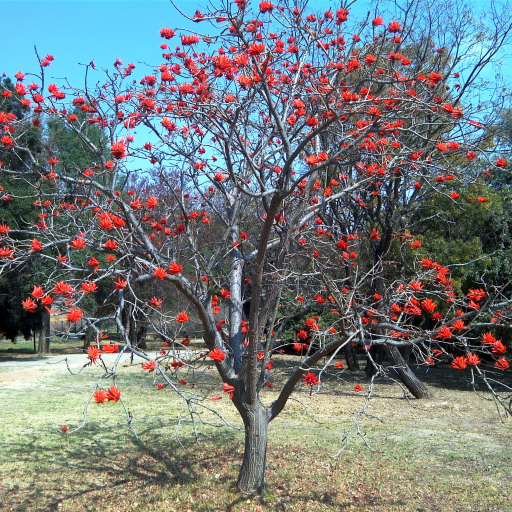
Plant Overview
Known as the Common Coral Tree or the Lucky Bean Tree, this South African icon is a showstopper that announces the coming of spring with a burst of fiery scarlet. In many cultures, it is regarded as a "sacred tree," often planted on the graves of chiefs or used to mark boundaries. Its leafless branches transform into "candelabras" of red blossoms, making it a favorite for those who want to attract vibrant birdlife to their landscape.
🔍 How to Identify
- 🌺 The Flowers: Intense scarlet to orange-red blossoms that are shaped like narrow, curved claws. They grow in dense, upright clusters at the ends of bare branches.
- 🍃 The Foliage: Large, heart-shaped leaves that grow in groups of three (trifoliate). The central leaflet is usually the largest, and the stems often feature small, hooked prickles.
- 🪵 The Bark: The trunk is grayish-brown and relatively smooth, but don't let that fool you—it is armed with short, woody thorns that protect the tree from climbing herbivores.
- 🫘 The "Lucky Beans": After flowering, the tree produces dark pods that split open to reveal striking bright red seeds with a distinctive black spot.
🏡 In Your Garden
- 🐦 A Wildlife Magnet: This tree is essentially a natural bird feeder. Its nectar-rich flowers are shaped specifically for sunbirds, whose curved beaks fit perfectly into the blooms, ensuring pollination while providing a sugary feast.
- 🏗️ Root Awareness: While beautiful, the Coral Tree has a vigorous and somewhat invasive root system. It is best planted at least 15 feet away from walls, swimming pools, or underground pipes to prevent "heaving" or damage.
- 🍂 Deciduous Drama: It loses its leaves in winter, which is actually a blessing for gardeners; it allows the low winter sun to reach the garden floor before the dense canopy returns in summer to provide deep shade.
⚠️ Safety & Toxicity
- 🚫 Toxic Seeds: While the seeds are often called "Lucky Beans" and used in jewelry, they contain erythroidine and other alkaloids which are toxic if swallowed.
- 👶 Keep Away from Kids: Because the seeds are bright, shiny, and look like candy, they are a high risk for children. Store any harvested seeds or jewelry made from them out of reach.
- 🌵 Prickly Defense: The thorns on the trunk and branches can cause painful scratches. Wear thick gloves when pruning or handling young saplings.
✨ Fun Fact
In South African folklore, the Common Coral Tree is often used as a "living fence." Because the branches root so easily, a "pole" cut from the tree and stuck into the ground will often grow into a brand-new tree, creating a permanent, thorny barrier for livestock!

Detailed Care Instructions
| Humidity | High |
| Difficulty | Medium |
To grow an Erythrina Lysistemon plant, also known as the common coral tree or lucky bean tree, you can follow these steps:
- Choose the right location: Erythrina Lysistemon plants thrive in full sun and prefer well-draining soil. Select a location in your garden that receives at least 6-8 hours of direct sunlight per day.
- Prepare the soil: Ensure that the soil is well-draining and fertile. If the soil in your area is heavy and clayey, add organic matter such as compost or well-rotted manure to improve its drainage and fertility.
- Planting: Dig a hole in the prepared soil that is slightly larger than the root ball of the plant. Gently place the plant into the hole, making sure that the base of the stem is at ground level. Backfill the hole with soil and lightly firm it around the plant. Water the newly planted tree thoroughly.
- Watering: Erythrina Lysistemon plants prefer moderate watering. Allow the top 2-3 inches of soil to dry out between waterings. Overwatering can cause root rot, so be cautious not to saturate the soil.
- Mulching: Apply a layer of organic mulch around the base of the plant to retain moisture, suppress weed growth, and regulate soil temperature. Keep the mulch away from the trunk to prevent rotting.
- Pruning: Regular pruning is not necessary for Erythrina Lysistemon plants, but you can remove any dead or diseased branches to maintain a healthy appearance.
- Fertilization: Fertilize the plant during the growing season with a balanced, slow-release fertilizer. Follow the package instructions for application rates and timing.
- Protection: Erythrina Lysistemon plants are generally hardy, but they can be susceptible to frost. If you live in an area with freezing temperatures, provide protection by covering the plant with a frost cloth or bringing it indoors during extreme cold.
- Propagation: Erythrina Lysistemon plants can be propagated through seeds or cuttings. If using seeds, scarify them by gently filing or nicking the hard seed coat before planting. Sow the seeds in a seed tray filled with well-draining soil and keep them warm and moist until germination. Cuttings can be taken from semi-hardwood stems and rooted in a suitable rooting medium.
Remember to check with your local gardening resources regarding specific care requirements and possible regional considerations for the Erythrina Lysistemon plant.

Place in a bright room that is sun drenched almost all day. Or directly in a south-facing window.

To properly water this plant, it is best to first consider the environmental conditions in which it is growing. This includes the amount of sunlight it receives, the temperature, and the humidity level. It is generally recommended to water this plant deeply and infrequently, allowing the soil to dry out slightly before watering again. However, it is important to avoid overwatering, as this can lead to root rot and other issues. When watering, it is best to water at the base of the plant rather than over the foliage, and to avoid getting water on the leaves and flowers. Additionally, it may be helpful to use a well-draining soil mix that allows excess water to drain away from the roots. Overall, the key to successful watering of this plant is to find a balance between providing enough moisture to support growth and avoiding excess water that can lead to problems.
To fertilize this plant, use a balanced fertilizer with a ratio of 10-10-10 or 20-20-20. Apply the fertilizer once every two weeks during the growing season, which is typically spring and summer. Water the plant thoroughly before and after fertilizing to prevent root burn. Avoid fertilizing during the winter months when the plant is dormant.
The Erythrina Lysistemon plant grows best in well-draining soil that is rich in nutrients. The soil should be slightly acidic to neutral, with a pH of 6.0-7.0. A soil mixture that includes equal parts of loam, sand, and peat moss will provide an ideal growing medium for this plant. Additionally, adding organic matter such as compost or aged manure can help to improve soil fertility and texture. It is important to avoid using heavy soils that are prone to waterlogging, as this can result in root rot and other problems. When planting, ensure that the soil is firmly packed around the roots to prevent air pockets. Regular watering and fertilization will help to promote healthy growth and flowering.
Erythrina lysistemon is a plant that can be propagated using different methods. One of the most common methods is by using stem cuttings. To do this, follow these steps:
- Choose a healthy stem from the plant that is at least six months old. It should be about 15cm in length and free from diseases and pests.
- Cut the stem at an angle to increase its surface area.
- Remove any leaves or buds from the bottom part of the stem. This will help the plant to focus its energy on growing roots.
- Dip the cut end of the stem into rooting hormone powder. This will help the stem to grow roots.
- Plant the stem in a pot filled with well-draining soil. Make sure that the soil is moist but not waterlogged.
- Cover the pot with a plastic bag to create a humid environment. This will help the stem to grow roots faster.
- Place the pot in a warm, bright location but away from direct sunlight.
- Keep the soil moist but not waterlogged. You can water it every two to three days.
- After a few weeks, check if the stem has grown roots by gently pulling it. If there is resistance, it means that the stem has grown roots.
- Once the stem has grown roots, you can transplant it into a bigger pot or into the ground.
Propagation of Erythrina lysistemon can also be done by seed, but it takes longer compared to stem cuttings.








