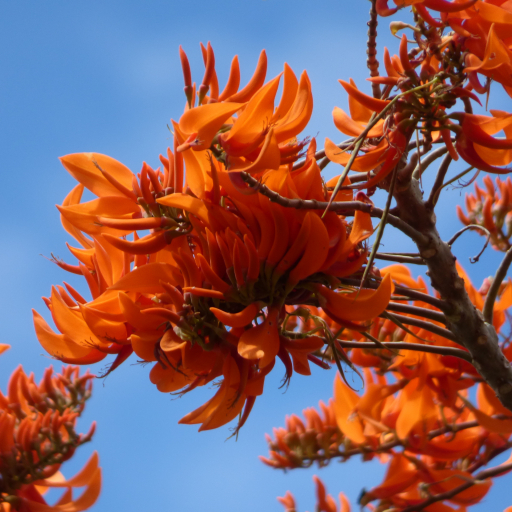
Plant Overview
Often called the "Mountain Immortelle" or "Bucare Ceibo," this tree is a majestic pillar of the South American landscape. In coffee and cocoa-growing regions, it is affectionately known as the "Madre de Cacao" (Mother of Cocoa) because it acts as a protective guardian, providing the perfect dappled shade and nutrient-rich soil for delicate crops to thrive. When it blooms, the entire canopy erupts into a fiery orange spectacle that can be seen from miles across the valleys.
🔍 How to Identify
- 🧡 The Flowers: Its most striking feature is the clusters of bright orange or reddish "machete-shaped" flowers. They typically bloom when the tree has dropped its leaves, making the orange canopy look like a cloud of fire.
- 🍃 The Foliage: The leaves are "trifoliate," meaning they grow in groups of three. They are large, heart-shaped, and a deep, matte green.
- 🛡️ The Bark: The trunk and branches are often armed with small, woody spines or prickles, especially when the tree is young, serving as a natural defense against climbing herbivores.
🏡 In Your Garden
- 🌱 The Soil Architect: This plant is a nitrogen-fixer. It has a symbiotic relationship with soil bacteria that allows it to "pull" nitrogen from the air and deposit it into the ground, naturally fertilizing everything planted nearby.
- 🌳 Space Requirements: This is not a plant for small patios. It is a fast-growing giant that needs significant room for its root system and canopy. It is best suited for large estates, parks, or as a "shade-over" for tropical permaculture gardens.
- 🍂 Seasonal Personality: Don't panic if it loses all its leaves! It is a deciduous tree that intentionally sheds its foliage during the dry season to prepare for its spectacular flowering phase.
⚠️ Safety & Toxicity
- 🚫 Status: Generally considered toxic if ingested.
- 🐾 Details: Like many members of the Erythrina genus, the seeds and bark contain erythroidine and other alkaloids. These can be dangerous to humans, dogs, and livestock if consumed, potentially causing muscle paralysis or respiratory distress. Keep the colorful seeds away from curious children and pets.
✨ Fun Fact
The Mountain Immortelle is a favorite "canteen" for wildlife. Because its flowers are shaped like small cups and hold a significant amount of nectar, they attract a huge variety of hummingbirds and orioles, which act as the tree's primary pollinators.

Detailed Care Instructions
To grow Erythrina Poeppigiana, also known as the Erythrina Tree or Coral Tree, follow these instructions:
- Choose a suitable location: Erythrina Poeppigiana prefers well-draining soil and full sunlight. Select an area in your garden or yard that receives at least six hours of direct sunlight per day.
- Prepare the soil: Erythrina Poeppigiana prefers slightly acidic to neutral soil with a pH range of 6.0-7.0. Test the soil's pH and amend it as necessary by adding organic matter such as compost or peat moss to improve drainage and fertility.
- Propagation: You can propagate Erythrina Poeppigiana from seeds or stem cuttings. Seeds should be soaked in warm water for 24 hours prior to planting, while stem cuttings should be taken from mature branches and treated with a rooting hormone before planting.
- Planting from seeds: Plant the soaked seeds about 0.5 to 1 inch deep in the prepared soil. Space multiple seeds several feet apart to allow room for growth. Water the seeds immediately after planting, keeping the soil slightly moist but not soggy throughout the germination process.
- Planting from stem cuttings: Prepare a small pot with well-draining soil and insert the hormone-treated stem cutting roughly 2-3 inches deep into the soil. Water thoroughly but avoid overwatering, keeping the soil slightly moist until roots are established.
- Watering: Erythrina Poeppigiana prefers regular watering but can tolerate short periods of drought once established. Water deeply and consistently, allowing the top inch of soil to dry out between waterings. Avoid excessive watering, as it can lead to root rot.
- Fertilization: Apply a balanced fertilizer during the growing season to promote healthy growth. Follow the manufacturer's instructions for application rates and frequency.
- Pruning: Prune Erythrina Poeppigiana during the dormant season, typically in late winter or early spring. Remove dead or damaged branches and shape the tree as desired. Avoid heavy pruning, as it can reduce flowering.
- Pests and diseases: Monitor for common pests such as aphids, mealybugs, and scale insects. Treat infestations with insecticidal soap or a horticultural oil spray. Erythrina Poeppigiana is generally resistant to diseases but may occasionally suffer from root rot if overwatered.
- Support and protection: Erythrina Poeppigiana can grow into a large tree, so providing support such as stakes or a trellis may be necessary. Additionally, protect young plants from strong winds or frost until they become more established.
Remember that Erythrina Poeppigiana is a tropical plant and may not tolerate freezing temperatures. If you live in a colder climate, it is best to grow it in a container and bring it indoors during winter or consider it as an annual plant.
To water this plant, first ensure that the soil has completely dried out before watering. Watering too frequently can lead to root rot. When watering, saturate the soil thoroughly, until water begins to drain out the bottom of the pot or the soil around the plant is wet. Make sure to water the plant slowly, so that the water can be absorbed deeply into the soil. Avoid getting water on the leaves or the trunk of the plant, as this can lead to fungal growth or other diseases. If the plant is in a container, be sure to empty the saucer of any excess water after watering. In general, this plant prefers moderate levels of moisture, so be sure to check the soil regularly and adjust watering levels accordingly.
To properly fertilize this plant, use a balanced fertilizer with equal ratios of nitrogen, phosphorus, and potassium. Apply the fertilzer every three months during the growing season, reducing frequency during the winter months. To minimize damage that may be caused by over-fertilizing, use less than the recommended concentration. Ensuring that soil is slightly moist is critical to fertilizer success. If plant leaves brown, fertilize less frequently.
The best type of soil to use for the Erythrina Poeppigiana plant is a well-draining soil mix with a pH balance of 6.0 to 7.5. The ideal soil should be rich in nutrients and organic matter, such as compost, to help promote healthy growth and strong root development. It's important to avoid heavy soils that may retain too much water, as this can lead to root rot and other plant diseases. A soil mix that combines equal parts of sand, peat moss, and perlite can provide the right balance of drainage and nutrient availability for this plant species. Additionally, adding a slow-release fertilizer to the soil can help provide a steady supply of nutrients throughout the growing season.
Propagation of this plant can be done through several methods, such as the use of seeds, stem cuttings, or suckers. To propagate through seeds, collect them from a mature plant and soak them in water for several hours before planting them in a well-draining potting mix. Germination should occur in about one to two weeks.
Stem cuttings should be taken from a healthy, mature plant and should be about six to eight inches long. Remove the lower leaves and dip the cut end in rooting hormone before planting in a well-draining potting mix. Keep the soil moist and in a bright, warm location until roots have formed.
Suckers are new shoots that arise from the base of the plant and can be propagated by division. Carefully remove the sucker from the parent plant, ensuring that it has some roots attached. Plant in a well-draining potting mix and keep the soil moist in a bright, warm location.
Regardless of the method used, it is important to provide proper care for new plants, including regular watering, fertilization, and protection from pests and disease. With proper care, new plants should establish and grow well within a few weeks.








