Plant Overview
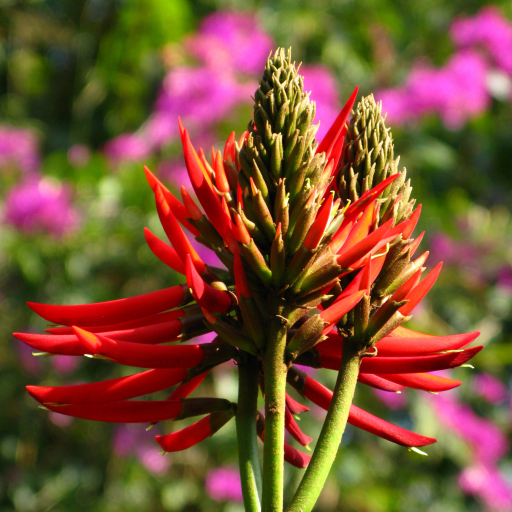
Often called the Coral Tree or Mulungu, Erythrina speciosa is a breathtaking ornamental from the Atlantic forests of Brazil. It is most famous for its dramatic "naked" flowering phase, where fiery, sword-shaped blooms erupt from bare, thorny branches, making the tree look like a living candelabra of flames. It’s a favorite for those looking to add a touch of tropical architectural flair to their landscape.
🔍 How to Identify
- 🔥 Candelabra Blooms: The flowers are a deep, electric red and grow in upright, cone-shaped clusters. Each individual flower is tubular and curved, resembling a small bird’s beak.
- 🍃 Three-Part Foliage: When in leaf, the plant produces large, heart-shaped leaflets in groups of three. These leaves are soft but provide a dense, lush green canopy.
- 🛡️ Prickly Texture: The trunk and branches are heavily "armed" with sharp, woody spines. These thorns are a classic trait of the Erythrina family, evolved to protect the tree from climbing animals.
🏡 In Your Garden
- ☀️ The Sun-Seeker: This tree craves full, direct sunlight. If planted in the shade, it will become leggy and may fail to produce its iconic red flowers. It is best used as a focal point where it has room to spread its thorny crown.
- 🍂 The Seasonal Reveal: Do not be alarmed if your tree drops all its leaves in late winter or early spring. This deciduous behavior is a natural strategy; by shedding its leaves, the tree ensures that nothing hides its brilliant flowers from the hummingbirds that pollinate it.
- 💧 Well-Draining Roots: While it enjoys regular water during the hot growing season, it is prone to root rot if left in standing water. It prefers "tough love" and well-draining soil once it has established its deep root system.
⚠️ Safety & Toxicity
- 🚫 Ingestion Hazard: Most parts of the tree, particularly the seeds and bark, contain alkaloids that are toxic if eaten. They can cause sedation or more serious neurological symptoms.
- 🩹 Physical Danger: The thorns are incredibly sharp and sturdy. They can easily puncture skin or bicycle tires, so it is highly recommended to plant this tree away from walkways, patios, or areas where children and pets play.
✨ Fun Fact
The Erythrina speciosa is a "Hummingbird Magnet." Because the flowers are shaped like long tubes and point upwards, they are perfectly designed to accommodate the long beaks of hummingbirds, who act as the tree's primary pollinators in the wild.

Detailed Care Instructions
| Humidity | High |
| Lighting | Full Sun |
| Difficulty | Medium |
| Hibernation | Cold Period |
| Hardiness Zones | Max 10 |
To grow Erythrina speciosa, also known as the coral tree or Indian coral tree, you can follow these steps:
- Obtain seeds or saplings from a reliable nursery or garden center. Erythrina speciosa plants are native to Brazil, so you may need to find a specialized supplier or consider collecting seeds if you are in a suitable climate.
- Choose a location that receives full sun or partial shade. Erythrina speciosa prefers warm and tropical climates, with temperatures above 60°F (15°C).
- Prepare the soil by ensuring it is well-draining and rich in organic matter. Sandy loam or loamy soil is ideal. Mix compost or well-rotted manure into the soil to improve its fertility.
- Dig a hole that is wide and deep enough to accommodate the roots of the sapling or seeds. For saplings, the hole should be slightly larger than the nursery container.
- If using seeds, scarify them (lightly scratch or nick the seed coat) to improve germination. Soak the seeds in water overnight before planting.
- Place the sapling or seeds in the hole and backfill with soil, gently firming it around the plant or seeds to remove air pockets.
- Water the newly planted Erythrina speciosa thoroughly, ensuring the soil is evenly moist but not waterlogged. Water regularly, especially during dry periods, to keep the soil consistently moist.
- Provide support for young plants to help them grow upwards. Erythrina speciosa plants have brittle branches, so they may require staking or the use of a trellis to prevent breakage.
- Apply a balanced fertilizer, such as a slow-release granular fertilizer, according to the package instructions. Feed the plant during the growing season to promote healthy growth.
- As the plant grows, prune to shape and remove dead or damaged branches. Pruning can help maintain a more compact and manageable size for your Erythrina speciosa.
- Protect young plants from frost or temperatures below 32°F (0°C). If you live in a region with cold winters, consider growing Erythrina speciosa as a container plant that can be moved indoors during the colder months.
Remember to always check the specific care requirements for Erythrina speciosa in your region as it may vary depending on climate and growing conditions.

Place in a window with dappled sun or a spot in the middle of a room. Or directly in a window facing west or east.

Here are some tips for watering this plant:
1. Water the plant deeply once a week during its growing season (usually spring and summer).
2. Allow the soil to dry out slightly before watering again.
3. Make sure the soil has good drainage to prevent waterlogged roots.
4. Avoid getting water on the plant's leaves or flowers, as this can promote fungal growth.
5. If the plant is in a pot, make sure there are drainage holes and that excess water can escape.
6. Water sparingly during the plant's dormant period (usually winter).
7. Consider using a moisture meter to help determine when the plant needs water.
8. In general, it's better to slightly underwater than overwater this plant.
To fertilize this plant, use a balanced fertilizer once every two weeks during the growing season. Make sure to dilute the fertilizer to half strength before applying it to the plant. Additionally, you can supplement the fertilizer with organic matter such as compost or aged manure to provide additional nutrients. Finally, always water the plant thoroughly after fertilizing to help distribute the nutrients evenly throughout the soil.
Erythrina Speciosa plant prefers well-draining soil with a pH range of 6.0 to 7.0. The soil should be enriched with organic matter and must be moist but not waterlogged. It prefers a mix of sand, clay, and loam, which will provide the right balance of water retention and drainage. The soil needs to be kept moist, but not wet. A layer of organic mulch can help retain moisture in the soil while also helping to suppress weeds. It is important not to overfertilize this plant because it can lead to excessive growth and decreased flowering. Therefore, it is recommended to only use a slow-release fertilizer once a year.
There are several methods to propagate the Erythrina Speciosa plant. One way is to take stem cuttings from the plant and root them in soil or water. Another method is to collect and plant the seeds of the plant.
To take stem cuttings, choose a healthy stem from the plant and cut it at an angle, just below a node. Remove any leaves from the bottom of the cutting and dip the cut end in rooting hormone. Plant the cutting in potting soil or place it in water until roots form. Once the roots have developed, transplant the cutting into a larger pot or into the ground.
To collect and plant seeds, wait for the seed pods of the plant to mature and dry. Collect the seeds and plant them in potting soil, making sure to keep the soil moist. Once the seedlings have grown several inches tall, they can be transplanted into larger pots or moved into the ground.
It is important to note that the Erythrina Speciosa plant prefers well-draining soil and plenty of sunlight. It is also susceptible to frost damage, so it should be protected in colder climates.








