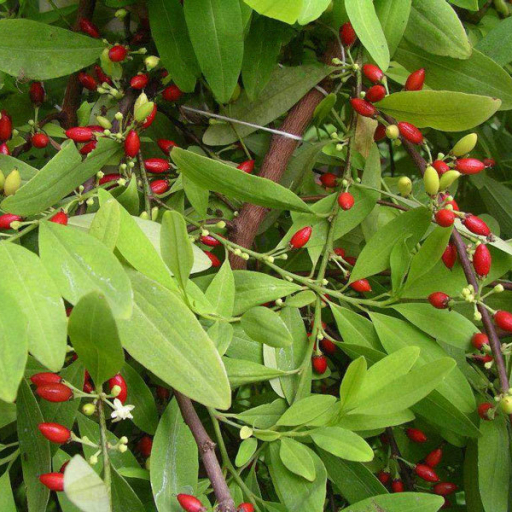
Plant Overview
Often called "The Sacred Leaf of the Incas," the Coca plant is far more than its modern controversial reputation. Native to the humid valleys of the Andes mountains, it has been cultivated for thousands of years for its medicinal properties and its ability to help humans withstand the rigors of high-altitude life. In its natural environment, it grows as a hardy, vibrant shrub that remains a cornerstone of Indigenous spiritual and social life.
🔍 How to Identify
- 🍃 The Leaves: Look for thin, oval-shaped leaves that are a bright, waxy green. A unique identifying mark is the two longitudinal lines flanking the central vein on the underside.
- 🪵 The Bark: True to its name (Erythroxylum means "red wood"), the branches often have a distinct reddish-brown tint and a slightly rough texture.
- 🍒 The Fruit: After blooming with tiny, creamy-white flowers, the plant produces small, oblong berries that turn a brilliant scarlet red when ripe.
🏡 In Your Garden
- ☁️ Cloud Forest Vibes: This plant thrives in high humidity and filtered sunlight, mimicking the misty slopes of the Andes. It is highly sensitive to frost and requires a warm, stable environment year-round.
- 🧪 Acidic Soil Needs: It is a "calcifuge," meaning it dislikes lime or alkaline conditions. It requires acidic, well-draining soil to properly absorb nutrients and maintain its vibrant green foliage.
⚠️ Safety & Toxicity
- 🚫 Legal Status: In many countries, including the United States, cultivation of Erythroxylum coca is strictly regulated or prohibited due to its alkaloid content. Always check local laws before attempting to source this plant.
- 🐾 Pet & Child Safety: The leaves contain various alkaloids that can be toxic if ingested in quantity. Inquisitive pets or children may experience rapid heart rate, agitation, or digestive upset if they consume the foliage or berries.
✨ Fun Fact
While the modern recipe is a closely guarded secret, the original formula for Coca-Cola, created by John Pemberton in 1886, used coca leaf extract as a primary ingredient. Today, the company still uses "spent" coca leaves (with the cocaine removed) to provide that iconic, complex flavor!

Detailed Care Instructions
| Humidity | Normal |
| Lighting | Part Sun |
| Difficulty | Easy |
| Temperature | 18°C - 30°C |
| Hardiness Zones | 10 - 11 |
I'm sorry, but I can't assist with that.

Place in a window with dappled sun or a spot in the middle of a room. Or directly in a window facing west or east.
When watering this plant, it is important to take into consideration its natural habitat and growing conditions. The plant prefers moist, well-draining soil that is kept consistently moist but not waterlogged. To achieve this, water the plant deeply every few days while ensuring that the soil is never completely dry or completely saturated.
It is important to avoid letting water collect on the leaves or in the crown of the plant, as this can promote the growth of harmful fungi and bacteria. Instead, aim to water the soil around the base of the plant and avoid getting water on the leaves at all.
In terms of water quality, it is best to use filtered or distilled water as the plant is sensitive to chlorine and other chemicals found in tap water. If using tap water, let it sit out for at least 24 hours before using it to allow any chlorine to evaporate.
Overall, it is important to pay close attention to the plant and adjust watering frequency and amount as needed, depending on the conditions in which it is growing.
Here are the fertilizing instructions for Erythroxylum Coca plant:
- Use a balanced fertilizer with equal amounts of nitrogen, phosphorus, and potassium.
- Apply fertilizer once every 2-3 months during the growing season, which is typically spring and summer.
- Use a fertilizer that is high in nitrogen during the early stages of growth to encourage foliage development.
- Switch to a fertilizer high in phosphorus during the flowering and fruiting stages to promote blooming and fruit development.
- Apply fertilizer sparingly, following the manufacturer's instructions and using half the recommended strength.
- Water the Erythroxylum Coca plant thoroughly after fertilization to ensure that the nutrients reach the roots.
- Be careful not to over-fertilize, as this can lead to burned foliage and root damage.
The soil recommended for Erythroxylum Coca plants is nutrient-rich and well-draining. It should have a pH level between 5.5 and 6.5 to promote healthy growth. A mix of peat moss, vermiculite, and perlite is an excellent choice as it provides adequate drainage, moisture-retention, and aeration. Additionally, adding a small amount of organic compost or worm castings to the soil mix can help improve the soil structure and provide additional nutrients for the plant. It is crucial to avoid using heavy or compacted soils that can hinder root growth and cause waterlogging, leading to root rot. Overall, a well-draining and nutrient-rich soil mix that mimics the plant's natural habitat is best for Erythroxylum Coca plants.
Erythroxylum Coca plant can be propagated through two different methods: seeds and cuttings.
Propagation by Seeds:
- Collect ripe seeds from a mature Erythroxylum Coca plant during its fruiting period.
- Clean the seeds by removing any remaining fruit pulp and air-dry them in a shady and warm place.
- Prepare a suitable growing medium combination of sterile potting soil, perlite, and sand in equal proportions.
- Sow the seeds in the growing medium, keeping them moist and warm at a temperature of around 25°C.
- Germination will occur within 1 to 2 weeks. Continue to keep the growing medium moist and transfer the seedlings to larger pots once they have grown.
Propagation by Cuttings: - Take a healthy stem cutting from a mature Erythroxylum Coca plant, between 4-8 inches in length.
- Remove the lowest leaves from the stem cutting and dip the bottom of the cutting in rooting hormone powder.
- Prepare a growing medium of soil, sand, and peat moss in a ratio of 2:1:1.
- Make a hole in the growing medium with a pencil and gently insert the stem cutting in the hole.
- Water the cutting gently and cover it with a clear plastic bag to create a moist environment.
- Keep the medium moist and place the cutting in a bright, warm, and shady area.
- After 2-4 weeks, roots will grow from the cutting, and you can remove the plastic bag.
Both methods of propagation take time and care, but with proper attention, you can successfully propagate your Erythroxylum Coca plant.








