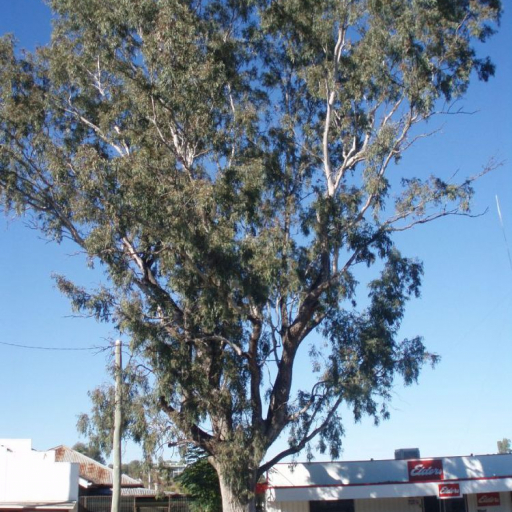
Plant Overview
Often called the Coolibah, this tree is an enduring icon of the Australian Outback. Immortalized in the classic folk song "Waltzing Matilda," it is the quintessential shade-giver of the parched plains. Known for its incredible resilience, it can survive for years in bone-dry soil, only to burst into life when the floodwaters finally arrive.
🔍 How to Identify
- 🪵 Dual-Textured Bark: Look at the trunk; the lower half is covered in rough, fibrous, grey-brown "box" bark, while the upper branches are smooth, creamy-white, and clean.
- 🍃 Narrow Foliage: The leaves are long, slender, and often slightly curved (sickle-shaped), featuring a dull, grey-green hue that helps them reflect harsh sunlight.
- 🍒 Miniature Capsules: It produces some of the smallest woody fruits in the Eucalyptus family—tiny, cup-shaped "gumnuts" that are barely a few millimeters wide.
🏡 In Your Garden
- 🏗️ Deep Roots: The Coolibah develops a massive taproot to search for deep underground water. Because of this, it hates being moved once planted and should be given a permanent home far away from pipes, pools, or house foundations.
- ☀️ Sun Seeker: This is not a plant for the shade. It requires a wide-open space with full, direct sun to maintain its structure. It is highly adapted to heavy clay soils that crack when dry and turn to boggy mud when wet.
⚠️ Safety & Toxicity
- 🐾 Pet Warning: Like most Eucalyptus species, the leaves contain essential oils (eucalyptol) that are toxic to dogs, cats, and horses if eaten. Ingestion can lead to vomiting, drooling, or lethargy.
- 🚫 Not for Foraging: While the scent is refreshing, the leaves are not meant for human consumption and can cause stomach upset if brewed or eaten in large quantities.
✨ Fun Fact
The name Microtheca comes from the Greek words mikros (small) and theke (case), referring to its tiny fruit. Despite its "small" name, the tree is a giant of survival, often living for over 200 years in some of the harshest environments on Earth.

Detailed Care Instructions
To water this plant, you should start by selecting a suitable watering can or hose, ensuring that it has a narrow spout for controlled watering. Next, you should prepare the water by letting it sit out at room temperature for at least an hour, as cold water may shock the plant's roots. Once the water is ready, gently pour it over the soil around the base of the plant, taking care not to wet the leaves or branches. You should water deeply and thoroughly, allowing the soil to become soaked, but avoiding overwatering, which can lead to root rot. It is best to water this plant in the morning or evening, when temperatures are cooler, to minimize stress to the plant. Finally, monitor the soil moisture level regularly and adjust your watering schedule as needed based on the plant's growth and environmental conditions.
Eucalyptus Microtheca plant prefers a well-draining soil that is slightly acidic. It is recommended to use a soil mix that contains a combination of sand, peat moss, and perlite to provide good drainage and aeration. The soil should also be enriched with organic matter such as compost or aged manure to help the plant grow healthy and strong. It is important to avoid using heavy soils that retain too much moisture as this can lead to root rot and other soil-borne diseases. Additionally, avoid using soils that are high in alkaline levels as this may cause nutrient deficiencies. It is recommended to test the soil pH before planting to ensure that the soil is within the appropriate range for the plant.








