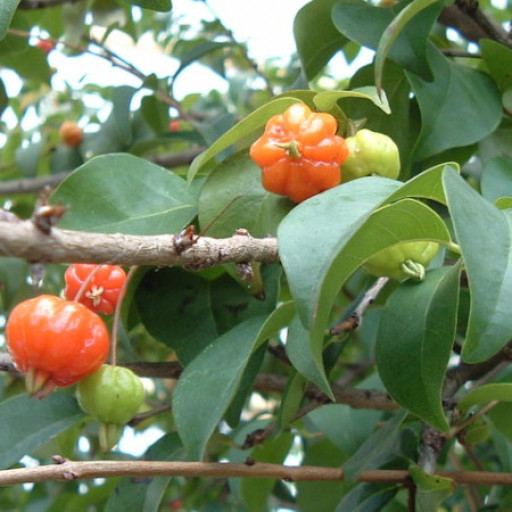
Plant Overview
Commonly known as the Surinam Cherry or Pitanga, this vibrant evergreen shrub is a tropical treasure originating from South America. Its most charming feature is its "pumpkin-shaped" fruit that transitions through a rainbow of colors as it ripens. Often used as a decorative "living fence" in warmer climates, it fills the air with a resinous, spicy fragrance whenever its leaves are crushed or the wind blows through its branches.
🔍 How to Identify
- 🍒 The Ribbed Fruit: The most distinctive feature; small, dangling berries with 8 prominent vertical ribs, looking like tiny, exotic lanterns.
- 🍃 Glossy Foliage: Ovate, shiny leaves that start as a delicate bronze-red when young, eventually maturing into a deep, glossy forest green.
- 🌸 Delicate Blooms: Small, creamy-white flowers with a cloud of long, spindly stamens that appear in clusters, looking like tiny white bursts of fireworks.
🏡 In Your Garden
- ✂️ The Perfect Hedge: Because it responds exceptionally well to shearing, the Surinam Cherry is a favorite for creating dense, aromatic privacy screens that offer both beauty and snacks.
- ☀️ Sun for Sugar: While it can grow in partial shade, the fruit becomes significantly sweeter and more abundant when the plant is given full, direct sunlight.
- 🪴 Container Potential: For those in cooler climates, this plant adapts well to large pots, allowing you to bring its tropical flair indoors when the frost arrives.
⚠️ Safety & Toxicity
- 🍓 Edible Fruit: The flesh of the fruit is perfectly safe and highly prized for jellies and jams, ranging from tart-sweet to a deep, black-cherry richness.
- 🚫 Resinous Seeds: Avoid the seeds. The large seeds inside the fruit are very resinous and can cause severe stomach upset or diarrhea if swallowed, especially in children or pets.
- 🐾 Pet Watch: While the fruit is generally safe for humans, the high resin content in the leaves and seeds can be irritating to the digestive tracts of dogs and cats.
✨ Fun Fact
In its native Brazil, the leaves of the Pitanga are often scattered over the floors of homes. When stepped upon, they release a potent, spicy aroma that acts as a natural, traditional repellent for flies and mosquitoes!

Detailed Care Instructions
| Color | Leaves Go From Bronze Or Copper To Deep, Glossy Green With White Flowers And Fruits That Start Green And Ripen To Maroon Or Scarlet |
| Soil Ph | 5.6-7.5 |
| Humidity | Normal |
| Lighting | Part Sun |
| Toxicity | Poisonous |
| Soil Type | Well-Draining, Sandy, Loamy, Heavy |
| Bloom Time | Spring |
| Difficulty | Easy |
| Plant Type | Shrub Or Small Tree |
| Mature Size | Up To 26 Feet Tall |
| Native Area | South America |
| Temperature | 21°C - 32°C |
| Sun Exposure | Full Sun To Partial Shade |
| Hardiness Zones | 9B-12 |
To grow Eugenia uniflora, also known as Surinam cherry or pitanga, follow these steps:
- Climate and soil: Ensure that you live in a suitable climate for growing Eugenia uniflora. They thrive in tropical and subtropical regions. The plant prefers well-drained soil with a pH level between 6.0 and 6.5.
- Propagation: Eugenia uniflora can be propagated from seeds, cuttings, or air layering. Seeds should be soaked in warm water for 24 hours before planting. Cuttings should be taken from hardwood stems and treated with rooting hormone before planting. Air layering involves selecting a healthy branch and scoring or stripping off a small section of bark, then wrapping it in a moist sphagnum moss or potting mix until roots form.
- Planting: Choose a location with full sun or partial shade to plant Eugenia uniflora. Dig a hole slightly larger than the size of the root ball or cutting. Place the plant in the hole and backfill it, gently firming the soil around the roots.
- Watering: Keep the soil consistently moist but not waterlogged. Water the plant thoroughly, then allow the top inch of soil to dry before watering again. During periods of drought, you may need to water more frequently.
- Fertilization: Eugenia uniflora benefits from regular fertilization. Apply a balanced slow-release fertilizer or a citrus fertilizer every three months during the growing season. Avoid over-fertilization as it can lead to excessive vegetative growth and reduced fruiting.
- Pruning: Prune Eugenia uniflora to maintain its desired shape and size. Pruning should ideally be done in late winter or early spring before new growth starts. Remove any dead, damaged, or diseased branches, and thin out crowded areas to improve airflow.
- Pest and disease control: Keep an eye out for common pests such as aphids, scale insects, and mealybugs. Treat infestations with insecticidal soap or neem oil if necessary. Watch for signs of diseases like leaf spot or root rot, and take appropriate action if detected.
- Harvesting: Eugenia uniflora produces small round fruits that ripen to a bright red or orange color. Harvest the fruits when they are fully mature and slightly soft to the touch. They have a tart, sweet flavor and can be eaten fresh or used in jams, jellies, or desserts.
Remember to research and consider any specific regional requirements for growing Eugenia uniflora in your area.

Place in a window with dappled sun or a spot in the middle of a room. Or directly in a window facing west or east.

To properly water this plant, you should first check the soil moisture level by inserting your finger into the soil. If the top inch feels dry to the touch, it is time to water. Use room temperature water and pour it slowly around the base of the plant, making sure to saturate the soil evenly. Avoid splashing water on the leaves and foliage as this can lead to disease or pest problems. Allow the excess water to drain away and avoid allowing the plant to sit in standing water, as this can also lead to root rot. The frequency of watering will depend on factors such as temperature, humidity, and the size of the plant and pot. It's important to monitor the soil moisture level regularly and adjust watering accordingly to ensure the plant is not over or under-watered.
- Begin fertilizing Eugenia Uniflora when it is young and continue regularly throughout its growth to promote healthy development.
- Choose a balanced fertilizer with equal amounts of nitrogen, phosphorus, and potassium.
- Apply fertilizer once every three months during the growing season, which is typically from spring to early fall.
- Follow the instructions on the fertilizer package for amounts to apply. Typically, it's recommended to use one tablespoon of fertilizer per inch of trunk diameter.
- Apply the fertilizer to the soil around the base of the plant, avoiding getting any on the leaves or stems.
- Water the plant immediately after fertilizing to help activate the nutrients and prevent burning of the roots.
- If the Eugenia Uniflora is potted, use a slow-release fertilizer to provide continuous nutrition over several months.
- Finally, monitor the plant for signs of over-fertilization, such as brown or wilted leaves. If this occurs, reduce the amount of fertilizer you use or reduce the frequency of applications.
The ideal soil for Eugenia Uniflora should be well-draining and rich in organic matter. It should also have a slightly acidic to neutral pH level between 5.5 and 7.0. A mix of sandy loam and peat moss or compost would be suitable for this plant. Avoid heavy clay soils that are prone to waterlogging, as this can lead to root rot and other fungal diseases. It's important to ensure that the soil is sufficiently moist but not waterlogged, as this can cause root damage and hinder the plant's growth. Regular fertilization with a balanced fertilizer can also help to maintain healthy growth and promote flowering.
Propagation of this plant can be done through several methods such as cutting, layering, and seeds. One of the easiest and most reliable ways is through stem cuttings. The cuttings are taken from healthy and matured stems which are around 4-6 inches in length. The lower leaves are removed, and the stem is dipped in a rooting hormone. The stem is then planted in a well-draining soil mix, and the cutting is covered with a plastic bag to maintain the humidity. After a few weeks, the cutting will develop roots and new growth.
Another method is through layering. In this method, a low-lying stem is buried in the soil, leaving the tip exposed. The stem is then secured to the soil with a wire or stake. After a few weeks, roots will start to grow, and the new plant can be separated from the parent plant.
Propagation through seeds is also possible but can be more challenging. The seeds should be collected from mature fruits and planted in a well-draining soil mix. Germination can take up to a few weeks to a few months, and it is important to maintain consistent moisture levels and provide adequate lighting.
Overall, propagation of this plant can be done with relative ease and can provide a great way to expand your plant collection.
Common pests of the surinam cherry include Scale insect, mealybugs, spider mites, aphids. Make a habit of checking your surinam cherry frequently for pests so that any infestations can be caught and managed early.








