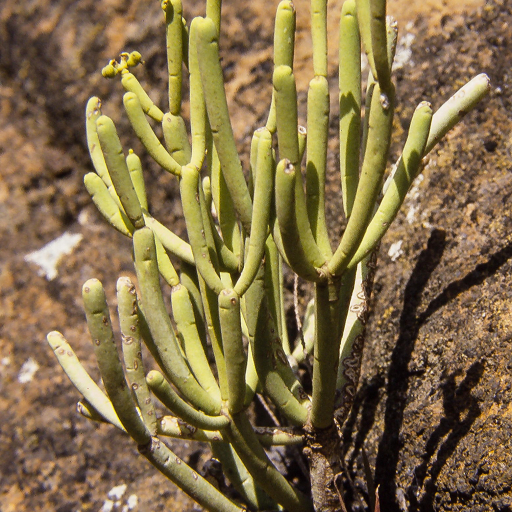
Plant Overview
Known as the Leafless Spurge or "Tabaiba Salvaje," this architectural beauty hails from the rugged, sun-drenched coastlines of the Canary Islands. It looks more like a cluster of green sea coral than a traditional garden plant, offering a minimalist aesthetic that is perfect for modern xeriscaping. Because it lacks true leaves, it has evolved into a striking, skeletal form that thrives where other plants would simply shrivel.
🔍 How to Identify
- 🌵 The Stems: Smooth, succulent, and cylindrical stems that branch out repeatedly from the base, eventually forming a dense, rounded mound.
- 🍃 The "Missing" Leaves: As the name aphylla suggests, this plant is virtually leafless; it performs photosynthesis directly through its green skin to prevent water loss in arid winds.
- 🌼 The Flowers: Tiny, star-shaped sulfur-yellow flowers (called cyathia) appear in small, waxy clusters at the very tips of the branches during the late winter and spring.
🏡 In Your Garden
- 🏝️ Coastal Roots: Since it originates from rocky cliffs near the ocean, it is incredibly salt-tolerant and thrives in poor, sandy soils that drain quickly.
- ☀️ Sun Worshiper: It prefers "baking" in the sun. If kept in too much shade, the stems will become thin, pale, and weak, losing the iconic tight-mound shape that makes it so visually appealing.
- 💧 Drought Strategy: It requires very little water once established. It is the ultimate "set it and forget it" plant for gardeners in Mediterranean climates.
⚠️ Safety & Toxicity
- 🚫 Toxic Latex: Like almost all Euphorbias, this plant contains a thick, milky white sap that is highly caustic.
- 🧤 Handling Warning: Always wear gloves when pruning. The sap can cause painful skin rashes (dermatitis) and is extremely dangerous if it comes into contact with the eyes.
- 🐾 Pet Safety: Highly toxic to cats, dogs, and horses if nibbled. It should be placed in areas inaccessible to curious pets.
✨ Fun Fact
The species name aphylla is derived from the Greek words for "without leaves." By ditching its foliage, the plant has fewer pores (stomata) through which water can escape, making it a true master of desert survival!

Detailed Care Instructions
To grow Euphorbia Aphylla plants, follow these steps:
- Choose a suitable location: Euphorbia Aphylla plants prefer full sun to partial shade. Select an area in your garden that receives at least six hours of direct sunlight each day.
- Prepare the soil: Euphorbia Aphylla plants thrive in well-draining soil. Make sure the soil is loose, crumbly, and fertile. If your soil is heavy or clayey, amend it with organic matter such as compost, well-rotted manure, or peat moss to improve drainage.
- Planting: Dig a hole in the prepared soil that is slightly larger than the root ball of your Euphorbia Aphylla plant. Place the plant in the hole, ensuring that the top of the root ball is level with the soil surface. Backfill the hole with soil, gently firming it around the roots.
- Watering: Initially, water the plant thoroughly after planting to settle the soil around the roots. After that, water the plant deeply once a week during dry periods. Avoid excessive watering as Euphorbia Aphylla plants are drought-tolerant and prefer slightly dry conditions.
- Mulching: Apply a layer of organic mulch around the plant to help retain moisture, suppress weed growth, and regulate soil temperature. Avoid mulching directly against the plant's stem to prevent rotting.
- Fertilizing: Euphorbia Aphylla plants typically do not require much fertilization. However, you can apply a balanced, slow-release fertilizer once or twice a year in spring and summer. Follow the package instructions for application rates.
- Pruning: Prune Euphorbia Aphylla plants in early spring to remove any dead or damaged branches or to shape the plant. Wear gloves and protective clothing when handling these plants as their sap can be toxic and irritating to the skin and eyes.
- Pest and disease control: Euphorbia Aphylla plants are generally pest and disease resistant. However, keep an eye out for aphids or mealybugs, which can occasionally infest the plant. If necessary, treat them with a horticultural oil or insecticidal soap according to the product instructions.
Remember to research and follow specific care instructions for your particular variety of Euphorbia Aphylla, as different species may have slightly different requirements.
Euphorbia Aphylla is a type of plant that requires careful watering to maintain its health. When watering this plant, it is essential to avoid overwatering, as this can cause the roots to rot and eventually kill the plant.
To water Euphorbia Aphylla, you should first assess whether the soil is dry or moist. Using your finger, gently press down on the topsoil to determine its moisture level. If the topsoil feels dry, it is time to water the plant.
When watering, aim to water the soil directly rather than the leaves or flowers. This helps to avoid any fungal growth or damage to the plant's foliage.
To water the soil, use a watering can or hose with a gentle spray nozzle. Water the soil slowly and carefully, ensuring that the water reaches the roots without causing any flooding or waterlogging.
After watering, allow the soil to drain and any excess water to flow away. Do not leave the plant sitting in a saucer of water, as this can cause root rot.
In general, Euphorbia Aphylla prefers to be kept on the drier side, so it is better to underwater than overwater. Monitor the plant regularly and adjust your watering schedule as necessary.
- Determine the specific variety of your plant and research its preferred nutrient needs.
- Use a balanced fertilizer with equal parts nitrogen, phosphorus, and potassium.
- Apply the fertilizer in the spring and summer months, when the plant is actively growing.
- Measure the fertilizer according to the package instructions and apply it evenly around the base of the plant.
- Water the plant thoroughly after fertilizing to allow the nutrients to penetrate the roots.
- Avoid over-fertilizing, as this can cause leaf scorching or root damage.
- Monitor the plant for signs of nutrient deficiency or excess, such as yellowing leaves or stunted growth, and adjust the fertilizer accordingly.
Euphorbia Aphylla plant prefers a well-draining soil mix that is gritty or sandy, with a pH range of 6.0 to 7.5. The soil should be rich in organic matter but not too heavy, as this may cause root rot. It is best to avoid using heavy soils such as clay. A cactus or succulent soil mix is ideal for Euphorbia Aphylla plant, which is often mixed with perlite or coarse sand to improve drainage. Topdressing the soil with a layer of gravel or decorative stones can also help with proper drainage. It is important to avoid overwatering, as this can lead to root rot or other fungal diseases.
To propagate this plant, identify a healthy stem that is at least 3-4 inches long. Make a clean, angled cut at a 45-degree angle just below a node (where the leaves meet the stem). Remove any leaves from the lower part of the stem.
Prepare a pot of well-draining soil mix and create a hole in the center. Insert the stem cutting into the hole, firming the soil around it.
Water the cutting thoroughly and place it in a location with bright, indirect sunlight. Keep the soil consistently moist but not waterlogged. It may take several weeks for roots to form and new growth to appear.
Once new growth has emerged and the plant looks established, it can be transplanted into a larger container or planted in the ground.








