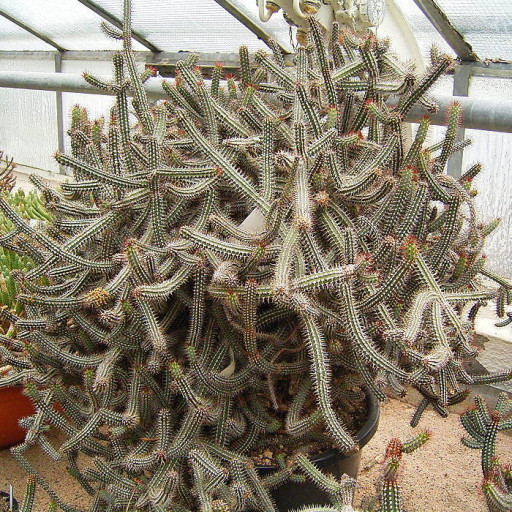
Plant Overview
Often referred to as the "Baio Euphorbia," this Kenyan native looks like a cluster of miniature, spiny sausages emerging from the earth. Discovered on the granite slopes of Mount Baio, it has become a favorite for succulent collectors who appreciate its rigid, geometric growth habit. It is a tough survivor that adds a touch of architectural drama to any sunny windowsill or desert-scape garden.
🔍 How to Identify
- 🌵 The Stems: Look for slender, cylindrical columns that grow upright and branch from the base to form dense, multi-stemmed clumps.
- 📐 Ribbed Texture: The stems feature 8 to 10 distinct vertical ribs, each lined with pairs of small, dark grey to black spines that create a serrated appearance.
- 🌼 The Blooms: In the growing season, tiny, bright yellow "flowers" (cyathia) appear along the upper parts of the stems, providing a vibrant contrast to the dull grey-green body.
🏡 In Your Garden
- ☀️ The Sun Worshipper: This plant lives for light. While it can handle light shade, it will quickly lose its compact shape and "stretch" (etiolate) if kept in a dark corner, so aim for a spot with at least six hours of bright sun.
- 💧 Mountain Roots: Because it originates from rocky slopes, it is highly sensitive to root rot. It thrives in a gritty, mineral-heavy soil mix and prefers the "soak and dry" method—never water it if the soil feels even slightly damp.
⚠️ Safety & Toxicity
- 🧪 The Milky Latex: Like all Euphorbias, it contains a white, sticky sap that is highly caustic. This sap can cause severe skin irritation, rashes, and intense pain if it gets into the eyes.
- 🐾 Keep Away from Pets: This plant is toxic if ingested by cats, dogs, or curious children. It is best placed on a high shelf or in an area where it won't be accidentally bumped or broken.
✨ Fun Fact
Despite its appearance, this is not a cactus! It is a classic example of "convergent evolution," where the Euphorbia genus in Africa evolved spines and water-storing stems to survive the heat, mirroring the way cacti evolved in the Americas despite being totally unrelated.

Detailed Care Instructions
To grow Euphorbia Baioensis, also known as the Baioensis spurge, you can follow these steps:
- Choose the right location: Euphorbia Baioensis prefers a sunny spot with well-draining soil. It can tolerate some shade, but full sun is ideal.
- Prepare the soil: Ensure the soil is loose, well-draining, and fertile. If it is heavy or clay-like, consider adding organic matter like compost or peat moss to improve drainage.
- Planting: Dig a hole slightly larger than the root ball of the plant. Place the Euphorbia Baioensis in the hole, ensuring the top of the root ball is level with the soil's surface. Backfill the hole with soil and gently firm it around the plant.
- Watering: After planting, water thoroughly to settle the soil and encourage root establishment. Euphorbia Baioensis has moderate water needs, so water only when the topsoil feels dry. Avoid overwatering as it can lead to root rot.
- Fertilizing: Euphorbia Baioensis generally doesn't require frequent fertilization. However, you can provide a balanced, slow-release fertilizer once or twice during the growing season to promote healthy growth.
- Pruning: Prune Euphorbia Baioensis in spring to remove any dead or damaged branches. Cutting back the plant can also help maintain its compact shape and encourage bushier growth.
- Protection: If you live in an area with frost, provide protection for Euphorbia Baioensis during the winter months. Cover it with a blanket or move it indoors to a protected location.
- Pests and diseases: Euphorbia Baioensis is generally resistant to pests and diseases. However, keep an eye out for aphids, mealybugs, or scale insects, and treat them promptly if they appear.
Remember, Euphorbia Baioensis contains a milky sap that can cause skin irritation and is toxic if ingested. It's important to handle the plant with care and use gloves when necessary.
By following these steps, you can successfully grow Euphorbia Baioensis and enjoy its unique and attractive appearance in your garden.

Place in a bright room that is sun drenched almost all day. Or directly in a south-facing window.

When the top few inches of soil dry out, water your plants. If the top few inches of soil are still moist, do not water your plant. Wait a few days, then poke your finger into the soil to see if anything has changed. Overwatering poses a disease risk, such as the development of fungal diseases in the roots. These plants have adaptations in there leaves that allow them to survive in low water supply.
Fertilize Euphorbia Baioensis once a month during the growing season (spring and summer) with a balanced liquid fertilizer diluted to half strength. Do not fertilize during the dormant season (fall and winter). Water the plant thoroughly before fertilizing to avoid burning the roots. Avoid over-fertilizing, as this can cause the plant to grow too quickly and become weak and spindly.
The best soil for Euphorbia Baioensis is a well-draining mixture that is rich in organic matter. It should be slightly acidic with a pH range between 6.0 to 6.5. The soil should be composed of a mixture of sand, perlite, vermiculite, peat moss, and/or coconut coir to provide good drainage and aeration. It is important to avoid using heavy soils that retain water since this can lead to root rot. Additionally, it is recommended to use a soil mixture that is free of disease and pests to prevent the spread of any potential pathogens to the plant. Overall, the soil should be nutrient-rich, loose, and well-draining to promote optimal growth and health for the Euphorbia Baioensis plant.
To propagate this plant, one can take stem cuttings from the mother plant during its active growth period. It is important to use a sharp, clean knife to make a clean cut on the stem. Remove any lower leaves from the cutting and allow it to dry in a shaded, well-ventilated area for several days. Once the cut end has calloused over, plant the cutting in a well-draining soil mix and water sparingly until roots have developed. It is important to keep the cutting in a bright, warm location but out of direct sunlight until it has established.
Common pests of the milli cactus include Scale insect, mealybugs, spider mites. Make a habit of checking your milli cactus frequently for pests so that any infestations can be caught and managed early.








