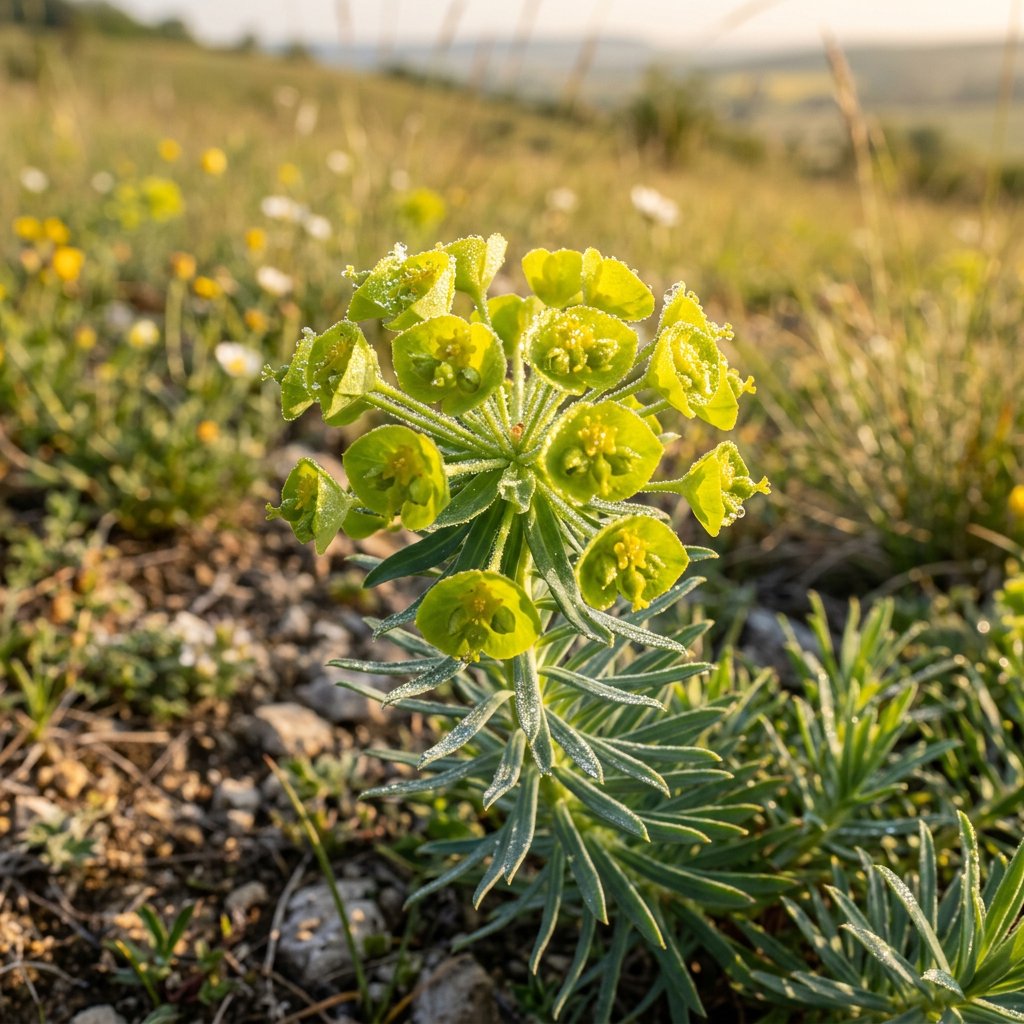
Plant Overview
Often called "Cypress Spurge" for its delicate, needle-like leaves, this plant creates a misty, lime-green carpet in sunny gardens. While it looks soft enough to nap on, its resilience has earned it the nickname "Graveyard Weed" because of its ability to thrive in neglected spaces for decades. It is a master of color, shifting from electric yellow-green in the spring to warm, reddish-orange tones in the autumn.
🔍 How to Identify
- 🌿 The Foliage: The plant features very fine, linear leaves arranged in dense spirals around the stems, giving it a soft, "bottle-brush" appearance similar to a tiny cypress tree.
- ☀️ The "Flowers": What look like petals are actually heart-shaped bracts (modified leaves) that turn from bright chartreuse to a deep gold or even purplish-red as they age.
- 📏 The Habit: It grows in low, mounding clumps that spread via underground runners (rhizomes), typically reaching about 8 to 12 inches in height.
🏡 In Your Garden
- 🏃 A Great Wanderer: This plant is an enthusiastic spreader. While it is perfect for filling a difficult, dry slope or a rock garden, it can be aggressive in "polite" flower beds where it may outcompete smaller, less vigorous plants.
- 🏜️ Tough as Nails: It thrives in poor, sandy, or rocky soil where other plants would wither. Because of its deep root system, it is exceptionally drought-tolerant and actually prefers to be left alone once it has settled in.
⚠️ Safety & Toxicity
- 🧪 Irritant Warning: All parts of the plant contain a thick, white milky sap (latex) that can cause severe skin irritation, redness, and even blistering. Always wear gloves when handling or pruning.
- 🐾 Harmful to Pets: The plant is toxic to dogs, cats, and horses if ingested. The sap causes immediate burning in the mouth and throat, which usually discourages animals from eating a significant amount, but it should still be planted away from curious pets.
✨ Fun Fact
The Cypress Spurge is the primary food source for the Spurge Hawk-moth caterpillar. These caterpillars are incredibly bright—sporting neon red, yellow, and black markings—to warn predators that they have become toxic by eating the plant’s sap!

Detailed Care Instructions
| Lighting | Full Sun |
| Hardiness Zones | Min 4A |
To grow Euphorbia Cyparissias, also known as Cypress Spurge or Bonaparte's Crown, follow these steps:
- Choose a suitable location: Euphorbia Cyparissias prefers full sun to partial shade. Select a well-draining soil with average fertility. The plant can tolerate various soil types but is best suited for sandy or loamy soil.
- Obtain the plant: You can purchase Euphorbia Cyparissias as seeds or young seedlings from a local nursery or online. Alternatively, you can propagate the plant from root cuttings or division of an existing plant.
- Planting: If using seeds, sow them directly into the soil where you want the plant to grow, or start them indoors a few weeks before the last frost date and transplant the seedlings outdoors later. If using young seedlings or divisions, plant them in prepared soil, ensuring they are spaced around 12-18 inches apart.
- Watering: Euphorbia Cyparissias is drought-tolerant once established, but it requires regular watering during the initial growth phase to help establish the plant's root system. Water deeply but infrequently, allowing the soil to dry out slightly between waterings.
- Mulching: Apply a layer of mulch around the plant to help conserve moisture, suppress weeds, and regulate soil temperature. Avoid piling mulch directly against the plant stem to prevent rotting.
- Pruning: Euphorbia Cyparissias generally doesn't require much pruning. However, you can trim back any dead or damaged stems in late winter or early spring to maintain the plant's shape and overall health.
- Fertilizing: Euphorbia Cyparissias is a low-maintenance plant and usually doesn't require additional fertilization. However, you can incorporate some organic compost or a balanced slow-release fertilizer during the spring season if the plant seems to need a boost.
- Maintenance: Keep an eye out for any signs of pests or diseases, such as aphids or powdery mildew. If detected, treat the affected areas promptly using appropriate organic pest control methods or consult a professional if needed.
- Propagation: You can propagate Euphorbia Cyparissias by collecting and planting its seeds in late summer or early fall. Additionally, the plant can be propagated by taking root cuttings in early spring or by dividing the plant in early spring or late fall.
Remember that Euphorbia Cyparissias is considered invasive in some regions, particularly in North America. Keep an eye on its growth and take necessary precautions to prevent it from spreading in unwanted areas.

Place in a bright room that is sun drenched almost all day. Or directly in a south-facing window.

Euphorbia Cyparissias is a plant that belongs to the Euphorbia family. The plant prefers well-draining soil that is sandy or loamy, with a pH of 6 to 7.5. It is a drought-tolerant plant that can survive long periods without water. However, in order for the plant to thrive, it is necessary to provide it with adequate moisture.
When watering Euphorbia Cyparissias, it is important to avoid overwatering. The soil should be allowed to dry out partially between watering sessions. It is recommended to water the plant once a week during the growing season, and reduce watering during the winter months.
When watering, it is important to avoid getting water on the leaves of the plant, as this can cause them to rot. Instead, water the base of the plant, soaking the soil deeply. After watering, allow excess water to drain away, and avoid allowing the plant to sit in a pool of water.
If the leaves of the plant start to droop or turn yellow, this may be a sign that the plant is not getting enough water. On the other hand, if the leaves start to turn brown and dry out, this may be a sign of overwatering. Adjust the watering schedule accordingly to ensure that the plant gets the right amount of moisture.
To fertilize this plant, mix a balanced fertilizer according to the instructions on the package. Apply the fertilizer to the soil around the base of the plant, being careful not to get any on the leaves or stems. Water the plant thoroughly after fertilizing to help the nutrients reach the roots. Do not fertilize during winter months, as the plant is dormant and does not need extra nutrients.
The ideal soil for this plant should be well-draining and slightly alkaline in pH. It should be composed of a mix of sand, clay, and organic matter such as compost. The soil should be moderately fertile with a nutrient balance that complements the plant's growth requirements. It is also important to ensure that the soil is not too acidic, as this can reduce the plant's ability to uptake nutrients. A sandy loam or clay loam soil with good drainage is optimal for this plant, and regular checks for soil moisture are recommended to prevent the soil from becoming waterlogged. In addition, this plant has a shallow root system, which means that care should be taken not to disturb the soil around the roots during planting or when watering the plant.
To propagate this plant, you will need to take stem cuttings in the spring or summer when the plant is actively growing. Select a healthy stem that has no flowers or buds on it and cut a 4-6 inch piece using a sharp, clean pair of scissors or pruning shears. Remove the leaves from the bottom half of the stem.
Next, prepare a pot with well-draining soil and water it so it is moist but not waterlogged. Dip the cut end of the stem in rooting hormone powder to encourage root growth, then insert it into the soil in the pot.
Cover the pot with a clear plastic bag to create a humid environment and place it in a bright, warm spot with indirect sunlight. Keep the soil moist but not saturated and mist the cutting regularly to maintain humidity.
After a few weeks, you should see new growth emerging from the top of the cutting, which is a sign that roots are forming. Once the cutting is established, you can gradually acclimate it to more sunlight and less humidity by opening the plastic bag a little each day. Eventually, you can remove the bag altogether and care for the plant as you would a mature plant.








