Plant Overview
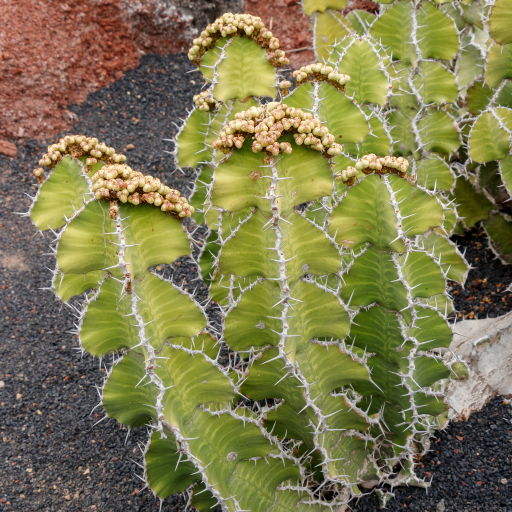
Often called the "Big-winged Euphorbia," this striking succulent looks like it belongs in a prehistoric landscape or a modern art gallery. Originating from the rocky hills of South Africa, its dramatic, wavy stems create a bold, architectural silhouette that captures the eye immediately. While it mimics the look of a desert cactus, it is actually a member of the diverse Spurge family, perfectly adapted for high-heat environments.
🔍 How to Identify
- 📐 Winged Stems: The plant is famous for its three-to-four-sided stems that feature deep, undulating "wings" or ridges, giving the branches a distinct zig-zag or scalloped appearance.
- 🌵 Paired Spines: Along the edges of these wings, you will find sturdy, greyish-brown thorns that grow in sharp pairs, acting as the plant's primary defense against thirsty herbivores.
- 🌼 Golden Cyathia: During the warmer months, tiny, vibrant yellow "false flowers" (called cyathia) sprout along the ridges, providing a brilliant color contrast against the deep green flesh.
🏡 In Your Garden
- 🏜️ Drought Specialist: This species is built for survival in arid conditions; it stores significant water reserves in its thick, fleshy stems, making it an excellent choice for xeriscaping or "neglect-friendly" indoor collections.
- ☀️ Light Requirements: To maintain its tight, wavy growth and avoid "stretching," it requires intense, bright light. In lower light conditions, the wings become less pronounced and the stems grow weak.
- 🪨 The Taproot Factor: Unlike some succulents with shallow roots, this Euphorbia develops a substantial root system that dislikes being disturbed. Once planted in well-draining, gritty soil, it prefers to stay put for several years.
⚠️ Safety & Toxicity
- 🚫 Caustic Latex: The most important safety rule is to avoid the "milk." If the plant is nicked or broken, it leaks a white, sticky sap that is highly irritating to the skin and can cause severe pain or temporary blindness if it contacts the eyes.
- 🐾 High Risk for Pets: This plant is toxic to cats, dogs, and horses. Between the sharp spines and the poisonous sap, it should be kept in a location where pets and children cannot brush against or accidentally damage it.
✨ Fun Fact
🧪 A Case of Double Identity: Euphorbia grandialata is a classic example of "convergent evolution." Although it looks nearly identical to many North American cacti, it is more closely related to Poinsettias! It evolved its thorny, succulent form in Africa to survive the exact same harsh conditions that cacti faced thousands of miles away in the Americas.

Detailed Care Instructions
To grow Euphorbia Grandialata, also known as Crown of Thorns, you can follow these steps:
- Plant selection: Choose a healthy and well-established Euphorbia Grandialata from a local nursery or online store.
- Pot selection: Select a pot with good drainage holes as this plant prefers dry conditions. Make sure the pot is slightly larger than the root ball to allow room for growth.
- Soil preparation: Euphorbia Grandialata prefers well-draining soil. Mix three parts of regular potting soil with one part sand or perlite to improve drainage.
- Planting: Place the plant gently into the pot, ensuring the root ball is level with or slightly above the soil surface. Fill any gaps with the prepared soil mixture and gently press down to secure the plant.
- Location: Choose a location that receives bright, indirect sunlight. Euphorbia Grandialata loves warmth, so keep it away from drafts or cold areas.
- Watering: Allow the soil to dry out between each watering, as Euphorbia Grandialata is susceptible to root rot. Water thoroughly, and then let the soil dry before watering again. Avoid overwatering.
- Fertilization: Use a balanced houseplant fertilizer once a month during the growing season (spring and summer). Follow the instructions on the fertilizer package for the correct dosage.
- Pruning: Prune off any dead or damaged leaves or stems regularly to maintain the plant's appearance and promote new growth.
- Propagation: Euphorbia Grandialata can be propagated through stem cuttings. Take 4- to 6-inch cuttings and allow them to dry for a day or two. Then, place them in a well-draining potting mix, and keep the soil slightly damp until roots develop.
- Pests and diseases: Watch out for common pests such as mealybugs and spider mites. Treat any infestations promptly with appropriate insecticidal soap or neem oil.
Remember to wear gloves and protective eyewear when handling Euphorbia Grandialata as the sap can cause skin irritation.

Place in a bright room that is sun drenched almost all day. Or directly in a south-facing window.

The plant should be watered regularly but not overwatered. It is best to water deeply but infrequently. Wait until the soil is dry before watering again. When watering, do not let water sit in the saucer beneath the pot as this can lead to root rot. The plant should also not be misted as it is susceptible to fungal diseases.
For optimal growth and health, follow the fertilizing instructions provided below for Euphorbia Grandialata plants:
- Select a balanced water-soluble fertilizer with an N-P-K (nitrogen, phosphorus, and potassium) ratio of 10-10-10 or similar.
- Dilute the fertilizer according to the manufacturer's instructions, usually mixing one tablespoon of fertilizer with one gallon of water.
- Apply the diluted fertilizer to the soil around the base of the plant, avoiding direct contact with the plant's stems or foliage.
- Ensure the soil is moist before applying fertilizer.
- Fertilize your Euphorbia Grandialata plant once every two to three weeks during the active growing season (usually spring and summer).
- During the dormant period (usually winter), reduce the frequency of fertilization to once every two months.
- Be cautious not to overfertilize, as it may result in excessive growth or damage to the plant.
- Regularly water the plant after fertilization to help distribute nutrients evenly throughout the root system.
- Observe the plant for any signs of nutrient deficiency or excess fertilization, such as yellowing leaves or stunted growth.
- Adjust the fertilization schedule or fertilizer strength if necessary, based on the plant's response and specific needs.
Remember, it is always recommended to consult specific fertilizing instructions tailored to your Euphorbia Grandialata plant and consider the plant's overall growing conditions for optimal results.
Euphorbia Grandialata plant thrives in well-draining soil that is rich in organic matter. It requires a soil pH of between 6.0 and 7.5, which can be achieved by adding lime or sulfur depending on the initial soil pH. Additionally, the soil should have good aeration and moderate moisture retention capacity. To create the perfect soil for Euphorbia Grandialata plant, you can mix loamy soil, coarse sand, and perlite in equal proportions. This will provide the necessary drainage and also help avoid soil compaction. You can also add some organic matter such as compost or shredded leaves to improve the soil structure and nutrient content. It is important to avoid using heavy clay soils as they can hold too much moisture which can lead to root rot. Overall, the goal is to create a well-draining soil with good aeration and moderate moisture retention.
Euphorbia grandialata is a perennial succulent plant that belongs to the Euphorbiaceae family. It is known for its striking appearance, featuring green stems with spiky protrusions along the margins. Propagating this plant can be done through various methods, including stem cuttings and seeds.
- Stem Cuttings:
- Start by selecting a healthy stem from the main plant. Look for a segment that is about 4-6 inches long and ensure it has at least 2-3 leaf nodes.
- Use a clean, sharp knife or pruning shears to cut the stem just below a leaf node. This will provide a good section to work with.
- Remove the lower leaves from the cutting, leaving only a few at the top.
- Allow the cutting to dry out for a day or two. This helps to prevent rotting and allows a callus to form at the cut end.
- Prepare a well-draining propagation mix. A mix of equal parts perlite, sand, and potting soil can be suitable.
- Dip the cut end of the stem into a rooting hormone powder (optional) to stimulate root development.
- Make a small hole in the propagation mix and place the cutting into it, ensuring that at least one leaf node is below the soil surface.
- Gently firm the soil around the cutting to hold it in place.
- Place the pot in a warm, bright location with indirect sunlight.
- Water the cutting sparingly, allowing the soil to slightly dry out between waterings.
- After a few weeks, you should begin to see new roots forming. This indicates successful propagation, and you can slowly acclimate the new plant to normal watering routines.
- Once the roots are established and the plant is growing well, you can transplant it into a bigger pot or its permanent location.
- Seeds:
- Collect seeds from a mature Euphorbia grandialata plant. Seeds will typically be found within the seed pods that develop after the plant blooms.
- Prepare a well-draining seed-starting mix, such as a combination of perlite, sand, and potting soil.
- Fill a seed tray or small pots with the seed-starting mix, leaving some space at the top.
- Moisten the soil lightly before sowing the seeds.
- Sprinkle the Euphorbia grandialata seeds over the soil surface, ensuring they are evenly distributed.
- Lightly cover the seeds with a thin layer of the seed-starting mix, or simply press them lightly into the soil.
- Place the seed tray or pots in a warm location with indirect sunlight.
- Mist the soil regularly to maintain moisture levels, but avoid overwatering or allowing the soil to become waterlogged.
- Germination can take anywhere from a few days to a few weeks, so be patient.
- Once the seedlings have grown a few sets of true leaves and are sturdy enough, they can be transplanted into individual pots.
- Gradually expose the young plants to more sunlight to help them adjust.
- Continue to care for the seedlings by providing regular water, well-draining soil, and appropriate sunlight conditions.
- As the plants mature, they can be gradually acclimated to outdoor conditions if preferred.
Remember, Euphorbia grandialata contains a milky sap that can be irritating to the skin and toxic if ingested, so it is important to handle the plant with caution and keep it away from children and pets.
Common pests of the euphorbia grandialata include Scale insect, mealybugs, spider mites. Make a habit of checking your euphorbia grandialata frequently for pests so that any infestations can be caught and managed early.








