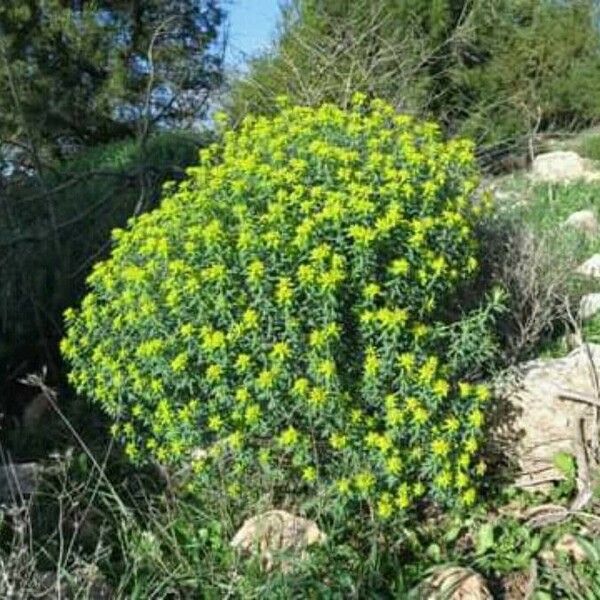
Plant Overview
The Jerusalem Spurge, or Euphorbia hierosolymitana, is a resilient Mediterranean native that paints the rocky hillsides of the Levant in vibrant shades of chartreuse. Known for its ability to thrive in harsh, sun-drenched environments, it is a favorite for xeriscaping and rock gardens. In the wild, it creates a striking visual contrast against ancient limestone, acting as a living link to the landscapes of biblical history.
🔍 How to Identify
- 🌿 The "Flowers": What look like bright yellow-green petals are actually modified leaves called bracts. The true flowers are tiny and tucked inside these showy structures.
- 🍃 Foliage & Form: It grows as a rounded, woody shrub with narrow, lance-shaped leaves that spiral up the stems, giving it a dense, architectural look.
- 💧 Milky Latex: Like all spurges, if a leaf or stem is broken, it immediately leaks a thick, white, sticky sap that looks like Elmer's glue.
🏡 In Your Garden
- ☀️ Sun Worshipper: This plant thrives on neglect and high heat. It requires full sun to maintain its compact, rounded shape; in the shade, it will become "leggy" and lose its vibrant color.
- 🪨 Drainage is Key: Because it is adapted to rocky cliffs, it hates "wet feet." Plant it in sandy or gravelly soil. If your garden has heavy clay, it is best grown in raised beds or terracotta pots to prevent root rot.
⚠️ Safety & Toxicity
- 🚫 Status: Toxic and Irritating.
- 🧴 Skin & Eyes: The milky sap contains diterpene esters, which are highly caustic. Contact with skin can cause redness and blistering, and getting it in your eyes is a medical emergency. Always wear gloves when pruning.
- 🐾 Pets & Kids: It is toxic if ingested, causing severe mouth irritation and stomach upset in cats, dogs, and curious toddlers.
✨ Fun Fact
The Jerusalem Spurge is a master of "summer dormancy." To survive the blistering heat of a Mediterranean July, the plant may drop some of its leaves to conserve water, waiting patiently for the cooler autumn rains to refresh its growth.

Detailed Care Instructions
To grow Euphorbia Hierosolymitana (also known as Jerusalem spurge) successfully, you can follow these steps:
- Choose a suitable location: Euphorbia Hierosolymitana prefers full sun exposure but can tolerate partial shade. It also requires well-draining soil.
- Prepare the soil: Amend the soil with organic matter, such as compost, to improve its drainage and fertility.
- Planting: Dig a hole slightly larger than the root ball of your plant. Place the plant in the hole and backfill with soil, ensuring that the top of the root ball is level with the soil surface.
- Watering: Water the plant thoroughly after planting to settle the soil around the roots. After that, water the plant regularly, allowing the soil to dry out slightly between waterings. Avoid overwatering, as Euphorbia Hierosolymitana is drought-tolerant once established.
- Fertilization: Euphorbia Hierosolymitana generally doesn't require frequent fertilization. However, you can apply a balanced slow-release fertilizer in spring or early summer to promote healthy growth.
- Mulching: Apply a layer of organic mulch around the plant to conserve moisture, suppress weed growth, and maintain consistent soil temperature.
- Pruning: Euphorbia Hierosolymitana does not require extensive pruning. However, you can remove any dead or damaged foliage as needed. Take care to wear gloves when handling the plant, as its sap can cause skin irritation.
- Propagation: Euphorbia Hierosolymitana can be propagated from stem cuttings. Take cuttings in spring, allow them to callus for a few days, then plant them in well-draining soil.
Remember, Euphorbia Hierosolymitana is known for its milky sap, which can be toxic and irritating to the skin and eyes. Take appropriate precautions and avoid contact with the sap when handling the plant.

Place in a bright room that is sun drenched almost all day. Or directly in a south-facing window.

To water this plant, you should first check the soil to ensure it is dry to the touch at a depth of about 1-2 inches. Once you have determined it is time to water, use room temperature water to avoid shocking the plant. Slowly water around the base of the plant until the soil is evenly moist but not waterlogged. Allow the soil to dry out slightly before watering again. It is important to avoid getting water on the leaves or stems of the plant as this can lead to rot.
To fertilize this plant, you should use a balanced fertilizer with equal parts nitrogen, phosphorus, and potassium. Apply the fertilizer to the soil every four to six weeks during the growing season, which typically runs from spring to fall. Be sure to follow the instructions on the label for specific dosage and application instructions. Avoid over-fertilizing as this can lead to excessive foliage growth at the expense of flowers.
The ideal soil for Euphorbia Hierosolymitana plant should be well-draining with good structural integrity. It should be rich in organic matter with a slightly acidic to neutral pH. The soil should not be too compacted as this can impede root growth and development. A sandy loam soil with sufficient nutrients is suitable for this plant. It is important to ensure adequate drainage as this plant is susceptible to root rot. Adding a layer of pebbles or gravel at the bottom of the pot can aid in drainage and prevent water from accumulating. Additionally, a layer of mulch can help retain moisture and regulate the temperature of the soil.
Euphorbia Hierosolymitana can be propagated through stem cuttings.
- Select a healthy and mature stem from the mother plant that is at least 6-8 inches long.
- Use a sharp and disinfected pair of scissors or pruning shears to cut the stem just below a node.
- Remove the lower leaves of the cutting, leaving only 1-2 pairs of leaves at the top.
- Dip the cut end in rooting hormone powder to encourage root growth.
- Plant the cutting in a well-draining potting mix and keep it moist but not waterlogged.
- Place the pot in a warm and bright location but avoid direct sunlight.
- In 2-3 weeks, the cutting should start developing new roots and leaves.
- After 4-6 weeks, transplant the rooted cutting into a larger pot or into the ground outside.
- Provide the new plant with adequate water, sunlight, and fertilizer to help it establish and grow into a mature plant.








