Plant Overview
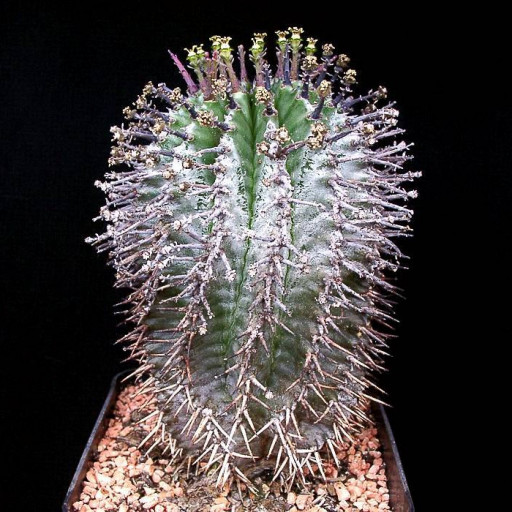
Commonly known as the African Milk Barrel, this striking succulent is a master of disguise. Native to the arid regions of South Africa, it has evolved to look remarkably like a cactus to survive harsh environments, though it belongs to a completely different family. With its heavy ribbing and frosted appearance, it adds a sculptural, desert-chic vibe to any collection.
🔍 How to Identify
- 🌵 The Barrel Shape: It features a thick, cylindrical stem that stays relatively low to the ground, though it can clump over time to create a "colony" of barrels.
- 🌊 Wavy Ribs: The plant is deeply pleated with irregular, wavy ridges that run vertically down the body, giving it a unique, accordion-like texture.
- 🛡️ "Spiny" Peduncles: While it looks prickly, those "spines" are actually dried-up flower stalks (peduncles) that remain on the plant long after the blooms have faded.
- ❄️ Glaucous Glow: The skin often has a chalky, blue-grey, or silver coating which acts as a natural sunscreen against intense ultraviolet rays.
🏡 In Your Garden
- ☀️ Light & Color: This plant craves bright, direct sunlight. If it’s kept in too much shade, it will lose its beautiful silvery "frost" and start to stretch out, losing its iconic barrel shape.
- 💧 The "Drought First" Rule: Because it stores so much water in its fleshy body, it is extremely prone to root rot. It’s better to forget to water it for a month than to water it twice in one week.
- 🪨 Mineral Focus: In its natural habitat, it grows among rocks. It prefers a "gritty" soil mix with plenty of pumice or perlite rather than standard potting soil, which holds too much moisture.
⚠️ Safety & Toxicity
- 🚫 Toxic Sap: Like almost all Euphorbias, this plant contains a thick, milky white latex. This sap is highly irritating to the skin and can cause temporary blindness if it gets into the eyes.
- 🐾 Pet & Child Warning: Keep this plant out of reach of curious pets and children. Both the sharp "spines" and the toxic internal sap make it a "look but don't touch" specimen.
- 🧤 Handling Tip: Always wear gloves when repotting or if the plant becomes damaged to avoid contact with the caustic sap.
✨ Fun Fact
The Euphorbia horrida is a perfect example of convergent evolution. Even though it looks like a North American cactus, it is more closely related to Poinsettias! It evolved the barrel shape and spines independently simply because that is the most efficient way to survive in a desert.

Detailed Care Instructions
To grow Euphorbia horrida (also known as the "African milk barrel" or "African milk tree"), follow these steps:
- Climate: Euphorbia horrida is native to arid regions, so it prefers dry and warm climates. It can be grown outdoors in USDA hardiness zones 9-11. If you live in a colder region, you can grow it in a container and bring it indoors during winter.
- Soil: It requires well-draining soil, so mix regular potting soil with perlite or sand to improve drainage. A cactus or succulent potting mix can also be used.
- Light: Provide the plant with bright, indirect sunlight. Place it near a south-facing window or in a spot where it can receive at least 6-8 hours of sunlight per day.
- Watering: Euphorbia horrida is a succulent and is adapted to survive drought conditions. Allow the soil to dry out completely between waterings. Water the plant deeply, until water drains out of the bottom of the pot or from the drainage holes. Avoid overwatering, as this can lead to root rot.
- Temperature: It prefers temperatures between 70-85°F (21-29°C) during the day and around 50-60°F (10-15°C) at night. Protect the plant from frost and cold drafts.
- Fertilizer: Euphorbia horrida doesn't require frequent fertilization. Apply a balanced, liquid fertilizer diluted to half-strength during the growing season (spring and summer) every 2-4 weeks.
- Pruning: If the plant becomes too tall or unruly, you can trim it back in spring. Be cautious while handling the plant, as the sap can cause skin irritation and is toxic if ingested.
- Propagation: Euphorbia horrida can be propagated from stem cuttings. Allow the cuttings to dry for a few days to form a callus, then plant them in well-draining soil. Keep the soil slightly moist until the cuttings establish roots.
Remember to wear gloves while handling Euphorbia horrida as its spines are sharp and can cause injury.

Place in a bright room that is sun drenched almost all day. Or directly in a south-facing window.

To water this plant, you should fill a watering can with room temperature water and carefully pour the water around the base of the plant. Make sure not to overwater it, as this plant prefers well-draining soil. Allow the soil to dry out slightly before watering again. During the winter months, water sparingly as the plant goes into a dormant state. It is important not to get water on the leaves or stem of the plant, as this can cause damage or rot.
To fertilize this plant, use a balanced fertilizer with equal parts nitrogen, phosphorus, and potassium. Apply the fertilizer once every month during the growing season and reduce the frequency during the winter. Make sure to dilute the fertilizer according to the manufacturer's instructions and apply it to the soil around the base of the plant, avoiding contact with the leaves. Water the plant thoroughly after fertilizing to help distribute the nutrients.
The best soil to use with this plant is a well-draining soil that is comprised of a mixture of sand, perlite, and organic matter. The soil should be able to retain moisture without becoming waterlogged or compacted. It is important to avoid using soil that is heavy in clay or silt, as these types of soil can lead to root rot and other problems. Additionally, it is recommended to fertilize the plant with a balanced fertilizer during the growing season to encourage healthy growth and blooms.
To propagate this plant, you will need a sharp knife, rooting hormone, a well-draining potting mix, and a small pot. Begin by selecting a healthy stem cutting from the mother plant. Make a clean cut at a 45-degree angle, ensuring that the cutting is at least 4 inches long. Remove any leaves from the lower half of the stem cutting.
Next, dip the cut end of the cutting into rooting hormone to stimulate root growth. Place the cutting into moist potting mix, making sure that at least half of the stem is buried in the soil. Water the cutting thoroughly, and cover it with a transparent plastic bag to create a humid environment.
Place the pot in a brightly lit area, but avoid direct sunlight. Check the soil moisture level daily and water as needed to keep it consistently moist. After several weeks, a root system should begin to form. You can check this by gently tugging on the cutting. If it resists, roots have formed.
Once a strong root system has developed, remove the plastic bag, and repot the new plant into a larger container using fresh potting soil. Continue to care for the plant as you would any other Euphorbia Horrida.
Common pests of the african milk barrel include Scale insect, mealybugs, spider mites. Make a habit of checking your african milk barrel frequently for pests so that any infestations can be caught and managed early.








