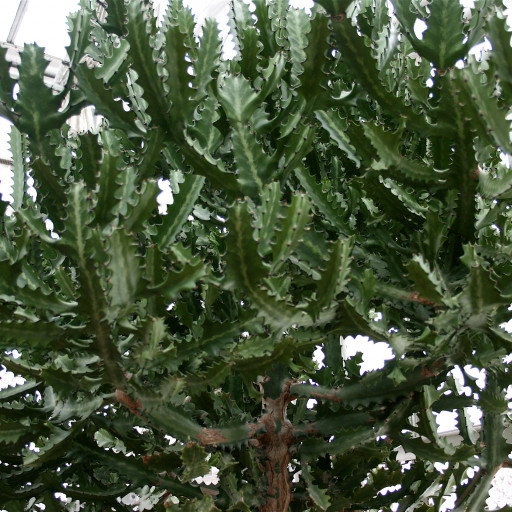
Plant Overview
Known as the "Dragon Bones" or "Candelabra Spurge," this striking succulent is a master of architectural geometry. Native to tropical Asia, it looks like a creature from a fantasy novel with its skeletal, mottled branches reaching upward. While it mimics the look of a desert cactus, it is actually a member of the diverse Euphorbia family, prized by collectors for its dramatic, marbled appearance.
🔍 How to Identify
- 🌵 Stem Structure: Features thick, three-sided or four-sided stems that grow in an upright, branching "candelabra" shape.
- 🦴 Mottled Coloration: The center of the stems displays a distinctive silvery-white or pale green marbled pattern against a darker green border.
- 🔪 Ridge Spines: Small, sharp, dark-colored spines grow in pairs along the wavy ridges of the stems.
🏡 In Your Garden
- ☀️ Light Seeker: This plant craves bright, indirect light to maintain its ghostly white variegation. If kept in too much shade, the "bones" will turn a solid, dull green as the plant struggles to photosynthesize.
- 💧 Drought Defense: Its thick stems are highly efficient water reservoirs. It is far better to underwater than overwater; the plant's biggest enemy is "wet feet," which causes the root system to collapse almost overnight.
- 🌡️ Tropical Roots: Unlike many cacti, Euphorbia lactea is tropical and hates the cold. It should be brought indoors or protected whenever temperatures dip toward freezing, as it has no frost tolerance.
⚠️ Safety & Toxicity
- 🚫 Toxic Milky Sap: Every part of the plant contains a thick, white latex sap. This sap is a potent irritant that can cause skin rashes and severe eye inflammation upon contact.
- 🐾 Keep Away from Pets: The sap is toxic if ingested, leading to stomach upset and vomiting in cats and dogs. The sharp spines also pose a physical danger to curious pets and children.
- 🧤 Handing Tip: Always wear gloves and eye protection when pruning or propagating to avoid accidental contact with the "milk."
✨ Fun Fact
The popular "Coral Cactus" seen in many plant shops isn't a single species! It is actually a "crested" mutation of Euphorbia lactea that has been surgically grafted onto the stem of a different Euphorbia species to create a fan-shaped, brain-like appearance.

Detailed Care Instructions
| Soil Ph | Acidic, Neutral |
| Humidity | Normal |
| Lighting | Part Sun |
| Toxicity | Poisonous |
| Soil Type | Sandy, Well-Drained |
| Difficulty | Medium |
| Plant Type | Succulent |
| Hibernation | Cold Period |
| Mature Size | Height: 5 Ft. - 15 Ft. |
| Native Area | Sri Lanka, India, Thailand |
| Temperature | 15°C - 30°C |
| Sun Exposure | Full Sun |
| Hardiness Zones | 10-11 |
To grow Euphorbia lactea plant, also known as the mottled spurge or Elkhorn, you can follow these steps:
- Choose a suitable location: Euphorbia lactea thrives in bright indirect sunlight, so choose a spot that receives a few hours of sun each day. It can also tolerate partial shade.
- Provide well-drained soil: This plant requires well-draining soil as overly wet conditions may cause root rot. You can mix regular potting soil with sand or perlite to improve drainage.
- Select the right pot: Euphorbia lactea doesn't require a large pot as the plant itself doesn't grow very big. A pot with drainage holes is essential to prevent waterlogging.
- Propagation: The most common way to propagate Euphorbia lactea is through stem cuttings. Select a healthy stem without any signs of disease or damage. Let the cut end callus over for a few days to prevent rotting. Then, insert the cutting into the potting mix and water sparingly. Roots should develop within a few weeks.
- Watering: Euphorbia lactea is a succulent and can tolerate dry conditions. Allow the soil to dry between waterings and avoid overwatering as it can cause root rot. Water thoroughly but infrequently.
- Temperature and humidity: This plant prefers temperatures between 60-85°F (15-29°C). It can tolerate humidity but doesn't require high levels of it.
- Fertilization: Feed your Euphorbia lactea plant with a balanced fertilizer diluted to half strength during the growing season, typically from spring to fall. Follow the manufacturer's instructions for application.
- Pruning: Trim any dead or damaged branches with sharp, sterilized pruning shears. This helps maintain the plant's shape and promotes new growth.
- Protect from frost: Euphorbia lactea is sensitive to frost and cold temperatures. If you live in an area with very cold winters, consider bringing it indoors during colder months or providing protection such as a frost cloth or greenhouse.
Remember to handle Euphorbia lactea with care as its sap can be toxic and may cause skin irritation or eye damage. Use gloves and take precautions while pruning or repotting the plant.

Place in a bright room that is sun drenched almost all day. Or directly in a south-facing window.

Euphorbia Lactea can be watered by thoroughly saturating the soil with water until it starts to drain from the bottom of the pot. It is important to allow the soil to dry out partially between waterings, as overwatering can lead to root rot and other issues. During the growing season, the plant may need to be watered more frequently than in the winter months when it may require less frequent watering. It is important to avoid getting water on the leaves or stem of the plant, as this can lead to rot or other issues. Additionally, it is recommended to use room temperature water to water the plant, as water that is too hot or too cold can shock the roots.
To fertilize this plant, use a balanced fertilizer with equal amounts of nitrogen, phosphorus, and potassium. Apply the fertilizer once every two weeks during the growing season, reducing frequency during the dormant period. Dilute the fertilizer to half-strength before applying, and water the plant thoroughly afterward. Avoid fertilizing newly transplanted or young plants until they are established.
Euphorbia lactea requires well-draining and fertile soil that is rich in nutrients and organic matter. It thrives in a soil pH range of 6.0 to 7.5. The soil should be loamy or sandy with a mixture of perlite, peat moss, and/or vermiculite for additional drainage. It is important to avoid using heavy soils or clay soils that retain moisture, as this can lead to root rot and other diseases. Additionally, it is recommended to add a balanced slow-release fertilizer before planting and to top-dress annually to replenish nutrients.
Euphorbia Lactea plant can be propagated through stem cuttings.
- Cut a healthy stem from the parent plant using a sharp, clean knife or scissors. The stem should be 3-5 inches long and have at least 2-3 pairs of leaves.
- Leave the cutting aside for a few days until the cut end has dried and formed a callus. This helps to prevent infection in the new plant.
- Dip the cut end of the stem in rooting hormone powder to encourage root growth.
- Fill a small container with well-draining potting soil and make a hole in the center. Insert the cutting into the hole, making sure that at least one pair of leaves is above the soil line.
- Water the cutting lightly, making sure not to overwater. Place the container in a bright, warm location, but out of direct sunlight.
- Keep the soil moist, but not waterlogged, and be patient. Roots should start to form within a few weeks, and new growth should appear soon after.
- Once the new plant has established root and has grown to a suitable size, it can be transplanted to a larger container or planted in the garden.
Common pests of the mottled spurge include Scale insect, mealybugs, spider mites. Make a habit of checking your mottled spurge frequently for pests so that any infestations can be caught and managed early.








