Plant Overview
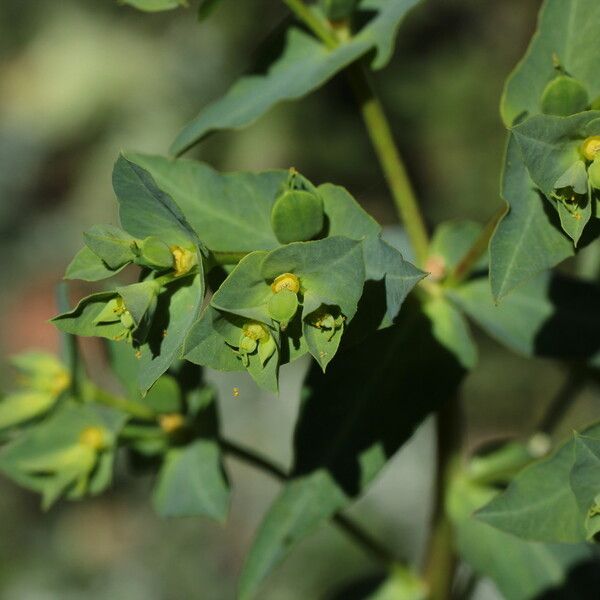
Often called Lagasca's Spurge, this Mediterranean native is a master of geometric elegance. With its architectural, upright stems and unique "flowers within flowers," it brings a cool, blue-green palette to any landscape. While it looks like a delicate ornamental, it is actually a rugged survivor that has caught the attention of scientists for its secret industrial potential.
🔍 How to Identify
- 🌿 The Foliage: Long, narrow, lance-shaped leaves with a distinct "glaucous" (waxy blue-green) tint that wrap symmetrically around the stems.
- 🌼 The "Flowers": It features yellow-green structures called cyathia. These aren't true flowers but specialized bracts that hold the tiny reproductive parts, creating a tiered, umbrella-like appearance.
- 📏 Growth Habit: It typically grows as a neat, upright mound, reaching about 30 to 60 centimeters in height, branching out near the top.
🏡 In Your Garden
- ☀️ Sun & Structure: This plant is a sun-worshipper. It relies on bright light to maintain its stiff, upright form; if placed in too much shade, the stems will become "leggy" and lean toward the light.
- 🏜️ Drainage Nuance: Coming from rocky, dry regions, it has a deep taproot that dislikes being disturbed. It is best to plant it in its "forever home" in sandy or gritty soil, as it can be quite grumpy about being transplanted.
⚠️ Safety & Toxicity
- 🚫 The Milky Sap: Like all members of the Euphorbia family, this plant contains a thick, white latex. This sap is a caustic irritant that can cause redness, itching, or even blistering on the skin.
- 👁️ Eye & Mouth Safety: Extreme care should be taken to avoid touching your eyes after handling. It is toxic if ingested, making it a plant to keep away from curious pets and small children.
✨ Fun Fact
- 🎨 Eco-Friendly Paint: The seeds of Euphorbia lagascae are rich in a specific fatty acid called vernolic acid. Scientists are breeding this plant to create "green" paints and coatings that don't release the harmful chemicals (VOCs) found in traditional hardware store cans!

Detailed Care Instructions
To properly water this plant, it should be placed in a well-draining soil mixture, as it does not like to be sitting in water. When watering, it is important to thoroughly saturate the soil, allowing the water to fully penetrate and reach the roots. It is recommended to water the plant only when the top inch of soil feels dry to the touch. Overwatering can lead to root rot and other issues, so it is important to avoid letting the plant sit in standing water.
When planting Euphorbia Lagascae, it is important to use a well-draining soil that is not too heavy. A soil mix that contains a good amount of coarse sand or perlite can help to prevent water from accumulating around the roots, which can lead to rotting. Additionally, some gardeners may choose to mix in some gravel or other inorganic matter to improve the drainage of the soil.
While it is important for the soil to be well-draining, it is equally important for it to retain some moisture. Gardeners may choose to add some organic matter, such as compost or leaf mold, to help hold onto moisture and provide some nutrients to the plant.
Overall, the ideal soil for Euphorbia Lagascae will be a well-draining mix that is fairly light and loose, with some added organic matter for nutrients and moisture retention. It is important to avoid heavy, compacted soils that can impede drainage and lead to waterlogged roots.








