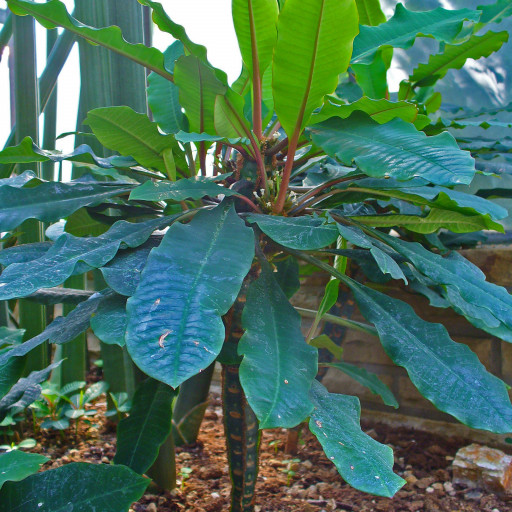
Plant Overview
Known as the "Madagascar Jewel," this striking succulent is a favorite for those who love architectural plants with a bit of a dramatic personality. Hailing from the rocky forest floors of Madagascar, it is famous for its "explosive" nature—literally shooting its seeds across a room when they are ripe. It is a slow-growing, upright beauty that brings a touch of the prehistoric to any indoor plant collection.
🔍 How to Identify
- 🌵 The Stem: It features a sturdy, dark green trunk with four or five distinct ridges. These ridges are often lined with small, brown, hair-like bristles that give it a unique "toothed" appearance.
- 🍃 The Leaves: Large, teardrop-shaped leaves grow primarily at the top of the stem. In younger plants, these leaves are marked by vivid, silvery-white veins that look like lightning bolts, though these often fade to solid green as the leaf matures.
- 🌼 The Flowers: It produces small, white, tuft-like flowers that emerge directly from the stem ridges rather than on long stalks.
🏡 In Your Garden
- 🌱 The "Volunteer" Plant: Because this plant flings its seeds up to several feet away through explosive dehiscence, you will often find "babies" sprouting in the pots of other nearby plants. It is one of the easiest succulents to propagate accidentally!
- ☀️ Light & Water: Unlike desert cacti, the Madagascar Jewel prefers "bright shade" or dappled light. It likes its soil to stay slightly more moist than a typical succulent, though it still demands excellent drainage to prevent its sensitive roots from rotting.
⚠️ Safety & Toxicity
- 🚫 Irritating Sap: Like all members of the Euphorbia family, this plant contains a thick, milky white latex sap. This sap is caustic and can cause significant skin rashes or intense eye irritation upon contact.
- 🐾 Keep Away from Pets: This plant is toxic if ingested. It should be kept out of reach of cats, dogs, and curious children, as the sap can cause swelling of the mouth and digestive distress.
✨ Fun Fact
In its native Madagascar, the Euphorbia leuconeura is actually considered a vulnerable species due to habitat loss. By growing one in your home, you are helping to preserve a lineage that is increasingly rare in the wild!

Detailed Care Instructions
| Color | Dark Green |
| Soil Ph | 6.1–6.5 |
| Humidity | Normal |
| Lighting | Part Sun |
| Toxicity | Poisonous |
| Soil Type | Well-Drained, Sandy Soil |
| Bloom Time | Spring |
| Difficulty | Medium |
| Plant Type | Flowering Succulent |
| Mature Size | Up To 1.8 Meters Tall |
| Native Area | Madagascar |
| Temperature | 18°C - 24°C |
| Sun Exposure | Light Shade To Partial Sun |
| Hardiness Zones | 10-11 |
To grow Euphorbia leuconeura, also known as the Madagascar jewel or the football plant, follow these steps:
- Purchase a healthy Euphorbia leuconeura plant or source seeds from a reliable supplier.
- Choose a suitable pot or container with drainage holes to prevent over-watering. Euphorbia leuconeura prefers shallow pots.
- Prepare well-draining soil mix that consists of equal parts of potting soil, sand, and perlite or pumice. This will ensure proper drainage.
- Place a layer of small rocks or broken pottery at the bottom of the pot to further improve drainage.
- Fill the pot with the prepared soil mix, leaving some space at the top for watering.
- Gently remove the plant from its growing container and loosen the roots.
- Place the plant in the center of the pot and add more soil mix around it, pressing it down gently to secure the plant.
- Place the potted Euphorbia leuconeura in a location with bright, indirect sunlight. It prefers temperatures between 65-85°F (18-29°C).
- Water the plant thoroughly until water drains out of the bottom of the pot. Allow the soil to dry out slightly between waterings, but do not let it completely dry out. Over-watering can be detrimental.
- Avoid waterlogging or sitting the pot in a saucer filled with water.
- Mist the leaves occasionally to increase humidity, as Euphorbia leuconeura enjoys a moderate to high humidity environment.
- Fertilize the plant once a month during the growing season (spring and summer) with a diluted, balanced liquid fertilizer.
- Trim any dead or yellowing leaves to maintain the plant's appearance and overall health.
- Euphorbia leuconeura is not frost-tolerant, so if you live in a colder climate, bring the plant indoors during winter or protect it from freezing temperatures.
- Be cautious with handling Euphorbia leuconeura, as it secretes a milky sap that can irritate the skin and eyes. Wash your hands thoroughly after any contact.
With proper care and attention to watering and lighting requirements, your Euphorbia leuconeura plant should grow and flourish.

Place in a bright room that is sun drenched almost all day. Or directly in a south-facing window.

When caring for this plant, it is important to provide it with appropriate moisture levels. One way to do this is by watering the plant regularly, but only when the soil has completely dried out. This will prevent overwatering, which can lead to root rot and other problems.
When watering, use room temperature water and pour it slowly over the soil, avoiding the leaves and stem of the plant. It is also important to ensure that the pot has proper drainage, so that excess water can escape and the soil does not become waterlogged.
In order to maintain appropriate moisture levels, it is important to monitor the plant closely and adjust watering as needed based on factors such as temperature and humidity. Fertilizer can also be used to provide additional nutrients, but should be used sparingly and only during periods of active growth. With proper care and attention, this plant can thrive and add beauty to any indoor space.
To fertilize this plant, use a balanced, water-soluble fertilizer diluted to half strength and apply once a month during the growing season. Avoid fertilizing during the winter months. Water the plant thoroughly before and after fertilizing to prevent burning the roots.
The best type of soil to use with this plant is one that is well-draining to prevent excessive moisture buildup. A recommended mix is using a combination of perlite, sand, and peat moss. The perlite and sand will provide good drainage, while the peat moss will retain moisture and nutrients. It is also recommended to use a container with drainage holes to allow excess water to escape. Additionally, it is important to avoid using soil that is too rich in nutrients or organic matter, as this may cause the plant to grow too quickly and become leggy.
One method of propagating this plant is by taking stem cuttings. Cut a stem from the main plant that is at least a few inches long and has several leaves attached. Allow the cutting to dry out for a few days to prevent excess moisture from causing rot. Once the cut end has callused over, plant the cutting in a moist potting soil mix and keep it in a brightly lit area with indirect sunlight. Water the cutting regularly, but do not allow it to sit in standing water. With proper care and time, the cutting will begin to grow roots and eventually develop into a new plant.
Common pests of the madagascar jewel include Mealybugs, spider mites, whiteflies. Make a habit of checking your madagascar jewel frequently for pests so that any infestations can be caught and managed early.








