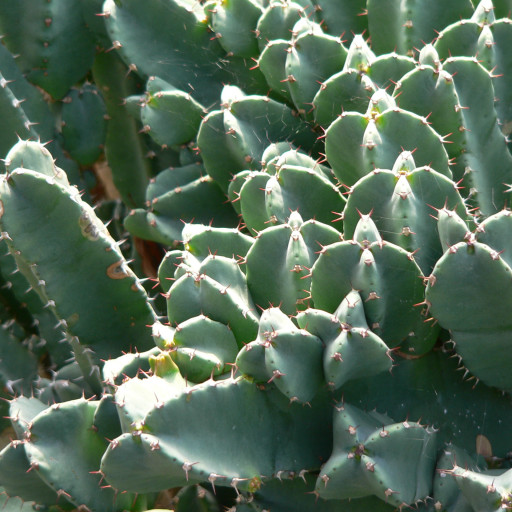
Plant Overview
The Euphorbia resinifera, commonly known as the Resin Spurge or Moroccan Mound, is an ancient succulent that mimics the look of a cactus but belongs to the diverse Spurge family. Native to the rugged Atlas Mountains of Morocco, it forms massive, geometrically perfect cushions that have decorated the desert landscape for centuries. While it looks like a stoic garden sculpture, it holds a secret: it is one of the most chemically "powerful" plants on the planet.
🔍 How to Identify
- 🌵 Growth Habit: It grows in dense, leafless mounds of upright, multi-stemmed columns that can eventually spread several feet wide.
- 📐 Stem Shape: The stems are pale green to glaucous blue, featuring four distinct, flat sides that give the plant a square-like architectural appearance.
- ⚔️ Spines: Along the ridges of the stems, you’ll find pairs of short, sturdy brownish thorns spaced evenly apart.
- 🌼 Flowers: In late spring, tiny, bright yellow "cyathia" (false flowers) emerge along the edges near the tips of the stems.
🏡 In Your Garden
- ☀️ Sun Worship: Hailing from the Moroccan heat, this plant thrives in intense, direct sunlight. It develops its most vibrant color and tightest growth form when it is allowed to "bake" in a bright spot.
- 🏜️ Drainage is Non-Negotiable: Because it is adapted to rocky slopes, its roots are highly sensitive to moisture. It requires extremely gritty, fast-draining soil; if the "feet" stay wet, the entire mound can collapse into rot quite quickly.
- 🛡️ Minimalist Maintenance: This is a "set it and forget it" plant. It requires almost no pruning, but if you must handle it, do so with extreme caution due to the volatile sap hidden inside.
⚠️ Safety & Toxicity
- 🚫 Status: HIGHLY TOXIC and a severe skin irritant.
- 🧪 The "Spiciest" Plant: The milky white latex (sap) contains resiniferatoxin. On the Scoville scale (used to measure heat), it is estimated to be 10,000 times hotter than a Carolina Reaper pepper.
- 🛑 Exposure Risk: Contact with the sap causes immediate, intense burning and blistering on the skin. It is extremely dangerous to the eyes and must be kept far away from children and pets who might accidentally break a stem.
✨ Fun Fact
Medical researchers are currently using the "heat" from this plant to create a revolutionary new type of painkiller. Because the chemical in the sap is so intense, it can actually "turn off" specific pain-sensing nerves in the body without affecting a person's ability to feel touch or move their muscles!

Detailed Care Instructions
| Humidity | Dry |
| Lighting | Full Sun |
| Difficulty | Easy |
| Hardiness Zones | 9 - 11 |
To grow Euphorbia Resinifera (also known as the Moroccan Mound or Resin Spurge) successfully, you can follow these steps:
- Climate: Understand the plant's natural habitat. Euphorbia Resinifera is native to Morocco and thrives in warm, arid regions. It prefers full sun exposure, high temperatures, and low humidity. If you live in a colder or humid climate, you may need to create a suitable environment indoors.
- Soil: Use well-draining soil mix specifically designed for succulents or cacti. You can also make your own by mixing equal parts potting soil, perlite, and coarse sand. Ensure the container or planting site has proper drainage to prevent waterlogging.
- Watering: Like most succulents, Euphorbia Resinifera prefers infrequent but deep watering. Allow the soil to dry out completely between waterings and be cautious not to overwater. Too much moisture can lead to root rot. During the winter months, reduce watering frequency further as the plant goes into dormancy.
- Pot/Container: Select a container with drainage holes that is slightly larger than the plant's root ball. Choose a shallow and wide pot rather than a deep one since Euphorbia Resinifera has a more spreading growth habit.
- Propagation: You can propagate Euphorbia Resinifera through stem cuttings. Make a clean cut with a sterilized knife or scissors and allow the cutting to dry for a couple of days before planting it in well-draining soil. Let the cutting callus over to prevent rotting.
- Fertilizer: Euphorbia Resinifera doesn't require frequent fertilization. Use a diluted succulent or cactus fertilizer once every two to three months during the growing season (spring and summer). Avoid fertilizing during winter when the plant is dormant.
- Pruning: If the plant becomes leggy or unruly, you can prune it back in the spring. Use sterilized pruning tools and wear protective gloves since Euphorbia Resinifera's sap can cause skin irritation.
- Pests and Diseases: Euphorbia Resinifera is generally resistant to most pests and diseases. However, you should monitor for common succulent pests like mealybugs or scale insects. If detected, address the issue promptly with appropriate organic or chemical controls.
Remember to handle Euphorbia Resinifera with care due to its potent and potentially irritant sap. Wear gloves and avoid contact with eyes or ingestion.

Place in a window with dappled sun or a spot in the middle of a room. Or directly in a window facing west or east.

To properly care for this plant, it is important to know when and how to water it. The watering schedule will vary depending on the climate and conditions of the plant's environment. It is best to water this plant thoroughly and allow the soil to dry out partially before watering again. Overwatering can cause root rot and other issues. When watering, it is important to water the soil directly, avoiding getting water on the leaves or stem as this can cause damage or infection. Additionally, it may be helpful to provide good drainage for the soil to prevent standing water and allow excess water to drain away from the plant.
The plant requires fertilization once every two months during its growing season. Use a balanced fertilizer with a ratio of 10-10-10, mixed according to the instructions on the label. Apply the fertilizer solution lightly to the soil, avoiding direct contact with the leaves or stem. Water the plant thoroughly after fertilization to prevent salt burn. Avoid over-fertilizing as this can cause damage to the plant.
The ideal soil for the plant in question should have good drainage qualities so as to prevent waterlogging which may result in root rot. It should also be well aerated, making use of a light and porous soil mix that allows for good airflow. The soil should be slightly sandy, with a pH level that ranges between 6.0 and 8.0. The recommended fertilizers should be organic and low in nitrogen, while the watering schedule should be done only when the soil is dry to the touch. Finally, care should be taken not to overpot the plant.
Euphorbia Resinifera plant propagation can be done through stem cuttings. To do this, take a cutting from the mother plant that is about 4-6 inches long using a sharp, clean pair of scissors or pruning shears. Allow the cutting to dry and callous over for a few days before planting it in a well-draining potting mix.
Make a small hole in the soil with your finger or a pencil and insert the cutting into the soil, making sure the soil is in full contact with the bottom of the stem. Water the cutting thoroughly, but do not allow the soil to become waterlogged.
Place the container in a warm, bright location, preferably with indirect sunlight. Continue to water the cutting sparingly and avoid fertilizing for the first few weeks. Once the cutting has established roots, you can begin to water regularly and eventually transplant it into a larger container or into your garden bed.
Propagation can also be done through seed, but this can be a more time-consuming process. Collect the seeds from a mature plant and plant them in a well-draining mix and keep them moist, but not waterlogged. Seedlings should appear within a few weeks.
Common pests of the resin spurge include Scale insect, mealybugs, spider mites. Make a habit of checking your resin spurge frequently for pests so that any infestations can be caught and managed early.








