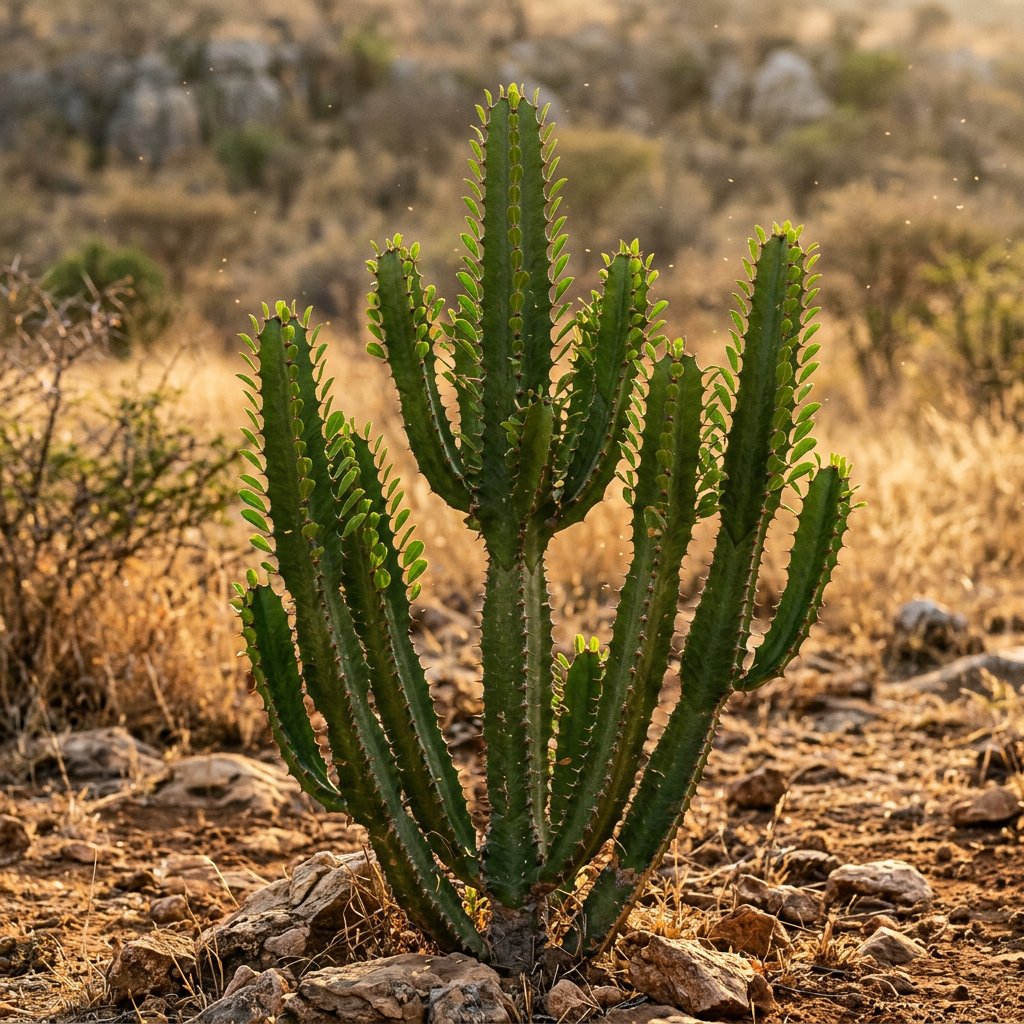
Plant Overview
Often called the African Milk Tree or Cathedral Cactus, this architectural marvel is a master of disguise. Despite its thorny, desert-like appearance, it isn't a cactus at all—it’s a succulent member of the Spurge family. Native to Central Africa, it is beloved by interior designers for its dramatic vertical growth and ability to reach the ceiling with ease.
🔍 How to Identify
- 🌵 Trigonal Stems: The plant features distinct three-sided (triangular) stems that grow vertically. These stems are usually a rich green, often marbled with light green or silvery-white "V" shaped patterns.
- 🍃 Teardrop Leaves: Unlike true cacti, this plant produces small, succulent leaves along the ridges of its stems between the thorns. These leaves are teardrop-shaped and may fall off during the dormant winter season.
- ⚔️ Paired Spines: Short, sharp, reddish-brown thorns grow in pairs along the edges of the stems, providing a rugged, protective silhouette.
🏡 In Your Garden
- ☀️ Light Nuance: This plant thrives in bright, indirect light. While it loves the sun, intense midday rays through a glass window can actually "sunburn" the stems. Conversely, if it’s too dark, the plant will lose its leaves and its stems will become thin and weak.
- 🪴 Top-Heavy Growth: Because it grows so tall and stores a lot of water in its stems, it can become quite heavy. It is best to use a heavy ceramic or terracotta pot to prevent the plant from tipping over as it matures.
- 💧 The "Soak and Dry" Method: It is highly susceptible to root rot. Only water when the soil is completely dry. In the winter, you can almost stop watering entirely as the plant enters a rest period.
⚠️ Safety & Toxicity
- 🚫 Irritating Latex: The "Milk" in its name refers to a thick, white sap (latex) that flows whenever the plant is cut or bruised. This sap is a powerful irritant.
- 👁️ Strict Warning: Always wear gloves and eye protection when pruning. The sap can cause severe skin rashes (dermatitis) and is extremely painful and dangerous if it comes into contact with the eyes or mouth.
- 🐾 Pet & Child Hazard: This plant should be kept out of reach. Ingestion leads to severe mouth irritation, vomiting, and internal distress for both humans and pets.
✨ Fun Fact
- ✨ The Living Fence: In its native regions of Africa, Euphorbia trigona is frequently used as a "living fence." Because it grows so rapidly and features such sharp thorns, it creates a nearly impenetrable (and very beautiful) natural barrier for villages and livestock!

Detailed Care Instructions
This succulent contains a white, milky sap when cut or broken. Always use care when pruning, and make sure to protect yourself and keep the plant out of the reach of children and pets.
Does African milk tree flower?
It is less likely that a tree kept as a houseplant will flower. But outdoor plants, as well as those in the wild, may bloom with white or yellow flowers in the spring or summer, under the right conditions.
Is African milk tree really a "tree?"
When grown outdoors, this large succulent can take on its characteristic candelabra shape and grow up to 9 feet tall. For this reason, this plant is sometimes referred to as a "tree."
| Color | White |
| Soil Ph | 6.1 To 7.8 (Mildly Acidic To Mildly Alkaline) |
| Humidity | Dry |
| Lighting | Full Sun |
| Toxicity | Poisonous |
| Soil Type | Medium Rich, Well Drained |
| Bloom Time | Spring - Summer |
| Difficulty | Easy |
| Plant Type | Succulent |
| Mature Size | 6 To 8 Feet |
| Native Area | Central Africa |
| Temperature | 15°C - 30°C |
| Sun Exposure | Indirect Sun To Partial Shade |
| Hardiness Zones | 9B To 11 |
To grow Euphorbia Trigona, also known as African milk tree or candelabra cactus, follow these steps:
- Choose the right location: Euphorbia Trigona requires bright, indirect sunlight. Avoid exposing it to direct sunlight as it can burn the plant. Additionally, make sure the temperature is warm, ideally around 65-85°F (18-29°C).
- Select a suitable pot: Use a well-draining pot with holes at the bottom to prevent waterlogging. Euphorbia Trigona prefers a slightly smaller pot, as it likes to be slightly rootbound. Ensure the pot has sufficient drainage.
- Prepare the soil: Use a cactus or succulent potting mix, or create a mixture by combining regular potting soil with perlite or coarse sand to enhance drainage.
- Plant the cutting or seedling: If you have a cutting, let it dry for a couple of days to allow the cut end to callus over. Then, plant the cutting about 1 inch deep in the soil, making sure the callus is in contact with the soil. If using seedlings, plant them at the same depth as they were in their original container.
- Watering: Euphorbia Trigona prefers slightly dry conditions. Water it deeply but infrequently. Allow the soil to almost completely dry out in between watering to avoid overwatering and root rot. In winter, reduce watering further as the plant goes into a semi-dormant state.
- Fertilize: Feed the plant with a balanced succulent or cactus fertilizer during the growing season (spring and summer) about once every month or two. Follow the instructions on the fertilizer package for application rate.
- Pruning: Prune the plant to maintain its shape and control its size. Additionally, watch out for any damaged or diseased branches and remove them to promote healthy growth.
- Propagation: Euphorbia Trigona can be propagated from stem cuttings. Simply cut a healthy branch from the plant, let it dry for a couple of days, and then plant it in the soil following the same steps as mentioned above.
Remember to always wear protective gloves when handling Euphorbia Trigona, as its sap can cause skin irritation or be harmful if ingested.

Place in a bright room that is sun drenched almost all day. Or directly in a south-facing window.

The best way to water this plant is to wait for the soil to dry out completely before watering it again. It is important to use well-draining soil and a pot with drainage holes to avoid waterlogging the roots. When watering, pour the water directly onto the soil and avoid getting water on the leaves or stem. It is also recommended to water less frequently during the winter months when the plant is in a dormant state. Overwatering can lead to root rot, so it is crucial to monitor the plant's moisture levels and adjust watering accordingly.
To fertilize this plant, you should use a balanced fertilizer with equal parts of nitrogen, phosphorus, and potassium. Apply the fertilizer once a month during the growing season, which is typically from spring through early fall. Be sure to dilute the fertilizer according to the instructions on the label, as over-fertilization can be harmful to the plant. Additionally, make sure the soil is moist before applying fertilizer to avoid burning the roots.
The ideal soil for this plant should be well-draining, sandy or loamy soil that is mildly acidic or neutral with a pH range of 6.0 to 7.0. The soil should be nutrient-rich without being too heavy or compact as that can lead to waterlogging and root rot. A good mix for this plant could be a combination of sand, perlite, and regular potting soil with added peat moss or coconut coir for moisture retention. It is important to ensure that there is proper drainage in the pot or container to prevent water buildup and keep the soil from becoming waterlogged. Finally, this plant does not require frequent watering, so it is important to let the soil dry out between waterings.
To propagate this plant, you will need to take a stem cutting from a healthy plant. The stem should be at least 4-6 inches long and have several leaves attached.
Using a sharp, clean pair of scissors or pruning shears, cut the stem at a 45-degree angle just below a node (the spot where a leaf attaches to the stem).
Allow the cutting to dry in a cool, shaded place for several days until a callus forms over the cut end.
Prepare a pot with well-draining soil and make a small hole in the center.
Insert the stem cutting into the hole and gently press the soil around it to secure it in place.
Water the cutting lightly, being careful not to overwater. Keep the soil moist but not waterlogged.
Place the pot in a bright, indirect light location and protect it from direct sunlight.
After a few weeks, you should start to see new growth from the stem cutting, indicating that it has rooted successfully.
At this point, you can gradually acclimate the new plant to brighter light and normal watering conditions.
Common pests of the african milktree include Mealybugs. Make a habit of checking your african milktree frequently for pests so that any infestations can be caught and managed early.








