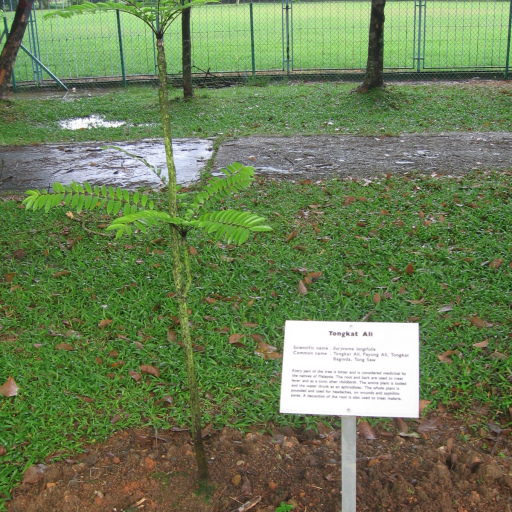
Plant Overview
Often called "Tongkat Ali" or "Ali’s Walking Stick," Eurycoma longifolia is the legendary powerhouse of the Southeast Asian rainforest. In its native lands, it is shrouded in folklore as a symbol of virility and strength, earning it the prestigious nickname "Malaysian Ginseng." This slender, slow-growing tree is highly prized for its medicinal roots, but it is also a striking example of tropical architectural beauty.
🔍 How to Identify
- 🌿 Growth Habit: A spindly, often unbranched evergreen tree that can reach up to 15 meters, though it usually appears as a single, tall "pole" topped with a dense umbrella of leaves.
- 🍃 Leaf Structure: It features large, compound leaves that can grow up to a meter long. Each leaf is composed of 20 to 40 pairs of lance-shaped, glossy dark-green leaflets.
- 🌸 Flowers & Fruit: Small, reddish-brown flowers emerge in large, fuzzy clusters. These eventually produce tiny, ovoid fruits that transition from green to a dark, burgundy-red when ripe.
🏡 In Your Garden
- 🌱 Deep Root System: The plant is famous for its incredibly long, vertical taproot. Because of this, it is notoriously difficult to transplant once established. If growing in a pot, it requires an exceptionally deep "long-tom" style container to thrive.
- ☁️ Environmental Preferences: It is a true child of the rainforest, preferring acidic, well-draining soil and high humidity. It dislikes direct, scorching afternoon sun when young, preferring the dappled light of a forest canopy.
⚠️ Safety & Toxicity
- ✅ General Safety: The foliage and stems are generally considered non-toxic to the touch and are not known to be hazardous to pets or children.
- 💊 Medicinal Caution: While the roots are widely used in supplements for energy and hormones, the raw plant parts should not be ingested without professional guidance. High concentrations of the extract can lead to side effects like restlessness or insomnia in humans.
✨ Fun Fact
- ✨ The Walking Stick: The name "Tongkat Ali" literally translates to "Ali’s Walking Stick." This refers to the plant's long, straight, and incredibly sturdy taproot, which can sometimes grow deeper into the earth than the tree is tall!

Detailed Care Instructions
To grow Eurycoma Longifolia plant, also known as Tongkat Ali, follow these steps:
- Choose a suitable location: Eurycoma Longifolia requires a warm and humid climate, ideally with temperatures around 77-86°F (25-30°C). It prefers a partially shady area with good air circulation.
- Prepare the soil: The plant thrives in well-draining, sandy or loamy soil with a pH level between 5.0 to 6.0. If the soil is heavy clay, mix it with sand or organic matter to improve drainage.
- Sow the seeds or propagate from a cutting: You can sow the seeds directly into the prepared soil or start with a cutting. If using seeds, place them approximately half an inch deep in the soil and cover lightly. For cuttings, take a mature stem with several leaves and plant it in a pot filled with a well-draining mix.
- Provide moisture: Keep the soil consistently moist but not waterlogged. It is important to keep the soil evenly moist during the germination process. Once the plant is established, water it regularly, providing enough moisture for continuous growth.
- Provide shade: Eurycoma Longifolia prefers partial shade. If exposing the plant to direct sunlight, make sure it receives sunlight for only a few hours a day, preferably in the morning or late afternoon.
- Fertilize regularly: Use a balanced fertilizer with a ratio of 10-10-10 or similar, following the manufacturer's instructions. Apply the fertilizer every three months or as advised by a gardening expert.
- Prune and maintain: Regularly prune the plant to encourage bushier growth and remove any dead or diseased parts. Monitor the plant for pests or diseases and take appropriate actions if necessary.
- Harvesting: Eurycoma Longifolia takes several years to mature fully. It typically starts producing flowers and fruits around 5-6 years after planting. Harvest the roots or fruits when they are mature and dry them for medicinal use.
Note: Growing Eurycoma Longifolia requires patience and a suitable climate. It is advisable to consult local gardening experts or refer to specialized resources for more accurate guidance based on your specific region and conditions.

Place in a bright room that is sun drenched almost all day. Or directly in a south-facing window.

The best way to water this plant is to allow the top layer of soil to dry out slightly before watering thoroughly. Use a watering can or hose to water the plant until water begins to drain out of the bottom of the pot or into the soil. Do not allow the plant to sit in standing water as this can lead to root rot. It is important to avoid getting water on the foliage as this can increase the risk of fungal diseases. Watering frequency may vary depending on the plant's environment and the size of the pot, so it is important to monitor the soil regularly and adjust watering as necessary.
To fertilize this plant, use a balanced fertilizer with equal parts nitrogen, phosphorus, and potassium. Apply the fertilizer at a rate of 1 tablespoon per square foot of soil around the base of the plant. Water the plant immediately after fertilizing to help the nutrients soak into the soil. Fertilize the plant once every two to three months during the growing season.
For Eurycoma Longifolia, it is recommended to use a well-draining soil that is rich in organic matter and has a neutral to slightly acidic pH level. The soil should be able to retain moisture but not become waterlogged. A mixture of sand, loam, and peat moss is ideal for the plant's growth and development. It is also important to fertilize the soil with a balanced fertilizer to provide essential nutrients for the plant's growth. Additionally, mulching around the base of the plant can help to retain soil moisture and prevent weed growth.
There are a few different methods for propagating this plant species. One way is to collect seeds from mature plants and sow them in a suitable growth medium. The seeds should be kept moist and warm until they sprout, and then gradually exposed to more light and air as they grow.
Another method is to take cuttings from the plant, selecting healthy branches and snipping them off at the stem. The cuttings should be dipped in a rooting hormone and then planted in a well-draining soil mixture. It is important to keep the soil moist but not waterlogged, and to provide the cuttings with some shade until they have established roots and demonstrate new growth.
Finally, the plant can also be propagated through division. This involves carefully digging up the root system of a mature plant and separating it into smaller sections, each with its own stem and roots. These divisions can then be potted up and treated like new plants, with regular watering and careful monitoring until they become established.








