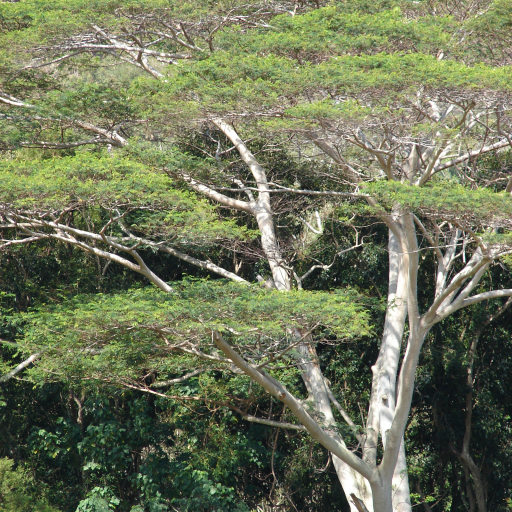
Plant Overview
Often referred to as the "Green Rocket" or the Moluccan Albizia, Falcataria falcata is legendary among arborists for its breathtaking growth speed. Originating from the lush islands of Southeast Asia and the Pacific, this tree creates a soft, feathery canopy that seems to touch the clouds almost overnight. While it is a symbol of vitality and rapid reforestation, its sheer size and brittle nature make it a giant that demands respect and plenty of elbow room.
🔍 How to Identify
- 🌿 The Foliage: The leaves are "bipinnate," meaning they look like delicate, oversized green feathers or ferns. They are light sensitive and often fold up slightly in the evening.
- ☁️ The Flowers: It produces small, creamy-white or pale yellow blossoms that look like tiny, fuzzy pompoms or brushes, releasing a faint, sweet scent into the air.
- 🐘 The Bark: The trunk is remarkably smooth and light grey, sometimes appearing almost white, which provides a striking contrast against its vibrant green crown.
- 🥜 The Seed Pods: After flowering, the tree develops flat, narrow brown pods that hang in clusters, eventually splitting open to scatter seeds in the wind.
🏡 In Your Garden
- 🚀 The Speed Demon: This is one of the fastest-growing trees on Earth, capable of shooting up over 15 feet in a single year. Because of this, it is best suited for large estates or parklands rather than small suburban yards where it might quickly overwhelm power lines and roofs.
- 🌱 Soil Improver: As a member of the legume family, it is a "nitrogen fixer." It actually improves the soil quality around it by pulling nitrogen from the air and depositing it into the ground through its roots.
- 🌬️ Brittle Beauty: Because it grows so fast, its wood is relatively soft and brittle. It is prone to "sudden branch drop," especially during high winds or heavy rain, so it should never be planted too close to walkways or parked cars.
⚠️ Safety & Toxicity
- 🟢 General Status: Falcataria falcata is generally considered non-toxic to humans and livestock.
- 🐾 Pet Watch: While not listed as a major poison risk, the pods and seeds contain saponins which can cause mild digestive upset if chewed on by curious dogs or cats.
- 🛡️ Physical Hazard: The primary safety concern is its physical structure; due to its weak wood, it is considered a "high-maintenance" tree that requires regular pruning to prevent falling limbs.
✨ Fun Fact
Falcataria falcata holds a botanical world record! In ideal tropical conditions in Sabah, Malaysia, a specimen was recorded growing an incredible 35 feet (10.7 meters) in just 13 months—roughly an inch of growth every single day!

Detailed Care Instructions
Here are some tips on how to grow Falcataria falcata (Albizia falcataria) plants:
- Choose a suitable location: Falcataria falcata plants prefer full sun to partial shade and well-draining soil. They can tolerate a wide range of soil types but thrive in fertile, moist soils.
- Planting: Plant seeds or seedlings in the spring after the danger of frost has passed. Plant the seeds at a depth of ¼ to ½ inch in the soil and space them 6 to 12 inches apart.
- Watering: Water the plants regularly, especially during dry periods. Be careful not to overwater, as this can cause root rot.
- Fertilizing: Apply a balanced fertilizer in the spring and summer to promote healthy growth. Follow the instructions on the fertilizer package for the correct dosage.
- Pruning: Prune the plants as needed to maintain their shape and size. Remove any dead or damaged branches to encourage new growth.
- Mulching: Apply a layer of mulch around the base of the plants to help retain moisture and suppress weeds.
- Pest and disease control: Keep an eye out for pests such as aphids, scale insects, and caterpillars, and treat them promptly with insecticidal soap or neem oil. Monitor the plants for signs of disease, such as leaf spot or root rot, and take appropriate action to control it.
By following these tips, you can successfully grow Falcataria falcata plants and enjoy their beautiful foliage and flowers.
To water the Falcataria falcata plant, it is important to ensure that the soil is evenly moist but not waterlogged. This plant prefers slightly moist soil, so water it regularly, especially during periods of dry weather. Make sure to water the plant at the base, avoiding getting water on the foliage which can lead to issues like fungal infections. Check the soil regularly to monitor moisture levels and adjust your watering schedule accordingly. It is also important to use room-temperature water to prevent shocking the plant's roots. Overall, maintaining proper watering practices will help keep the Falcataria falcata plant healthy and thriving.
To properly fertilize the Falcataria Falcata plant, apply a balanced fertilizer with an N-P-K ratio of 10-10-10, following the manufacturer's instructions for dilution and application frequency. Fertilize the plant during the growing season, typically from spring to early fall, every 4-6 weeks. Avoid over-fertilizing as it can lead to nutrient imbalances and potential harm to the plant. Water the plant thoroughly after fertilizing to help distribute the nutrients evenly in the soil.
The ideal soil for Falcataria Falcata plants should be well-draining, slightly acidic, and rich in organic matter. It should have a loamy texture that retains moisture without becoming waterlogged. Additionally, the soil should be fertile and provide essential nutrients for the healthy growth of the plant. It is recommended to mix in some compost or organic matter when planting to ensure the soil is nutrient-rich. Avoid heavy clay soils, as they can lead to poor drainage and root rot in Falcataria Falcata plants.
To propagate Falcataria falcata plants, one can use both sexual and asexual propagation methods.
- Sexual propagation: This involves collecting seeds from mature trees and germinating them in a seedbed or nursery. The seeds should be collected from healthy trees and sown in a well-draining potting mix. Keep the soil consistently moist but not waterlogged, and provide warmth and bright, indirect light to encourage germination.
- Asexual propagation: This method involves taking cuttings from established trees to create new plants. Select a healthy, mature branch from the parent plant and make a clean cut just below a leaf node. Remove the lower leaves from the cutting and place it in a container with well-draining potting mix. Keep the cutting moist and in a warm, humid environment to encourage root growth.
Regardless of the propagation method used, it is important to provide the young plants with proper care and attention to ensure their healthy growth. Regular watering, fertilizing, and protection from pests and diseases are essential for the successful propagation of Falcataria falcata plants.








