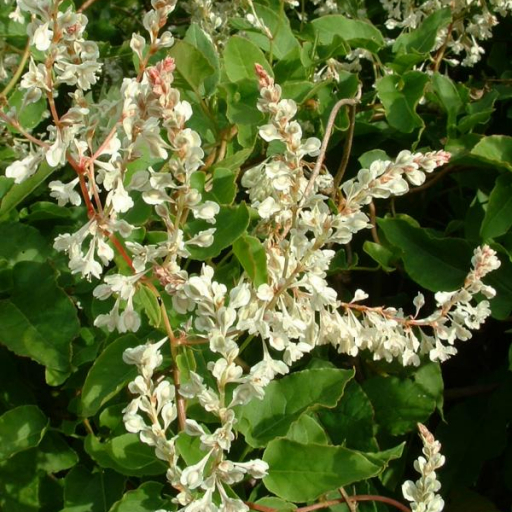
Plant Overview
Often called the Silver Lace Vine or the "Mile-a-Minute Vine," Fallopia aubertii is a champion climber famous for its frantic growth rate. Originating from the rocky slopes of Western China and Tibet, it is the go-to solution for gardeners who need to hide an ugly fence or cover a pergola in record time. By late summer, it transforms into a frothy, fragrant cloud of white blossoms that look like delicate lace draped over the landscape.
🔍 How to Identify
- 🌿 Vigorous Vines: Long, woody stems that twine aggressively around any available support, capable of reaching 25–30 feet in a single season.
- 🍃 Heart-Shaped Foliage: Small, pointed, emerald-green leaves that often emerge with a slight bronze tint in the spring.
- ☁️ Lacy Blooms: Massive, airy clusters (panicles) of tiny, creamy-white flowers that appear in such profusion they can almost hide the leaves entirely.
🏡 In Your Garden
- 🏗️ Support is Key: Because of its weight and speed, this vine requires a very sturdy structure. It can easily collapse a flimsy plastic trellis or pull down weak gutters if left to its own devices.
- ✂️ The Need for Control: It earned the name "Mile-a-Minute" for a reason. To keep it from "eating" your neighbor's yard, you should prune it hard in late winter or early spring. Since it blooms on new wood, heavy pruning actually encourages a more spectacular flower show.
- ☀️ Sun & Soil: It is incredibly resilient and thrives in urban pollution or poor soil, provided it has plenty of sunlight to fuel its rapid expansion.
⚠️ Safety & Toxicity
- 🐾 Generally Safe: Fallopia aubertii is not considered toxic to dogs, cats, or horses, making it a pet-friendly alternative to many other aggressive climbers.
- 🚫 Invasive Potential: While beautiful, its vigor can be a downside. In some regions, it is considered invasive because it can smother native plants. Always check your local ecosystem guidelines before planting it near wild, unmanaged areas.
✨ Fun Fact
The Silver Lace Vine is a close botanical relative of the infamous Japanese Knotweed. While it shares its cousin's "unstoppable" DNA and ability to grow in almost any conditions, it is much easier to manage and far more welcome in a controlled garden setting!

Detailed Care Instructions
| Humidity | Normal |
| Difficulty | Medium |
| Hibernation | Cold Period |
| Temperature | 16°C - 26°C |
| Hardiness Zones | 5B - 9 |
To grow Fallopia Aubertii, also known as Silver Lace Vine, you can follow these steps:
- Planting: Choose a location with full sun to partial shade, where the vine can receive at least 6 hours of direct sunlight per day. Make sure the soil is well-draining and fertile. Dig a hole twice as wide and deep as the root ball of the plant. Place the plant in the hole and backfill with soil, firming it gently around the roots. Water thoroughly.
- Watering: Keep the soil consistently moist but not soggy during the growing season. Water deeply once or twice a week, especially during dry spells. Avoid overwatering, as this vine prefers slightly drier conditions during winter dormancy.
- Fertilizing: Fertilize the plant in early spring with a balanced, slow-release fertilizer according to the package instructions. Avoid excessive fertilization, as it can promote foliage growth at the expense of blooming.
- Pruning: Silver Lace Vine is a vigorous grower and can benefit from occasional pruning. To control its growth and prevent invasion of other plants or structures, prune it in late winter or early spring before new growth begins. Remove dead or damaged branches and shape the vine as desired.
- Support: Provide a sturdy trellis, pergola, or fence for the vine to climb on. Silver Lace Vine is a twining vine that will naturally wrap around a support as it grows.
- Mulching: Apply 2-3 inches of organic mulch around the base of the plant to help retain moisture, suppress weeds, and insulate the roots during winter.
- Pests and Diseases: Silver Lace Vine is generally resistant to pests and diseases. However, keep an eye out for common garden pests like aphids or spider mites. Treat as necessary with insecticidal soap or neem oil, following the label instructions.
With proper care and support, Silver Lace Vine can grow quickly and produce cascades of beautiful, white, fragrant flowers in late summer to fall.

Place in a window with dappled sun or a spot in the middle of a room. Or directly in a window facing west or east.
Fallopia Aubertii requires regular watering during the growing season, particularly in hot and dry conditions. When watering, it is important to ensure that the soil is evenly moist but not waterlogged as this can lead to root rot. The plant prefers well-draining soil that does not hold onto moisture for too long. To water, either use a watering can or a hose fitted with a gentle spray nozzle to avoid damaging the delicate foliage. Water at the base of the plant rather than overhead to prevent fungal diseases. Avoid watering in the evening as this can increase the chances of fungal growth in the damp environment. In winter or during periods of dormancy, reduce watering and allow the soil to dry out slightly between waterings.
Ensure to apply a balanced fertilizer to the plant in spring before the active growth period. Fertilizer should be applied again after flowering has ceased. Use a slow-release fertilizer that is balanced with nitrogen, phosphorus, and potassium. Follow the instructions on the fertilizer label for dosage and application methods. Avoid over-fertilizing the plant as it may lead to excessive growth and weak stems.
The ideal soil for this plant should be well-draining and fertile, with a pH level between 6.0 and 7.0. The texture of the soil should be loamy, providing a balance of sand, silt, and clay particles. It should also contain ample organic matter, such as compost or leaf litter, to promote healthy root growth and nutrient uptake. Avoid heavy, compacted soils that retain too much moisture, as this can lead to root rot and other problems. Ideally, the soil should be prepared prior to planting, with any weeds and debris removed and the area thoroughly tilled or dug up to a depth of about 6-8 inches. It is also recommended to add a slow-release fertilizer or amendments such as bone meal or blood meal to the soil to provide additional nutrients for growth.
To propagate this plant, you will need to take stem cuttings during the summer season. Select stems that have just finished blooming and are still green and healthy. Cut the stem to about six inches in length and remove any leaves from the bottom two inches.
Next, dip the cut end of the stem into rooting hormone and place it into a pot filled with a soilless medium such as perlite. Be sure to water the medium thoroughly and cover the pot with a plastic bag to maintain humidity.
Place the pot in a warm, bright location but avoid direct sunlight as it can damage the cutting. Check the pot regularly to ensure the medium remains moist, but be careful not to overwater as this can lead to rotting.
After a few weeks, the cutting should start to grow roots and shoots. Once the roots are established, you can transplant the plant into a larger pot or into the ground, being careful not to disturb the roots. With proper care, your new plant will continue to thrive and bloom for years to come.








