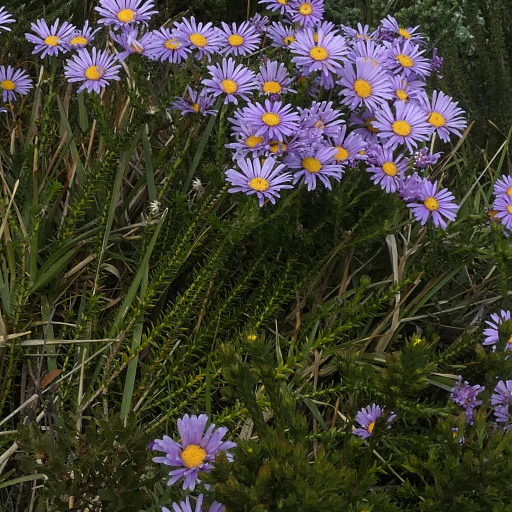
Plant Overview
Often called the Prickly Felicia or Blue Daisy Bush, this tough little shrub hails from the sun-drenched coastal dunes of South Africa. Despite its somewhat "thorny" name, it is a cheerful garden companion that blankets itself in a sea of sky-blue daisies. It is a favorite for gardeners in windy or coastal areas who need a plant that is as resilient as it is beautiful.
🔍 How to Identify
- 🌿 The Foliage: Unlike its softer cousins, the leaves of Felicia echinata are small, stiff, and crowded tightly along the stems. They point upwards and overlap like green scales, giving the plant a textured, "hedgehog" appearance.
- 🌼 The Blooms: The flowers are classic "daisy" stars, featuring delicate sky-blue to deep lilac petals surrounding a bright, sunshine-yellow central disc.
- 📏 Growth Habit: It grows as a compact, rounded evergreen shrub. It stays relatively low to the ground, usually topping out at about 2 or 3 feet, which helps it hide from heavy coastal winds.
🏡 In Your Garden
- 🌊 Coastal Warrior: This plant is incredibly salt-tolerant. If you live near the ocean where salt spray or sandy soil kills more delicate species, the Prickly Felicia will thrive where others fail.
- ☀️ Sun Seeker: It demands full sun to produce its best display. If planted in the shade, the plant often becomes "leggy" or sparse as it stretches desperately toward the light.
- 🏜️ Drainage is Key: Because it is adapted to sandy coastal dunes, it hates "wet feet." It requires very gritty, well-draining soil; sitting in stagnant water will quickly lead to root rot.
⚠️ Safety & Toxicity
- ✅ Non-Toxic: Felicia echinata is generally considered safe and non-toxic to cats, dogs, and humans.
- 🌵 Mechanical Irritation: While not poisonous, the "echinata" (meaning hedgehog-like) leaves are quite stiff and scratchy. If you are pruning or transplanting, wearing gloves is recommended to avoid minor skin scrapes from the prickly foliage.
✨ Fun Fact
🍀 The Happy Flower: The genus name Felicia is derived from the Latin word felix, which means "happy" or "lucky." This is likely a reference to the cheerful, bright-eyed appearance of the flowers that seem to "smile" at the sun.

Detailed Care Instructions
To grow Felicia echinata, also known as the blue daisy, follow these steps:
- Choose a suitable location: Felicia echinata prefers full sun, so select a spot in your garden that receives at least 6 hours of direct sunlight per day.
- Prepare the soil: The plant thrives in well-draining soil with a slightly acidic to neutral pH (around 6.0 to 7.0). Loosen the soil with a garden fork or tiller and remove any weeds or debris.
- Planting: Dig a hole that is slightly wider and deeper than the root ball of your Felicia echinata plant. Place the plant in the hole and backfill with soil, gently firming it around the base of the plant. Make sure the soil level is the same as the original planting depth.
- Watering: After planting, thoroughly water the plant to ensure good root establishment. Afterward, water regularly to keep the soil consistently moist, but not waterlogged. Avoid overwatering, as it can cause root rot.
- Mulching: Applying a layer of organic mulch around the plant will help retain moisture, suppress weeds, and regulate soil temperature. Use materials like wood chips, straw, or compost.
- Fertilizing: Felicia echinata plants generally do not require heavy fertilization, but you can apply a balanced, slow-release fertilizer once or twice a year to promote healthy growth. Follow the manufacturer's instructions for proper application.
- Pruning: Pruning is not necessary for Felicia echinata, but you can pinch off wilted flowers to encourage more blooming.
- Pests and diseases: Monitor your plant for common garden pests like aphids or snails and take appropriate actions to control them if necessary. Felicia echinata is generally resistant to diseases, but it may suffer from root rot if the soil becomes too waterlogged.
By following these steps, you should be able to successfully grow Felicia echinata and enjoy its beautiful blue daisy-like flowers.

Place in a bright room that is sun drenched almost all day. Or directly in a south-facing window.

Felicia Echinata plants require regular watering to thrive. It is important to provide them with proper moisture levels while avoiding overwatering or underwatering. Here are some guidelines for watering Felicia Echinata plants:
1. Understanding the moisture needs: Felicia Echinata plants prefer evenly moist soil. They require adequate water to support their growth and maintain healthy foliage.
2. Monitoring soil moisture: Check the moisture level in the soil by inserting your finger about one inch into the soil. If it feels dry at this depth, it indicates that the plant needs watering. However, if it feels moist, hold off watering for a few days.
3. Watering frequency: As a general rule, water Felicia Echinata plants whenever the top inch of soil feels dry. This may vary depending on various factors such as environmental conditions, pot size, and plant size. Always remember to assess the soil moisture level before watering to prevent overwatering.
4. Watering techniques: When watering Felicia Echinata plants, it is advisable to use the soak and drain method. Water the plant until you see water coming out of the drainage holes at the bottom of the pot. This ensures that the entire root ball receives sufficient moisture.
5. Water temperature: Always use water at room temperature or slightly warm when watering Felicia Echinata plants. Cold water can shock the roots and affect the overall health of the plant.
6. Avoiding waterlogged conditions: Felicia Echinata plants are susceptible to root rot if left in soggy soil. Ensure that the pot has proper drainage holes to allow excess water to escape. Additionally, remove any standing water at the bottom of saucers or trays to prevent the roots from sitting in stagnant water.
7. Adjusting watering in different seasons: Consider adjusting the watering frequency depending on the season. During the growing season, typically spring and summer, the plant may require more frequent watering. In contrast, during winter or dormancy, the watering frequency may be reduced as the plant's growth slows down.
By following these watering guidelines, you can provide optimal moisture levels for Felicia Echinata plants, promoting their health and growth.
To fertilize Felicia echinata, you can follow these instructions:
- Select a balanced, water-soluble fertilizer with equal proportions of nitrogen (N), phosphorus (P), and potassium (K). Look for a formula with a ratio such as 10-10-10 or 20-20-20.
- Dilute the fertilizer according to the manufacturer's instructions. Typically, you'll need to mix a certain amount of fertilizer with water to achieve the desired concentration.
- Water the Felicia echinata plant deeply before applying the fertilizer. This helps prevent root burn.
- Apply the diluted fertilizer to the soil around the base of the plant. Be careful not to spray it directly on the plant's leaves as this may cause damage.
- Use enough fertilizer to evenly cover the soil surface without excessive runoff. Remember that less is usually better than too much, so err on the side of caution and avoid over-fertilization.
- After applying the fertilizer, water the plant again to help distribute the nutrients and avoid any potential burning of the roots.
- Repeat the fertilization process every 4-6 weeks during the growing season, which is typically spring and summer. Adjust the frequency and amount of fertilizer based on the specific instructions provided by the fertilizer manufacturer and the condition of your plant.
Remember to always read and follow the instructions on the fertilizer packaging for the best results.
Felicia Echinata plants thrive in well-draining soil that is rich in organic matter. The ideal soil for this plant should have a slightly acidic to neutral pH level, ranging from 6.0 to 7.0. It should also be light and loamy, offering good aeration to the roots. The soil should retain moisture well while allowing excess water to drain away easily, preventing waterlogging.
To create an appropriate soil mix, you can start with a base of high-quality potting soil. Additionally, adding compost or organic matter can improve the soil's fertility and ability to retain moisture. Some gardeners also like to include perlite or coarse sand in the mix to enhance drainage and prevent compacting.
It is crucial to avoid heavy clay soils or those that are overly compacted, as they can lead to root rot and hinder the plant's growth. Similarly, excessively sandy soils may drain too quickly, resulting in inadequate moisture retention.
Regularly monitoring the moisture levels in the soil and adjusting your watering routine accordingly is vital for the overall health and well-being of the Felicia Echinata plant.
Felicia echinata is a perennial flowering plant that can be propagated using various methods. Here is a detailed guide on how to propagate this plant:
- Seeds: Collect the mature seeds of Felicia echinata after the flowers have faded and the seed heads have dried on the plant. The seeds are usually produced in small, papery capsules. Gently gather the capsules and extract the small, light brown seeds from within.
- Soil preparation: Prepare a well-draining soil mix by combining equal parts of potting soil, perlite, and coarse sand. This will ensure proper drainage and prevent waterlogged conditions.
- Pots or trays: Fill small pots or seed trays with the prepared soil mix. Make sure the containers have drainage holes at the bottom to allow excess water to escape.
- Sowing the seeds: Scatter the Felicia echinata seeds evenly over the soil surface, ensuring they are not too close together to prevent overcrowding. Lightly press the seeds into the soil or cover them with a thin layer of fine vermiculite or sand.
- Moisten the soil: Gently water the soil using a fine mist or spray bottle, ensuring the seeds are not dislodged. Avoid over-watering as it may lead to fungal diseases. Place the pots or trays in a warm location with indirect sunlight.
- Germination: Keep the soil consistently moist but not waterlogged. Germination usually occurs within 2-4 weeks, but it can vary depending on the conditions and freshness of the seeds.
- Transplanting: Once the seedlings have developed a few sets of true leaves and are large enough to handle, they can be transplanted into individual containers. Carefully lift the seedlings from the tray using a small spatula or a spoon, taking care to disturb the roots as little as possible.
- Container selection: Choose small pots with drainage holes and fill them with a well-draining potting mix. Make sure the containers are large enough to accommodate the growing root system.
- Planting: Dig a small hole in the center of the container and gently place the seedling into it, ensuring the soil level of the seedling matches that of the container. Gently firm the soil around the plant to provide stability.
- Care: Place the potted seedlings in a bright location with indirect sunlight. Water them regularly, keeping the soil moist but not overly saturated. Avoid overwatering, as it may lead to root rot. Fertilize every two to three weeks with a balanced liquid fertilizer to promote healthy growth.
By following these steps, you should be able to successfully propagate Felicia echinata from seeds and grow new plants.








