Plant Overview
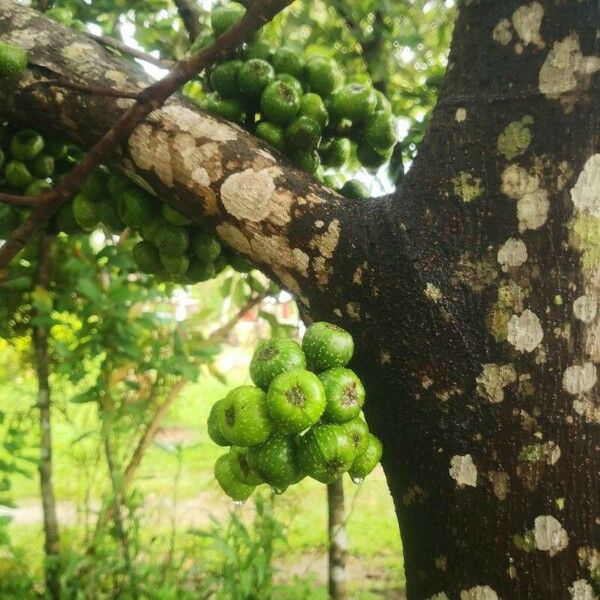
Known as the "Tibig" tree in its native Philippines, Ficus nota is a fascinating member of the fig family that breaks the traditional rules of fruit growth. Instead of hiding its bounty among the leaves, it displays heavy, grape-like clusters of figs directly on its main trunk and older branches. In its homeland, it is often respected as a "water-bringer," frequently found near hidden springs and lush riverbanks.
🔍 How to Identify
- 🍃 Large, Rough Leaves: The leaves are broad, oblong, and have a slightly asymmetrical base with a sandpaper-like texture that feels coarse to the touch.
- 🍒 Trunk-Borne Fruit: Look for "cauliflory"—the unique sight of green-to-yellowish figs growing in dense bunches directly from the bark of the main trunk rather than on the tips of branches.
- 🌳 Spreading Canopy: It typically forms a low-branching, wide-reaching canopy that provides deep shade, often looking more like a giant shrub in its younger years.
🏡 In Your Garden
- 💧 Water Indicator: This tree is a notorious water lover. If you are planting it, ensure the soil stays consistently moist. In the wild, it is a "pioneer species" that signals the presence of nearby water sources or high water tables.
- 🏗️ Root Management: Because it grows rapidly and seeks out moisture, avoid planting it near pipes, septic tanks, or foundations. Its roots are persistent and will find their way into any crack where water might be hiding.
⚠️ Safety & Toxicity
- 🥛 Sticky Latex: Like most Ficus species, the Tibig contains a white, milky sap. This latex can cause mild skin irritation or dermatitis if it gets on your hands during pruning.
- 🐾 Pet Caution: While the ripe fruits are technically edible for humans, the sap and unripe figs can cause stomach upset or mouth irritation in cats and dogs due to proteolytic enzymes.
✨ Fun Fact
The Tibig has a "secret" partnership with specialized fig wasps. Each fig is actually an inverted flower, and a specific species of tiny wasp must enter a small hole at the bottom to pollinate it, making the tree and the wasp entirely dependent on each other for survival!

Detailed Care Instructions







