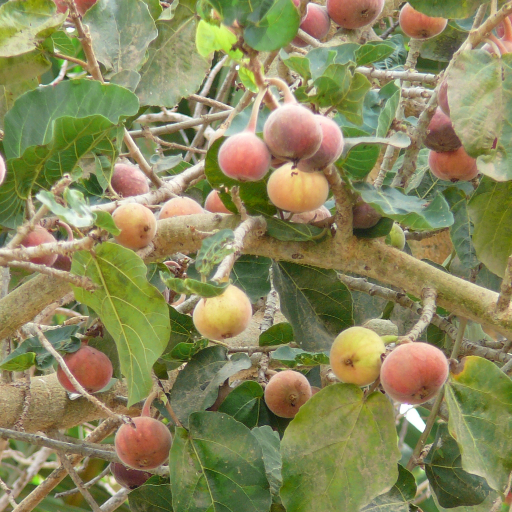
Plant Overview
Known as the "Sycomore" or "Pharaoh’s Fig," this ancient giant has been a symbol of life and resilience for millennia. Mentioned frequently in biblical texts and prized by ancient Egyptians for its durable timber, it creates a massive, welcoming canopy that can span wider than the tree is tall. It is a tree of deep history, often found shading travelers in the hot landscapes of Africa and the Middle East.
🔍 How to Identify
- 🌳 The Bark: The trunk is a standout feature, often displaying a distinctive yellowish-to-orange tint with bark that flakes off in papery patches.
- 🍃 Heart-Shaped Leaves: The leaves are vibrant green, slightly heart-shaped, and have a rough, sandpaper-like texture on the surface.
- 🍐 Trunk-Grown Fruit: Unlike many trees, its small, pale green to reddish figs grow in dense clusters directly on the main trunk and old branches—a process known as cauliflory.
🏡 In Your Garden
- 🏞️ Space and Roots: This is not a plant for small spaces; it possesses a powerful, invasive root system designed to find water deep underground. If planting outdoors, keep it far away from pipes, walls, or foundations.
- 🌞 Sun-Seeker: It thrives in full sun and loves heat. While it is remarkably drought-tolerant once established, it prefers growing near "wadies" or water sources where its roots can stay hydrated while its leaves bake in the sun.
⚠️ Safety & Toxicity
- 🧴 Sap Irritation: Like most members of the Ficus family, the Sycomore produces a milky white sap (latex). This can cause skin irritation or "phytophototoxicity" (skin sensitivity to sun) in some people.
- 🐾 Pet Safety: The sap and unripe fruit can cause digestive upset if ingested by curious cats or dogs. It is best to keep young pets away from fallen leaves or broken branches.
✨ Fun Fact
The wood of the Sycomore fig was so prized in Ancient Egypt that it was the primary material used for carving the sarcophagi (coffins) of mummies. Because the wood is incredibly resistant to decay, many of these wooden coffins have survived for thousands of years!

Detailed Care Instructions
| Humidity | Dry |
| Lighting | Full Sun |
| Difficulty | Medium |
| Temperature | 30°C - 40°C |
| Hardiness Zones | 10A - 12 |
To grow a Ficus sycomorus plant, also known as the sycamore fig or the Egyptian sycamore, follow these steps:
- Choose the right location: Ficus sycomorus thrives in warm, tropical regions with a moderate to high humidity level. Select a location that provides full sun to partial shade.
- Prepare the soil: Ficus sycomorus grows well in a well-draining soil mixture that is rich in organic matter. Prepare the soil by mixing compost or well-rotted manure into the planting area.
- Obtain a healthy plant: Purchase a Ficus sycomorus sapling from a reputable nursery or propagate from a cutting. If obtaining a cutting, make a clean cut from a mature plant and dip it in rooting hormone powder before planting.
- Planting: Dig a hole in the prepared soil that is slightly larger than the root ball of the sapling or cutting. Place the plant in the hole, ensuring that it is planted at the same depth as it was in its previous container or the cutting is planted deep enough to promote root growth. Backfill the hole with soil, gently firming it around the plant.
- Watering: Ficus sycomorus prefers consistent moisture. Water the plant thoroughly after planting, and then water it regularly to keep the soil evenly moist, but not waterlogged. Reduce watering during the winter months.
- Pruning: Prune Ficus sycomorus to maintain its desired shape and size. Remove any dead or diseased branches and shape the plant as needed. Pruning in early spring is generally recommended.
- Fertilizing: Ficus sycomorus benefits from regular fertilization. Use a balanced fertilizer for houseplants or a slow-release fertilizer specifically formulated for trees. Follow the package instructions for application rates and frequency.
- Pests and diseases: Monitor the plant for common pests such as aphids, mealybugs, and spider mites. Treat any infestations promptly with appropriate insecticides or by using natural methods such as neem oil or insecticidal soap. Watch out for diseases such as leaf rust or leaf spot and treat them accordingly.
- Mulching: Apply a layer of organic mulch around the base of the plant to help retain moisture, suppress weeds, and provide essential nutrients as it breaks down.
Remember to check your specific growing zone and climate conditions to ensure that Ficus sycomorus is suitable for your region.

Place in a window with dappled sun or a spot in the middle of a room. Or directly in a window facing west or east.

To water this type of plant, you first need to check the soil moisture level by inserting your finger about an inch deep into the soil. If it feels dry, it's time to water. When watering, make sure to apply water slowly and evenly, allowing the soil to absorb it fully. Avoid overwatering, as this can lead to root rot, and make sure that the water drains out of the bottom of the pot or container. It's also important to note that this type of plant prefers slightly moist soil, so don't let the soil completely dry out between waterings. Finally, be sure to adjust your watering schedule based on the time of year and the individual needs of your plant.
To promote growth, fertilize your plant regularly during the growing season with a balanced, slow-release fertilizer. Begin fertilizing in the early spring and continue every two to four weeks until fall. Use a fertilizer with a ratio of 10-10-10 or 20-20-20. Apply according to the instructions on the package, taking care not to over-fertilize, which can burn the roots. Water the plant thoroughly after fertilizing to help distribute the nutrients evenly throughout the soil.
The ideal soil for the Ficus Sycomorus plant should be well-draining and porous, with a pH level range of 6.0 to 7.5. The soil should be able to retain moisture without being waterlogged, as this can lead to root rot. A mixture of organic materials like compost, peat moss, and sand can be added to the soil to improve its texture and drainage. It is also important to ensure that the soil is free of any pests or diseases that can affect the Ficus Sycomorus plant. Regular fertilization and soil amendment can help maintain the health and vitality of the plant.
To propagate this plant, first select healthy branches that are approximately 8-12 inches long. Remove any leaves or buds from the bottom half of the stem. Dip the bottom of the stem into rooting hormone powder and plant it in a well-draining potting mix. Cover the pot with a plastic bag to create a humid environment and place it in a warm, bright location. Water the plant sparingly to prevent root rot, and mist it regularly to maintain humidity. After about 4-8 weeks, roots should begin to form. Once the plant is established, it can be transferred to a larger pot or planted in the ground.
Common pests of the sycomore include Scale insect, mealybugs, spider mites, thrips. Make a habit of checking your sycomore frequently for pests so that any infestations can be caught and managed early.








