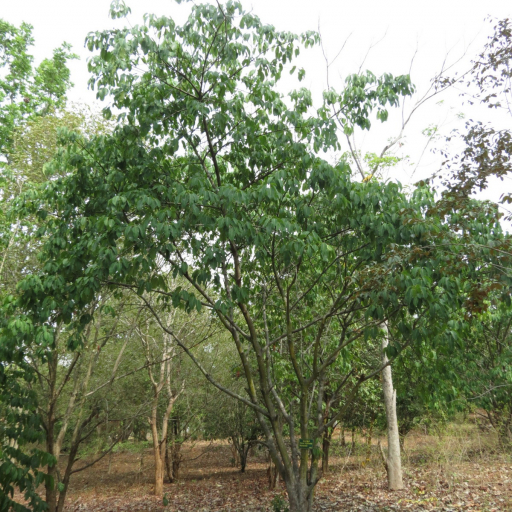
Plant Overview
Often called the Mock Peepal or Karivayal, Ficus tsjahela is a majestic giant of the tropical world. While it shares a striking resemblance to the Sacred Fig, this tree is a powerhouse of the Western Ghats, often starting its life as a "strangler" before developing into a massive, shade-giving canopy. In its native India and Sri Lanka, it is revered as a resilient survivor that can thrive in rocky crevices where other trees would wither.
🔍 How to Identify
- 🍃 The Leaves: Glossy, leathery, and oval-shaped. Unlike the Sacred Fig, its "drip tip" (the pointy end of the leaf) is short and blunt rather than long and tail-like.
- 🥈 The Bark: The trunk is remarkably smooth and wears a distinctive silvery-grey hue that can appear almost white in direct sunlight.
- 🍒 The Figs: Look for small, pea-sized fruits that grow in pairs or clusters. They are "sessile," meaning they sit directly on the branch without a stalk, turning from green to a dull purple when ripe.
🏡 In Your Garden
- 🌳 Space Requirements: This is not a plant for a small backyard! Because of its aggressive and expansive root system, it is best suited for large estates or public parks where it can spread without lifting up pavements.
- ✂️ Bonsai Potential: Due to its hardy nature and beautiful bark, it is a favorite among bonsai enthusiasts who wish to mimic the look of an ancient forest giant in a miniature pot.
- 🐦 Wildlife Magnet: If you have the space to grow one, expect a constant parade of visitors; the tree acts as a vital "supermarket" for fruit-eating birds, squirrels, and bats.
⚠️ Safety & Toxicity
- 🧪 Irritant Sap: Like most members of the Ficus family, this tree produces a milky white latex when a leaf or branch is broken. This sap can cause itchy skin rashes (dermatitis) for some people.
- 🐾 Pet Warning: Keep an eye on curious pets. Ingesting the leaves or stems can lead to vomiting or oral irritation in dogs and cats due to the presence of ficin and psoralens.
✨ Fun Fact
In the wild, Ficus tsjahela is known as a "deciduous fig," meaning it briefly drops all its leaves at once. For a few weeks a year, it stands completely bare, looking like a ghostly silver skeleton, before exploding back into vibrant green almost overnight!

Detailed Care Instructions
To grow a Ficus Tsjahela plant, also known as the Burmese Fig, you can follow the following steps:
- Choose an appropriate location: Ficus Tsjahela plants prefer bright but indirect sunlight. Avoid placing them in direct sunlight, as it can lead to leaf burn. Find a location with moderate light levels, such as near a window with a sheer curtain.
- Provide the right temperature and humidity: Ficus Tsjahela plants thrive in temperatures between 60-75°F (15-24°C). Maintain a consistent temperature range for optimal growth. These plants also appreciate moderate to high humidity levels, so misting the leaves regularly or placing a humidifier nearby can help.
- Watering: Water the plant when the top inch of soil feels dry to the touch. Make sure the soil is well-draining, as Ficus Tsjahela plants don't like to sit in waterlogged soil. Allow excess water to drain away, and empty the saucer beneath the pot to prevent root rot.
- Fertilize regularly: Use a balanced liquid fertilizer, diluted according to the package instructions, during the growing season (spring to summer). Apply the fertilizer every 2-4 weeks to provide essential nutrients for growth.
- Pruning: To maintain a desired shape and size, prune the plant regularly. You can pinch or trim the stems and leaves to encourage bushier growth. Be cautious of latex sap, which can be irritating to the skin. Wear gloves or wash your hands thoroughly after handling the plant.
- Repotting: When the plant becomes rootbound or outgrows its pot, repot it into a slightly larger container with fresh potting soil. Avoid disturbing the roots too much, and water the plant well after repotting to settle the soil.
- Pest control: Keep an eye out for common houseplant pests such as spider mites, mealybugs, and scale. Monitor the plant regularly and take appropriate action if you notice any signs of infestation, such as webbing, sticky residue, or visible insects. Use natural or chemical pest control methods as needed.
Overall, providing proper lighting, watering, fertilizing, and care will help your Ficus Tsjahela plant thrive and grow.
The Ficus Tsjahela plant should be watered consistently and thoroughly, but avoid over-watering which can lead to root rot. Wait for the soil to dry out slightly before watering again. It is best to use room-temperature water to avoid shocking the roots. Avoid letting the plant sit in standing water, as this can also lead to root rot. It is also recommended to mist the leaves occasionally to increase humidity levels around the plant.
To fertilize this plant, use a balanced, water-soluble fertilizer with equal parts nitrogen, phosphorus, and potassium. Apply the fertilizer every two weeks during the growing season and reduce to once a month during the winter. Dilute the fertilizer to half strength, and thoroughly saturate the soil with the solution while also avoiding getting the fertilizer on the leaves. Water the plant thoroughly after fertilizing to prevent fertilizer burn.
The ideal soil for the Ficus Tsjahela plant is a well-draining, nutrient-rich soil that is slightly acidic. It should be a mix of organic matter like peat moss or compost, and sand or perlite for good drainage. It is important to avoid soils that are too heavy and compact as they can lead to root rot. It is recommended to let the soil dry out slightly between watering to prevent overwatering. Overall, the soil should provide enough support for the roots while also allowing for proper water and nutrient absorption.
Propagation of this plant can be done using stem cuttings. Take a healthy stem cutting from the plant with a sharp, sterilized knife. The cutting should be about 6-8 inches in length with at least 1-2 leaves. Remove the lower leaves from the stem and make a clean cut at the bottom.
Dip the cut end of the stem in rooting hormone powder and place it in a pot filled with well-draining soil. Water the soil lightly and cover the pot with a plastic bag to create a humid environment. Place the pot in a bright and warm spot, but away from direct sunlight.
Check the cutting regularly and water the soil as needed to keep it moist. After a few weeks, roots should start to form and new growth should appear. Once the new plant is established, it can be transplanted into a larger pot or directly into the ground outdoors.







