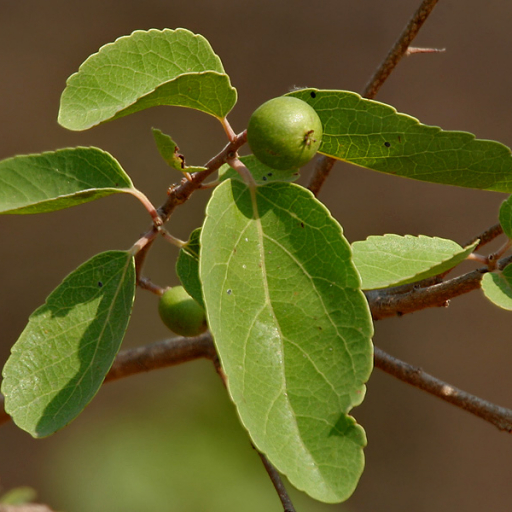
Plant Overview
Often called the Governor’s Plum or Ramontchi, this rugged tropical tree is as much a living fortress as it is a fruit producer. Native to parts of Africa and Southeast Asia, it is beloved for its deep purple, tart berries that make excellent jams. Whether it is being used as a prickly security hedge or a source of vitamin-rich snacks, this plant is a resilient survivor that thrives where others might wilt.
🔍 How to Identify
- 🌵 Thorny Armor: The most distinct feature is the presence of long, sharp spines (thorns) that grow along the trunk and lower branches, especially in younger trees.
- 🍃 Changing Leaves: The oval, serrated leaves often emerge with a reddish-copper tint before maturing into a glossy, dark green. In cooler climates, they may turn vibrant shades of red or plum before falling.
- 🍒 The "Plums": The fruit is small, round, and fleshy (about 1 inch wide). It transitions from a pale green to a deep, bruised purple or maroon when fully ripe.
🏡 In Your Garden
- 🛡️ Natural Security: Because of its dense growth habit and formidable thorns, many gardeners use it as a "living fence." It is nearly impossible for large animals or intruders to push through a mature Flacourtia hedge.
- 🌱 Tough as Nails: This plant is incredibly adaptable. It is highly drought-tolerant once established and can handle poor, rocky soils, though it prefers a sunny spot to maximize fruit production.
- 👫 The Mating Game: Keep in mind that most Governor's Plums are "dioecious," meaning individual trees are either male or female. If you want fruit, you will usually need one of each planted near each other.
⚠️ Safety & Toxicity
- ✅ Safe Fruit: The ripe fruit is entirely edible for humans and is frequently used in jellies or fermented into wine.
- ⚠️ Sharp Hazard: The primary safety concern is physical. The spines are exceptionally sharp and can easily puncture skin or clothing. It is best kept away from playgrounds or narrow walkways where children and pets roam.
- 🐾 Pet Note: While the fruit isn't known to be toxic to dogs or cats, the thorns can cause significant injury to paws or mouths if a pet tries to explore the inner branches.
✨ Fun Fact
- 🙌 The "Massage" Trick: To make the tart fruit taste sweeter, locals in its native regions often roll the fruit firmly between their palms before eating it. This "massaging" is said to break down internal tannins and reduce the puckering sourness!

Detailed Care Instructions
To grow Flacourtia indica, commonly known as the Governor's Plum, you can follow these steps:
- Climate and Soil Requirements: Flacourtia indica is native to tropical and subtropical regions. It prefers a warm climate with temperatures between 20-30°C (68-86°F). The plant can grow in a wide range of soils but thrives in well-draining, fertile soil.
- Propagation: Flacourtia indica can be propagated through seeds or cuttings. If using seeds, soak them in water for 24 hours before planting. For cuttings, take a 6-8 inch (15-20 cm) long cutting from a healthy plant and remove any leaves from the lower part of the stem.
- Planting: Select a site that receives ample sunlight. Dig a hole slightly larger than the size of the root ball or cutting, ensuring good drainage. If planting multiple plants, space them about 10-12 feet (3-3.6 meters) apart.
- Watering: Flacourtia indica requires regular watering, especially during its initial growth phase. Water deeply and consistently, keeping the soil moist but not waterlogged. Reduce watering during winter or rainy seasons.
- Fertilization: Apply a balanced fertilizer during the growing season to promote healthy growth. Use a slow-release, organic fertilizer or compost every 2-3 months to provide essential nutrients.
- Pruning: Prune the plant in early spring to remove any dead, damaged, or overcrowded branches. This helps maintain a desired shape and promotes healthy growth.
- Mulching: Apply a layer of organic mulch around the base of the plant to retain moisture, suppress weeds, and provide essential nutrients as it breaks down over time.
- Pests and Diseases: Flacourtia indica is generally resistant to pests and diseases. However, occasional issues like aphids or scale insects may occur. Use organic insecticides or consult a local garden center for appropriate pest control methods.
- Harvesting: The fruit of Flacourtia indica ripens around 4-5 months after flowering. Harvest the plums when they are firm, slightly soft, and have developed their characteristic purple color. They can be eaten fresh or used in jams, jellies, or desserts.
Remember to check your local regulations regarding the planting of non-native species before growing Flacourtia indica.

Place in a bright room that is sun drenched almost all day. Or directly in a south-facing window.

1. Determine the watering needs of the plant by checking the soil moisture level. Insert your finger into the soil up to the first knuckle. If it feels dry, then it's time to water.
2. Water the plant at the base of the stem and not on the leaves to avoid fungal infections.
3. Water deeply but less frequently, rather than lightly and often. This encourages deeper root growth and prevents the soil from becoming waterlogged.
4. Use room temperature water and avoid using chlorinated water. You can also collect rainwater for your plants.
5. Mulch around the base of the plant to help retain moisture and prevent the soil from drying out. This will also provide some nutrients as it decomposes.
6. Water the plant early in the morning or late in the afternoon to avoid evaporation due to the heat of the sun.
7. You can also mist the plant occasionally to increase humidity levels around the leaves. This is especially beneficial in dry climates.
8. Adjust watering frequency according to the changing seasons. During the winter months, water less frequently, while during the hotter months, water more often.
To fertilize this plant, first make sure the soil is moist but not waterlogged. Then, choose a balanced fertilizer with equal amounts of nitrogen, phosphorus, and potassium. Apply the fertilizer around the base of the plant but keep it at least a few inches away from the trunk. Use a rake or hoe to lightly scratch the fertilizer into the top inch of soil. Water the plant thoroughly after fertilizing to help the nutrients soak in. Repeat every 4-6 weeks during the growing season, but do not fertilize during the dormant season.
Flacourtia Indica prefers acidic, well-drained soils with a pH range of 5.5 to 7.5. The soil should be rich in organic matter and should have good water-holding capacity, but the plant cannot tolerate waterlogging. A nutrient-rich soil with sufficient nitrogen, phosphorus, and potassium is ideal for the growth and development of Flacourtia Indica. The plant prefers sandy loam or loamy soils but can also grow in heavier soils with proper drainage and aeration. It is important to avoid using soils that are high in salts or alkaline in nature, as this can negatively impact the growth and health of the plant.
Flacourtia Indica can be propagated through several methods including seed propagation, stem cuttings, and air layering.
Seed propagation involves collecting fresh seeds from ripened fruits and sowing them in a well-draining potting mixture. The seeds should be sown at a depth of 2-3 times their diameter and kept moist until germination.
Stem cuttings can be taken from healthy, mature branches during the growing season. Cuttings should be 6-8 inches long with at least 2-3 nodes. Remove the leaves from the lower portion of the cutting and dip the cut end in rooting hormone. Plant the cutting in a well-draining potting mix, water thoroughly, and provide partial shade until roots develop.
Air layering is another method of propagation that involves wounding a mature branch and promoting root growth at the wound site. Choose a healthy branch and make a 1-inch deep cut on the underside. Cover the cut with moist sphagnum moss and wrap it tightly with plastic wrap. Keep the moss moist and in a few weeks, roots should begin to grow. Cut below the rooted section and plant it in a well-draining potting mix.








