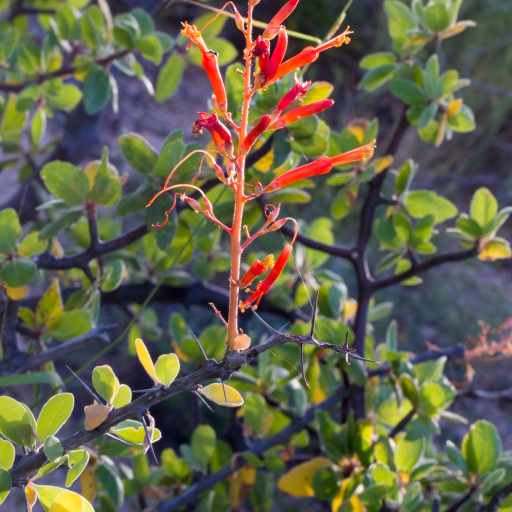
Plant Overview
Known in its native Baja California as "Palo Adán" (Adam’s Tree), the Fouquieria diguetii is a surreal desert masterpiece that looks like a cross between a cactus and a blooming shrub. While it resembles the more common Ocotillo, this species develops a distinct, thick trunk, giving it a more tree-like and ancient silhouette. It is a master of transformation, standing as a bundle of dry, thorny sticks one day and exploding into lush green leaves and fiery red flowers within hours of a desert rain.
🔍 How to Identify
- 🌵 The Trunk: Unlike the standard Ocotillo which branches from the ground, F. diguetii features a short, stout main trunk before dividing into multiple upright stems.
- ⚔️ Armor: The stems are heavily armed with sharp, grayish spines that are actually the hardened petioles (stalks) of former leaves.
- 🔥 Floral Tips: Clusters of tubular, brilliant red flowers bloom at the very tips of the branches, acting as beacons for desert pollinators.
🏡 In Your Garden
- 🏜️ Drainage is King: This plant thrives on neglect but will rot quickly in "wet feet." It requires extremely gritty, mineral-heavy soil—think crushed lava rock or coarse sand rather than potting soil.
- 💧 Rain-Triggered Growth: Do not be alarmed if your Palo Adán drops all its leaves; it is drought-deciduous. It sheds leaves to conserve water during dry spells and will regrow them almost instantly once you give it a deep drink.
- ☀️ Sun Seeker: To maintain its compact, "bonsai-like" trunk and prevent it from becoming "leggy," it needs the most intense full sun your garden can offer.
⚠️ Safety & Toxicity
- 🌵 Physical Hazard: While not known to be chemically toxic to humans or pets, its spines are incredibly sharp and rigid.
- 🚶 Placement: Avoid planting it near walkways or narrow paths. The spines can easily snag clothing or cause deep puncture wounds if a pet or child accidentally runs into it.
✨ Fun Fact
The Fouquieria diguetii is a favorite pit stop for migrating hummingbirds. Because its bright red, tubular flowers are perfectly shaped for their beaks, these birds will often defend a single plant as their personal territory during the blooming season!

Detailed Care Instructions
To grow Fouquieria diguetii (also known as Sonoran tree, boojum tree, or cirio), you can follow these steps:
- Climate and location: Fouquieria diguetii is native to the Sonoran Desert in Mexico. It requires a hot and dry climate, with temperatures ranging between 80-100°F (27-38°C) during the day and dropping to around 50°F (10°C) at night. It thrives in full sun, so choose a location where it will receive direct sunlight for most of the day.
- Soil: Make sure the soil is well-draining as the plant cannot tolerate waterlogged conditions. Sandy or gravelly soil with good drainage is ideal. Amend the soil with organic matter, such as compost or well-rotted manure, to improve its moisture retention capacity.
- Planting: You can start Fouquieria diguetii from seeds. Soak the seeds in warm water for about 24 hours before planting to soften the hard seed coat and encourage germination. Plant the seeds in early spring when the soil has warmed up. Create a small hole about 1-2 inches (2.5-5 cm) deep and place the seed inside. Cover it lightly with soil.
- Watering: During the first few weeks after planting, water the seedling regularly to help it establish a strong root system. After that, reduce the frequency of watering. Fouquieria diguetii is drought-tolerant and can survive with minimal water once established. Water deeply but infrequently, allowing the soil to dry out between waterings. Avoid overwatering, as it can cause root rot.
- Pruning: Fouquieria diguetii generally requires very little pruning. Remove any dead or damaged branches as needed. If the plant grows too tall or starts leaning, you can provide it with a stake or support until it becomes more stable.
- Protection: Young Fouquieria diguetii plants may require protection from extreme temperatures, frost, or heavy rains. Consider using a frost cloth or covering during colder nights in winter or during unexpected weather events.
Note: Fouquieria diguetii is a slow-growing plant, and it may take several years for it to reach its mature size. Plan accordingly and be patient with its growth.
Remember to always consult with local gardening experts or the nearest botanical garden for specific advice tailored to your region and climate.

Place in a bright room that is sun drenched almost all day. Or directly in a south-facing window.

The plant requires watering once every two weeks during the growing season, and less frequently during dormancy. It is important to allow the soil to dry out between watering sessions to prevent overwatering and root rot. When watering, be sure to thoroughly saturate the soil to ensure that water reaches the roots. Additionally, it is recommended to use a well-draining soil mix to prevent water from pooling at the base of the plant.
To fertilize this plant, begin by selecting a fertilizer with equal parts nitrogen, phosphorus, and potassium. Dilute the fertilizer to half-strength and apply every two to four weeks during the growing season. Be cautious not to over-fertilize as this can lead to root burn and damage the plant.
The most suitable soil for this plant is a well-draining soil with a pH level ranging from neutral to slightly acidic. It should have a good mix of organic matter, such as compost or peat moss, to promote healthy growth. The soil should be loose and not compacted, which will allow for good root growth and development. It should also be able to retain some moisture, but not be overly damp or waterlogged. A sandy or loamy soil may be ideal for this plant, as it will allow for good drainage while still retaining some moisture. Additionally, adding perlite or sand to the soil mixture can help improve drainage and prevent root rot.
To propagate this plant, one can take stem or leaf cuttings. The cutting should be taken from the top of the plant and should be approximately four inches long. Once the cutting is taken, it should be left to dry for a few days in a dry and shaded area to prevent any infections. Once the cutting has dried, it can be planted in a pot with well-draining soil. The soil should be kept moist, but not too wet, and the cutting should be placed in a bright and indirect location to encourage growth. It is advised to cover the cutting with plastic to create a humid environment for healthy growth. After a few weeks, new growth should appear, and the plant can be transferred to a larger pot or planted in the ground.








