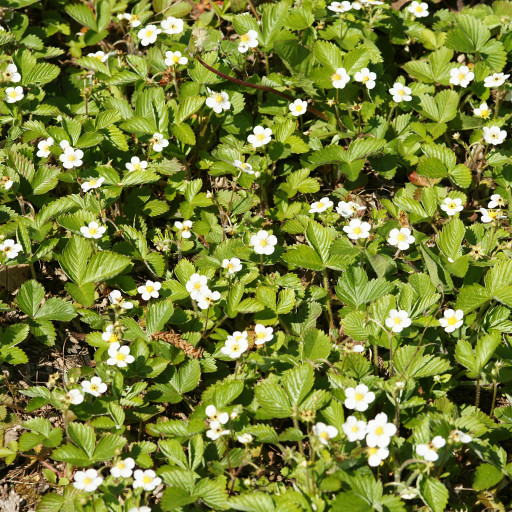
Plant Overview
Often called the Woodland Strawberry or Alpine Strawberry, this charming perennial is the wild ancestor of our modern garden varieties. While the berries are tiny—rarely bigger than a fingernail—they pack a concentrated punch of sweetness and aroma that mass-produced berries simply cannot match. In European folklore, these dainty plants were often seen as symbols of purity and were frequently depicted in the margins of medieval manuscripts.
🔍 How to Identify
- 🍃 The Foliage: Features "trifoliate" leaves (groups of three leaflets) with deep, saw-toothed edges and a vibrant green, slightly fuzzy texture on the undersides.
- 🌼 The Flowers: Delicate, five-petaled white blossoms with bright yellow centers emerge in mid-spring, sitting atop thin, wiry stalks.
- 🍓 The Fruit: Small, teardrop-shaped red fruits appear in early summer. Unlike commercial strawberries, the "seeds" (achenes) sit prominently on the surface rather than in recessed pits.
🏡 In Your Garden
- 🌲 The Edge Effect: As a woodland native, this plant thrives in dappled sunlight. It is the perfect choice for "edging" a garden path or filling in those tricky semi-shaded spots where traditional turf grass struggles to grow.
- 🌱 Master of Runners: The plant spreads primarily through "stolons" or runners—long horizontal stems that root into the ground to create new plantlets. Because of this, it makes an excellent, low-maintenance groundcover that naturally suppresses weeds.
⚠️ Safety & Toxicity
- ✅ Safe & Edible: The fruits are completely non-toxic and highly prized for jams and fresh eating. They are also considered safe for dogs, cats, and horses.
- ⚠️ Minor Sensitivities: Some people may experience "strawberry allergy" (skin rashes or hay fever symptoms) when handling or eating the fruit. If you have a known rose-family allergy, proceed with caution.
- 🐾 Wildlife Magnet: Be aware that while safe, these berries are a favorite of slugs, birds, and turtles, so you may have to share your harvest!
✨ Fun Fact
✨ Botanical Trickery: Botanically speaking, the strawberry is not a "berry" at all. The red fleshy part we eat is actually an enlarged part of the flower stem (the receptacle). The tiny "seeds" on the outside are the actual fruits, each one containing a tiny seed inside!

Detailed Care Instructions
| Color | White Blooms With A Yellow Center |
| Soil Ph | 6.0-6.5 |
| Humidity | High |
| Lighting | Full Sun |
| Toxicity | Non-Toxic |
| Soil Type | Humus-Like, Well-Draining, Fertile Soil |
| Bloom Time | May- August |
| Difficulty | Medium |
| Plant Type | Herbaceous Perennial |
| Mature Size | .25 - .75 Ft In Height, .75- 1 Ft Wide |
| Native Area | Europe & Asia, Northern Hemisphere |
| Temperature | 15°C - 25°C |
| Sun Exposure | Full To Partial Shade |
| Hardiness Zones | 5-9 |
To grow Fragaria Vesca plants, also known as wild strawberries or alpine strawberries, follow these steps:
- Choose a suitable location: Select a spot that receives partial shade to full sun, as Fragaria Vesca plants thrive in these conditions. The soil should be well-draining and fertile.
- Prepare the soil: Clear the area of weeds and rocks. Loosen the soil to a depth of about 8-10 inches and mix in organic matter like compost or well-rotted manure to improve fertility and drainage.
- Sow the seeds or plant seedlings: Fragaria Vesca can be grown from either seeds or seedlings. If using seeds, sow them in early spring or late summer according to the instructions on the seed packet. To plant seedlings, dig a small hole, place the roots in the hole, and cover them with soil, gently firming it around the plant.
- Watering: Keep the soil consistently moist, but not waterlogged, until the plants are established. After that, water them regularly, providing about 1 inch of water per week.
- Mulching: Apply a layer of organic mulch, like straw or wood chips, around the base of the plants to retain moisture, suppress weeds, and regulate soil temperature.
- Fertilizing: Every spring, provide a balanced organic fertilizer according to the package instructions to ensure adequate nutrients for healthy growth.
- Pruning: Remove any dead or yellowing leaves as well as runners (long stems that produce new plants) that go beyond the desired growing area. This helps maintain a neat appearance and promotes good airflow.
- Protect from pests: Watch out for pests like slugs and birds that may be attracted to the fruit. Place protective netting over the plants or use organic pest control methods, if necessary.
- Harvesting: Fragaria Vesca plants typically start producing fruit in their second year. Harvest the ripe berries by gently plucking them from the plants. Enjoy the delicious fruits fresh, or use them in various culinary applications.
Remember to provide consistent care and attention to your Fragaria Vesca plants throughout the growing season for optimal growth and fruit production.

Place in a bright room that is sun drenched almost all day. Or directly in a south-facing window.

To properly water this plant, one should ensure that the soil is moist but not waterlogged. It is important to water the plant regularly, but make sure not to overwater as this can lead to root rot. The best way to water this plant is to do so at the base of the plant, rather than on the leaves or flowers. One should also ensure that any excess water drains away from the plant to prevent waterlogging. Finally, during periods of prolonged drought or high temperatures, it may be necessary to increase the frequency of watering to ensure the plant stays healthy and hydrated.
To fertilize this plant, apply a balanced fertilizer with equal parts nitrogen, phosphorus, and potassium. Use a granular fertilizer and apply it to the soil around the base of the plant, avoiding contact with the leaves. Water the plant after fertilization. Repeat this process every 4-6 weeks during the growing season.
The ideal soil for the plant species that belongs to the Rosaceae family would be a loose, well-draining soil with good water retention capacity. It is important that the soil is rich in nutrients, particularly nitrogen, phosphorus, and potassium, as these are essential for the healthy growth and development of the plant. Additionally, the soil should have a slightly acidic pH, around 5.5-6.5.
Since the plant is shallow-rooted, it is advisable to use a soil mix that is not too heavy or compact and can prevent moisture from collecting around the roots. A mix of garden soil, sand, and compost can be used to provide the plant with the necessary nutrients, drainage, and aeration.
It is also recommended to regularly amend the soil with organic matter and fertilizer, especially during the growing season, to ensure that the plants receive adequate nutrition. Mulching around the base of the plants can also help to conserve moisture and suppress weed growth.
- Choose healthy parent plant: To propagate this perennial plant, the first step is to identify a healthy and mature parent plant from which you will take cuttings.
- Prepare the cuttings: Once you have identified the parent plant, take 2-3 inch cuttings of the stems. Ensure you remove any flowers or buds, as these will take energy away from the cutting during rooting.
- Plant the cuttings: Plant the cuttings in a well-draining potting mix, ensuring that at least an inch or two of the stem is buried in soil. Cuttings taken in early spring have higher chances of success.
- Water regularly: Since the cuttings have no established root system, they will need constant moisture. Water the cuttings whenever the soil feels dry to the touch.
- Provide proper lighting: Fragaria Vesca plants prefer bright, indirect light. Once you have planted the cuttings, place them in a well-lit area, but not in direct sunlight as this may scorch the young plants.
- Keep the cutting warm: To improve the chances of rooting, maintain a temperature of about 60-70°F (15-21°C) around the cuttings. You can use a heat mat or heating pad to maintain consistent warmth.
- Monitor for signs of growth: In about 2-4 weeks, you should start to see signs of growth in the form of new leaves sprouting from the stem. This indicates that the cutting has taken root and is establishing itself.
- Transplant: Once the cutting has had time to develop a healthy root system, it can be transplanted into a larger container or directly into the ground.
Common pests of the wild strawberry include Spider mites, aphids, thrips, whiteflies. Make a habit of checking your wild strawberry frequently for pests so that any infestations can be caught and managed early.








