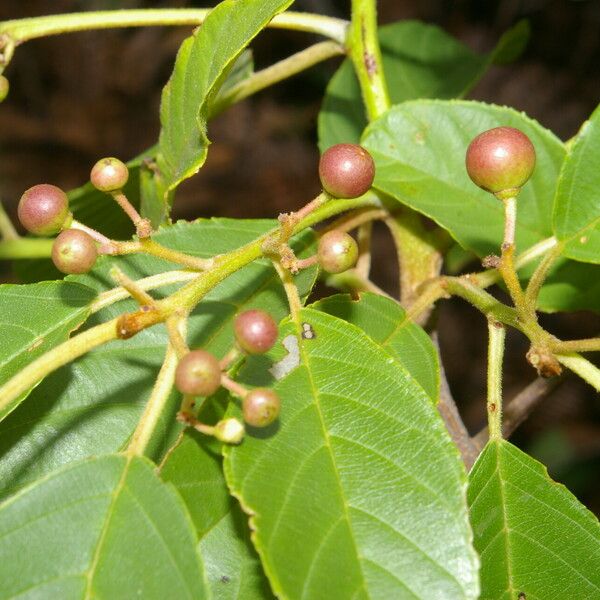
Plant Overview
Often called the "Fountain of Foliage," the Weeping Alder Buckthorn (Frangula alnus 'Pendula') is a living sculpture for the damp corners of your garden. While its wild cousins grow as upright thickets, this elegant cultivar turns the hardy buckthorn into a graceful, cascading beauty. It is a favorite for those wanting a woodland aesthetic or a focal point near a pond without the massive footprint of a weeping willow.
🔍 How to Identify
- 🌳 Growth Habit: Easily recognized by its "weeping" stature; the branches arch sharply downward toward the ground, creating a curtain-like effect.
- 🍃 Foliage: Small, oval, glossy green leaves with prominent parallel veins. In the autumn, the foliage shifts to a subtle, buttery yellow.
- 🍒 Berries: It produces tiny berry-like drupes that transition through a "sunset" of colors—starting pale green, ripening to a vibrant red, and finally maturing to a dark, glossy black.
🏡 In Your Garden
- 💧 The Moisture Specialist: This plant is an excellent choice for "problem areas" with heavy or wet soil. It thrives in boggy conditions where many other ornamental trees would succumb to root rot.
- 🦋 Wildlife Sanctuary: It is one of the primary host plants for the Brimstone butterfly. By planting one, you are providing a direct nursery for these bright yellow pollinators to lay their eggs and feed their larvae.
⚠️ Safety & Toxicity
- 🚫 Gastrointestinal Irritant: All parts of the plant, especially the berries and bark, contain anthraquinones. If ingested, they act as a potent and painful laxative.
- 🐾 Pet & Child Safety: The colorful berries can be tempting to children and curious pets. Ingestion usually leads to severe stomach upset, vomiting, and diarrhea. It is best planted in a spot where it won't be easily grazed upon.
✨ Fun Fact
Historically, the bark of the Buckthorn was a prized ingredient for making high-quality gunpowder. It produced a very fine, "soft" charcoal that was essential for the most consistent explosive mixtures used in the 19th century!

Detailed Care Instructions








