Plant Overview
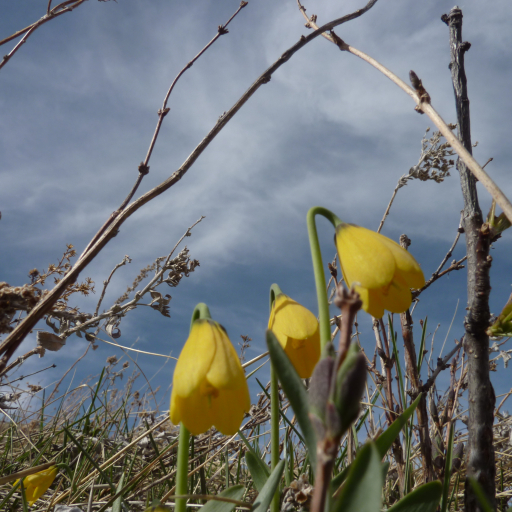
Often called the Yellow Bell or "Bashful Lily," Fritillaria pudica is a charming spring ephemeral that signals the end of winter across the interior of Western North America. Its scientific name, pudica, translates to "modest" or "bashful," perfectly describing the way its golden flowers bow toward the ground as if shyly hiding their faces from the sun.
🔍 How to Identify
- 🔔 The Flower: A single, nodding, bell-shaped bloom that starts as a vibrant lemon-yellow and matures into a deep, burnt orange or brick red as it ages.
- 🍃 The Foliage: Two to three narrow, fleshy, grass-like leaves that clasp the lower half of the stem.
- 📏 The Stature: A petite plant, rarely growing taller than 6 to 8 inches, making it a "treasure hunt" species for early-season hikers.
🏡 In Your Garden
- 🏜️ Drainage is Key: In a garden setting, these bulbs demand impeccable drainage. They are native to the dry, rocky slopes of the sagebrush steppe and will rot quickly if left in heavy, water-logged soil during their dormant phase.
- ⏳ The Great Vanishing Act: As a true ephemeral, the plant completely disappears by mid-summer. It spends most of the year dormant underground, storing energy in its small, rice-like bulbs to survive the summer heat and winter freeze.
⚠️ Safety & Toxicity
- 🛑 Status: Low to Moderate Toxicity.
- 🐾 Details: Like many members of the Lily family, Fritillaria species contain alkaloids (such as imperialine) that can cause cardiac or digestive distress if consumed in large quantities. While not usually fatal, it can cause vomiting and discomfort in pets and small children.
✨ Fun Fact
- 🍚 Nature's Rice: The bulbs of the Yellow Bell are surrounded by tiny, white offsets that look remarkably like grains of rice. Because of this, many Indigenous groups and early settlers referred to the plant as "Rice Root," often boiling the starchy bulbs for food during the early spring when other resources were scarce.

Detailed Care Instructions
Although transplanting wild plants is tempting and often successful, it is strongly discouraged, as yellow fritillary is quickly losing ground as a plentiful native plant. Many states have laws against harvesting native wild plants from public lands. Your best option is to find a native plant nursery that can send you either bulbs or container-grown plants.While there are many good reasons to want to plant native plants in a home garden (including attracting native pollinators and wildlife), in some cases it's difficult for these sometimes-delicate plants to make that transition. Generally, they're better left where they are.
How long does yellow fritillary live?
In a desirable location, yellow fritillary will colonize and last for many years, though this process involves the eventual demise of large bulbs and replacement by offsets. Should you be lucky enough to get yellow fritillary to grow for you, then lifting, dividing, and replanting the bulbs every few years should keep your colony healthy for decades.
Are there other Fritillaria species I can grow?
There are several other species in the Fritillaria genus that are common landscape plants. Most are considerably more showy than the native yellow fritillaryFritillaria imperialis (crown imperial) is a 3- to 4-foot-tall plant topped with clusters of yellow-bell-shaped flowers. Hardy in zones 5 to 8, it blooms in May or June.Fritillaria michailovskyi is a native of Turkey. It has a similar growth habit to yellow fritillary but has brownish-purple flowers. It is hardy in zones 5 to 8.Fritillaria meleagris (snake's head fritillary) is a native of eastern Asia with unusual checkered reddish-brown and purple flowers. Growing 6 to 9 inches tall and flowering in early spring, it is hardy in zones 3 to 8.
Is yellow fritillary edible?
The bulbs can be dug up and eaten, raw or cooked. Yellow fritillary was once a common food source for American Indian tribes, who often ground it into a coarse meal to store for winter. The bulbs are also eaten by bears and rodents, while deer and other grazing wildlife eat the leaves and seed pods.But it is best not to harvest wild populations of a plant that is becoming increasingly rare.
To grow Fritillaria Pudica plants, follow these steps:
- Choose a suitable planting location: Fritillaria Pudica plants prefer partial shade to full sun. They thrive in well-draining soil, so make sure the soil is loose and fertile.
- Prepare the soil: If the soil is heavy or compacted, amend it with organic matter, such as compost, to improve drainage and fertility.
- Plant the bulbs: The best time to plant Fritillaria Pudica bulbs is in the fall. Dig a hole that is two to three times deeper than the bulb's height. Place the bulb in the hole with the pointed end facing upwards. Space the bulbs 6-8 inches apart.
- Water the bulbs: After planting, water the bulbs thoroughly to help settle the soil. However, avoid overwatering, as excessive moisture can lead to rot.
- Mulch the area: Mulching the planting area with a layer of organic material, such as wood chips or straw, helps retain soil moisture and suppresses weed growth.
- Provide regular watering: While Fritillaria Pudica plants are drought-tolerant, they still require regular watering, especially during dry periods. Water deeply and infrequently to encourage deep root growth.
- Fertilize: In early spring, when new growth emerges, apply a balanced, slow-release fertilizer according to the package instructions. This will provide the necessary nutrients for healthy plant development.
- Control pests and diseases: Fritillaria Pudica plants are generally resistant to pests and diseases. However, keep an eye out for common issues like aphids or slugs. Use organic pest control methods or commercial insecticides if necessary.
- Enjoy the bloom: Depending on the variety, Fritillaria Pudica plants typically bloom in spring or early summer. The plant produces unique, drooping bell-shaped flowers in shades of yellow, green, or white. Enjoy their beauty and fragrance.
- After blooming care: Once the flowers fade, allow the foliage to die back naturally. This allows the plant to store energy in the bulb for the next growing season. Avoid cutting the foliage prematurely.
By following these steps, you can successfully grow Fritillaria Pudica plants and enjoy their stunning flowers in your garden.

Place in a bright room that is sun drenched almost all day. Or directly in a south-facing window.

To water this plant, you should first check the soil moisture level by inserting your finger into the soil up to your second knuckle. If the soil feels damp, wait another day or two before watering. If the soil feels dry, water the plant thoroughly, making sure that the water reaches the roots. Be careful not to overwater, as this can cause root rot. Water should be allowed to drain away from the pot to prevent the plant from sitting in water. It is also important to avoid getting water on the leaves, as this can lead to fungal infections.
To fertilize this plant, use a water-soluble fertilizer with a balanced N-P-K ratio of 10-10-10. Apply the fertilizer once a month during the growing season, which is typically in the spring. Follow the instructions on the fertilizer packaging for the appropriate amount to apply. Be careful not to over-fertilize, as this can damage the plant's roots. Water the plant thoroughly after fertilizing to help distribute the nutrients evenly in the soil.
Fritillaria Pudica is a bulbous perennial plant that prefers well-draining soil that is moderately fertile with good drainage. The soil should be slightly acidic with a pH level between 6.0 and 7.0. It is recommended to use a soil mix that includes peat moss, perlite, and sand for improved drainage. A layer of mulch can be added to the top of the soil to help conserve moisture. Adequate drainage is particularly important during the winter months when the plant goes dormant, as wet soil can lead to rot. It is also beneficial to add a slow-release fertilizer to the soil to promote healthy growth and flowering.
Fritillaria Pudica plant can be propagated through seedlings or bulb division. To propagate through seedlings, collect seed pods from the mature plant and sow the seeds in a well-draining potting mix. Keep the soil moist and place the pot in a bright but shaded spot. Once the seedlings grow bigger, they can be transplanted into individual pots or directly into the ground.
To propagate through bulb division, carefully dig out the bulbs from the mother plant and separate them. Make sure each bulb has some roots attached. Plant the bulbs in a well-draining soil mix, with the pointed end facing upward and burying it just under the soil surface. Water the bulbs regularly and wait for new shoots to emerge.
Propagation by bulb division is the most common and efficient way to propagate Fritillaria Pudica plant. It is important to note that it may take a few years for the new bulbs to reach maturity and produce flowers.








