Plant Overview
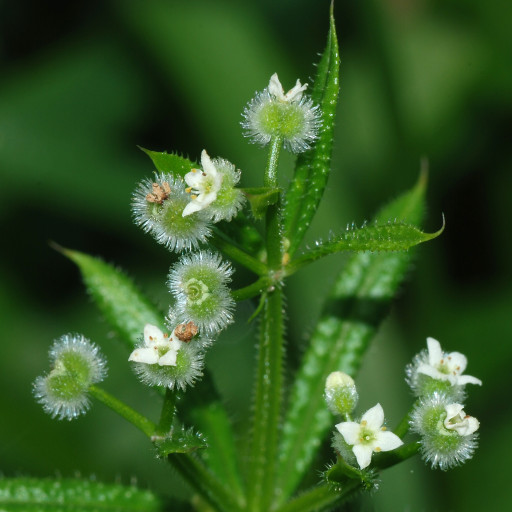
Commonly known as Cleavers or the cheeky "Sticky Willy," Galium aparine is the ultimate hitchhiker of the botanical world. This sprawling annual has been used for centuries in traditional herbalism and was even once used as a primitive sieve for straining milk. Its most famous trait is its "Velcro" texture, which allows it to scale tall structures and hitch rides on the fur of passing animals or the socks of hikers.
🔍 How to Identify
- 🌿 Sticky Hairs: The stems and leaves are covered in tiny, hooked bristles (trichomes) that cling to skin, fur, and fabric with surprising strength.
- 🌀 Leaf Whorls: Look for narrow, lance-shaped leaves arranged in starry "whorls" of six to eight along a distinctly square-shaped stem.
- ⚪ Tiny Blooms: In late spring, it produces minuscule, four-petaled white flowers that eventually turn into small, twin-lobed green seeds covered in hooks.
🏡 In Your Garden
- 🧗 The Scrambler: Cleavers doesn't have tendrils like a pea plant; instead, it "scrambles" by hooking itself onto neighboring plants for support. It can quickly form dense mats that smother smaller seedlings.
- 🌱 Nitrogen Indicator: This plant loves nutrient-rich, damp soil. If it is suddenly thriving in your garden, it is often a sign of high nitrogen levels or a particularly moist microclimate.
⚠️ Safety & Toxicity
- 🐾 Pet Nuisance: While not considered toxic to dogs or cats, the hooked seeds (burrs) can become painfully matted in long fur or cause irritation if they get stuck between paw pads or in ears.
- 🖐️ Skin Irritation: Some individuals may develop a mild, itchy rash (contact dermatitis) after handling the plant with bare hands, as the tiny hooks can cause mechanical irritation to sensitive skin.
✨ Fun Fact
- ☕ A Caffeine Cousin: Cleavers is actually in the same family (Rubiaceae) as the coffee plant! In historical times, the seeds were dried, roasted, and ground to create a caffeine-free coffee substitute that is said to smell remarkably like the real thing.

Detailed Care Instructions
To grow Galium Aparine, commonly known as Cleavers or Bedstraw, follow these steps:
- Obtain seeds or seedlings: You can purchase seeds from local nurseries or order them online. Alternatively, you can find mature plants and carefully remove the seedlings and transplant them.
- Choose the right location: Cleavers prefer a sunny or partially shaded location. The soil should be moist but well-draining. The plant can tolerate a wide range of soil types, including sandy or clayey soil.
- Prepare the soil: Clear the area of any debris and weeds. Loosen the soil to a depth of about 6 inches and mix in compost or organic matter to improve fertility and drainage.
- Plant seeds or seedlings: Sow the seeds directly into the soil or transplant the seedlings, following the instructions on the packet or label. Space them about 6 to 12 inches apart.
- Water regularly: Keep the soil consistently moist but not waterlogged. Water the plants regularly, especially during dry spells. Water at the base of the plant, avoiding wetting the leaves, to minimize fungal diseases.
- Control weeds: Cleavers can spread aggressively, so it's important to control weeds around the plant. Mulching can help suppress weed growth and retain moisture in the soil.
- Provide support if needed: Cleavers are climbing plants that can grow up to several feet in length. If you want to encourage vertical growth, provide trellises or fences for the vines to cling to.
- Harvest and maintain: Cleavers can be harvested when they are young and tender. Regular harvesting will help prevent the plant from becoming too invasive. Trim back the plant occasionally to encourage bushier growth.
Note: Cleavers can become invasive in some areas, so always check with local authorities or gardening experts to ensure it is suitable for your region.

Place in a window with dappled sun or a spot in the middle of a room. Or directly in a window facing west or east.

To water this plant, it is important to wait until the soil has completely dried out before watering again. Overwatering can cause root rot and hinder the growth of the plant. When watering, pour water directly onto the soil, making sure not to get any water on the leaves as this can cause damage or disease. It is also important to ensure proper drainage, as any excess water should be able to drain out of the pot or container. If the plant is growing outside, it may require less frequent watering depending on rainfall and outdoor conditions.
To fertilize this plant, start by choosing a fertilizer with a balanced N-P-K ratio. Apply the fertilizer around the base of the plant, taking care to avoid touching the leaves or stem. Water the plant immediately after fertilizing to help distribute the nutrients. Repeat this process every 4-6 weeks throughout the growing season. Avoid over-fertilizing, as this can harm the plant.
Galium Aparine prefers a nutrient-rich and well-draining soil that is slightly acidic or neutral in pH. The soil should be composed of a mixture of organic matter, such as compost or leaf mold, and sandy loam to ensure good drainage. The plant also prefers a soil that is not too wet or too dry, so it is important to choose a soil that can hold water but also allows excess water to drain away easily. Adding perlite or coarse sand to the soil mix can help improve drainage. Additionally, Galium Aparine is a shallow-rooted plant, so a soil depth of at least 6 inches is recommended.
Galium Aparine plant can be propagated through a variety of methods such as through seeds, cuttings, or by division. Seeds can be sown in pots or directly in soil in the spring or fall. The seeds should be lightly covered with soil and kept moist until germination occurs.
Propagation by cuttings involves taking a 4-6 inch long stem cutting from an established plant and removing the lower leaves. The cutting should be dipped in rooting hormone and planted in soil or in water until roots develop. Once roots have formed, the cutting can be planted in soil.
Division is another method of propagation that involves separating an established plant into smaller sections and planting them in soil. This should be done in the spring or fall when the plant is dormant.
Regardless of the propagation method chosen, it is important to keep the young plants moist and in a protected environment until they have become established.








