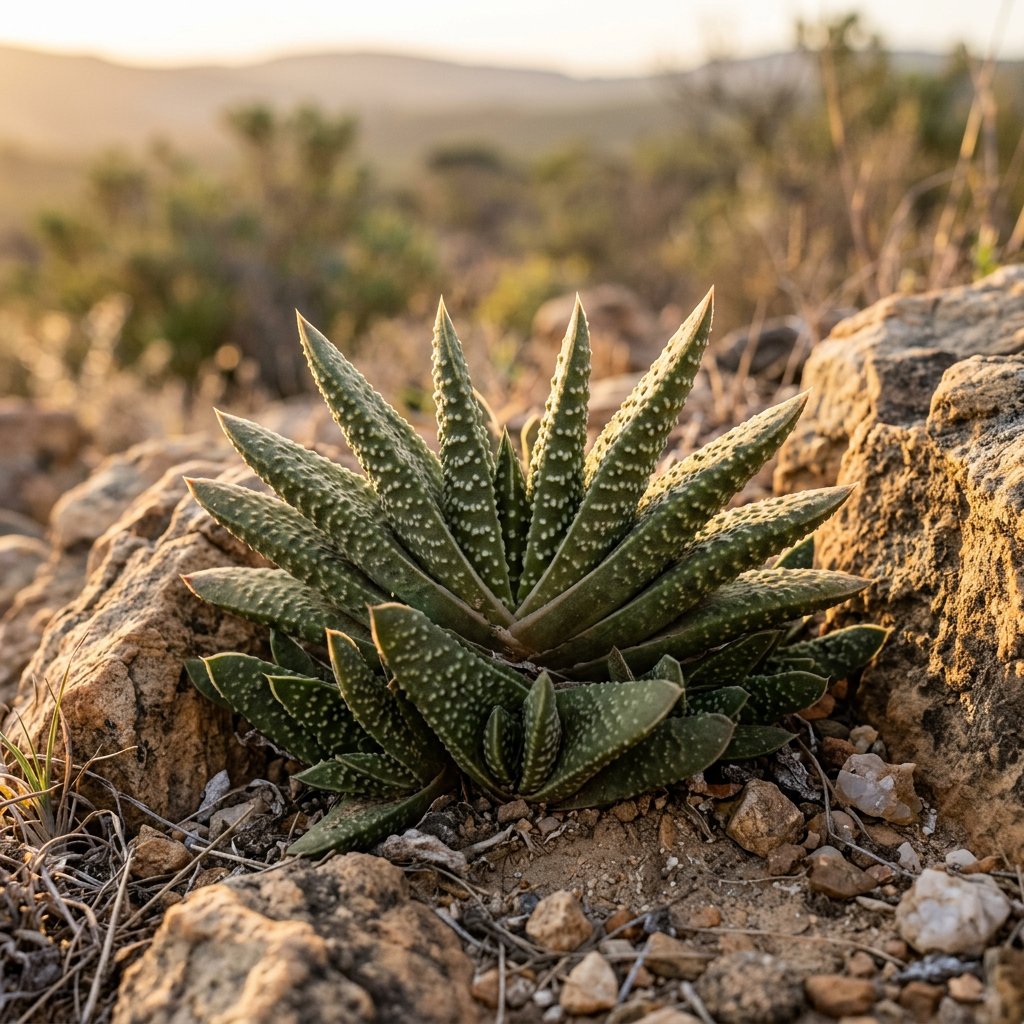
Plant Overview
Often called the Keeled Gasteria, this South African native is a master of texture and structural resilience. Its specific name, carinata, refers to the distinct "keel" or ridge on the underside of its leaves, making each leaf look like the hull of a tiny, green ship. In its homeland of the Western Cape, it is a rugged survivor, often found tucked under the cooling shade of scrub bushes and rocky outcrops.
🔍 How to Identify
- 🍃 Sculpted Leaves: The leaves are triangular and incredibly thick, featuring a sharp ridge (the keel) on the underside that gives the foliage a deep, three-dimensional profile.
- ⚪ Warty Texture: The surface is typically covered in small, white, raised bumps called tubercles, which give the plant a rough, sandpaper-like feel and a speckled appearance.
- 🌸 Stomach-Shaped Blooms: True to its genus name (derived from the Greek word gaster, meaning stomach), it produces arching stems of pendulous, pinkish-orange flowers that are swollen at the base.
🏡 In Your Garden
- ⛅ The Shade Seeker: Unlike many sun-hungry succulents, this plant thrives in bright, indirect light or dappled shade. If the leaves start turning a dark reddish-brown, it’s likely telling you it’s getting too much direct sun.
- 🪴 Slow and Steady: It is a slow-growing species that hates being "pampered" with too much water. It prefers a "soak and dry" method and rarely needs repotting, as it actually enjoys the stability of a cramped root system.
⚠️ Safety & Toxicity
- 🐾 Non-Toxic: Good news for indoor gardeners! Gasteria carinata is generally considered non-toxic to cats, dogs, and humans.
- 🌵 Mechanical Irritation: While it lacks the dangerous spines of a cactus, the leaf tips can be quite stiff and pointy. Keep it on a stable shelf where it won't be accidentally bumped by toddlers or curious pets.
✨ Fun Fact
Because of their rough, tongue-shaped leaves, Gasterias are commonly nicknamed "Ox Tongue" or "Cow's Tongue." In South African folklore, some Gasteria species were even believed to provide protection against lightning if planted on a roof!

Detailed Care Instructions
To grow a Gasteria Carinata plant, you can follow these steps:
- Choose a suitable pot: Select a pot with drainage holes to prevent waterlogging. Make sure it is slightly larger than the current size of the plant to allow for growth.
- Soil mixture: Gasteria Carinata prefers well-draining soil. You can mix equal parts regular potting soil, sand, and perlite for optimal drainage. Avoid using heavy clay soil.
- Proper lighting: Place the plant in bright, indirect sunlight. Gasteria Carinata can tolerate some shade, but it thrives in bright light conditions.
- Watering: Allow the soil to dry out between waterings. Overwatering can lead to root rot, so it's important to let the top inch of soil dry before watering again. During winter, reduce watering frequency due to decreased growth.
- Temperature and humidity: Gasteria Carinata prefers temperatures between 65-80°F (18-26°C). It can tolerate higher temperatures but may suffer above 90°F (32°C). It appreciates average humidity levels.
- Fertilization: Use a balanced liquid fertilizer that is diluted to half strength during the growing season (spring and summer). Apply it once a month, following the package instructions.
- Propagation: Gasteria Carinata can be propagated through offsets or leaf cuttings. Remove offsets once they have grown to a reasonable size or carefully remove a healthy leaf and plant it in a well-draining soil mixture. They should root in a few weeks.
- Pruning: Trim any damaged or dead leaves as needed to maintain the plant's appearance and health.
- Repotting: Repot the plant every 2-3 years during spring if the roots have become crowded. Use fresh soil and a slightly larger pot to accommodate growth.
- Pest control: Monitor for pests like mealybugs or spider mites. If detected, gently wipe the affected areas with a cotton swab dipped in rubbing alcohol.
Remember to research specific care instructions for Gasteria Carinata, as preferences may vary slightly between individual plants. Regular observation and care will help ensure the healthy growth of your plant.

Place in a window with dappled sun or a spot in the middle of a room. Or directly in a window facing west or east.

To water this type of plant, you should place it in a location with good drainage and avoid overwatering it. Water the soil directly once a week during the growing season, allowing the soil to dry out slightly between waterings. During the dormant season, reduce watering to every other week. Monitor the plant closely for signs of overwatering, such as yellowing leaves or soft, mushy stems. If this occurs, adjust your watering schedule accordingly. Additionally, it is best to use room temperature water for watering rather than cold water.
- Choose a balanced fertilizer with equal amounts of nitrogen, phosphorus, and potassium.
- Dilute the fertilizer with water according to the manufacturer's instructions.
- Apply the fertilizer to the soil around the base of the plant, avoiding foliage.
- Water the plant thoroughly after fertilizing to ensure the nutrients reach the roots.
- Fertilize every 2-4 weeks during the growing season (spring and summer).
- Reduce fertilization frequency to once a month during the dormant season (fall and winter).
- Monitor the plant for signs of over-fertilization such as yellowing leaves, stunted growth, or wilting. If necessary, flush the soil with water to remove excess fertilizer.
The ideal soil for Gasteria Carinata plant is a well-draining and nutrient-rich soil mix. It should consist of a blend of organic materials such as peat moss, coconut coir, or leaf mold, mixed with a porous mineral component, such as perlite, sand, or pumice.
It is crucial to avoid using soil mixes that hold onto too much moisture or become compacted. The root structure of the Gasteria Carinata plant requires adequate drainage and air circulation. A soil mix that holds onto too much water can cause root rot or fungal issues.
Additionally, it is important to ensure that the pH of the soil mix is slightly acidic. Gasterias thrive in a pH range between 6.0 and 7.0, and alkaline soil conditions can cause nutrient deficiencies.
Overall, a well-draining and nutrient-rich soil mix with a slightly acidic pH is necessary for healthy growth and development of Gasteria Carinata plants.
To propagate this plant, you will need a healthy, mature specimen with several leaves. Start by gently removing a leaf or two from the base of the rosette. Be careful not to damage the plant or break the leaf in the process.
Once you have removed the leaf, allow it to dry and callus over for a few days. This will help prevent the leaf from rotting when you plant it.
When the leaf is dry, place it in a pot filled with a well-draining soil mix. The leaf should be partially buried in the soil with the cut end facing down. Water the soil lightly but be careful not to overwater as the leaf may rot.
Place the pot in a warm, bright location with indirect sunlight. The leaf will slowly begin to grow roots and develop a new plantlet. This process can take several weeks or even months.
Once the new plantlet has grown several leaves and established a root system, it can be transplanted into a larger pot or planted in the ground. Be sure to provide it with ample sunlight, water, and nutrients to help it thrive.
Common pests of the roundtip aloe include Mealybugs, thrips. Make a habit of checking your roundtip aloe frequently for pests so that any infestations can be caught and managed early.








