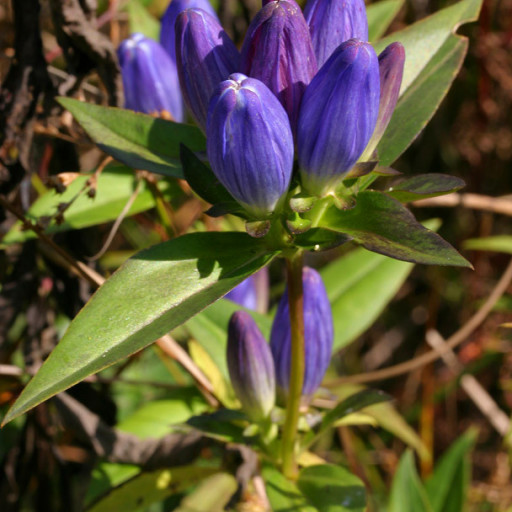
Plant Overview
The Bottle Gentian, or "Closed Gentian," is one of nature’s most peculiar mysteries. Unlike most flowers that unfurl to invite visitors, this North American native keeps its deep cobalt petals tightly furled in a permanent bud-like shape. It looks as though it is forever waiting for a grand opening that never comes, making it a sophisticated and secretive addition to any moist garden corner.
🔍 How to Identify
- 🗳️ The "Bottle" Flower: The flowers are 1–2 inches long, shaped like narrow bottles or cigars. They are typically a brilliant, deep violet-blue, though rare white versions exist.
- 🚫 Never-Opening Petals: The most distinct feature is that the petals stay fused at the top. If you see a blue bud that looks like it’s about to bloom for weeks but never does, you’ve found a Gentian.
- 🍃 Glossy Foliage: The leaves are smooth, lance-shaped, and arranged in opposite pairs along a sturdy, upright stem that can reach about 2 feet in height.
🏡 In Your Garden
- 💧 The "Wet Feet" Rule: In the wild, these plants thrive in wet prairies and fens. In your garden, they require consistently moist, rich soil. They are perfect candidates for rain gardens or near pond edges where other plants might get "drowned."
- 🛑 Look But Don't Touch: Bottle Gentians develop a deep, sensitive taproot. They are notoriously difficult to transplant once established, so choose their "forever home" carefully to avoid stressing the plant.
- ☀️ Light Balance: While they love water, they also need decent light to produce those vivid blue pigments. Dappled sunlight or morning sun with afternoon shade is their "sweet spot."
⚠️ Safety & Toxicity
- ✅ Safe for Humans: There are no known toxicities for humans, and various Gentian species have historically been used in herbal bitters.
- 🐾 Pet Friendly: The Bottle Gentian is generally considered non-toxic to cats and dogs. However, as with any ornamental plant, it’s best to discourage chewing to avoid mild stomach upset.
✨ Fun Fact
The Bottle Gentian is a "Bumblebee Gym." Because the flower is sealed shut, only the strong, heavy-set bumblebee is powerful enough to pry the petals apart and crawl entirely inside to reach the nectar. Smaller insects and honeybees simply aren't strong enough to "break into" the flower!

Detailed Care Instructions
To grow Gentiana Andrewsii, also known as bottle gentian, follow these steps:
- Location: Choose a suitable location that receives partial shade or filtered sunlight. The plant prefers cool temperatures and can tolerate some direct sunlight in the morning or late afternoon. Ensure the soil is moist and well-draining.
- Soil: Gentian plants prefer slightly acidic to neutral soil. Prepare the soil by adding organic matter such as compost or well-rotted manure to improve its fertility and drainage.
- Planting: Purchase Gentiana Andrewsii plants from a reputable nursery or start them from seeds. If using seeds, start them indoors in early spring. Transplant the seedlings or purchased plants to your garden after the last frost date. Space the plants about 1 to 2 feet apart to allow room for growth.
- Watering: Keep the soil consistently moist, as Gentiana Andrewsii thrives in damp conditions. However, do not overwater, as waterlogged soil can rot the roots. Water the plant deeply once or twice a week, providing enough water to reach the root zone.
- Mulching: Apply a layer of organic mulch, such as bark chips or straw, around the base of the plant. Mulching helps retain moisture, suppresses weed growth, and insulates the roots during colder months.
- Pruning: Trim off any dead or damaged leaves or stems as needed. Gentle pruning can be done after the flowering season to promote better growth and shape the plant. Leave the foliage intact in the fall to protect the plant during the winter.
- Fertilizer: Gentiana Andrewsii generally does not require heavy fertilization. However, you can apply a slow-release, balanced fertilizer in early spring to boost growth. Follow the package instructions for dosage and timing.
- Pests and Diseases: This plant is relatively resistant to pests and diseases. However, it can be susceptible to root diseases if the soil is too wet. Avoid overwatering and provide good air circulation around the plant to prevent fungal issues.
- Winter Care: Gentiana Andrewsii is quite hardy, but it may benefit from mulching with straw or leaves to protect the plant during cold winters. Remove the mulch in early spring when the temperatures start to warm up.
With proper care, Gentiana Andrewsii should thrive and provide beautiful blooms in late summer or early fall.

Place in a window with dappled sun or a spot in the middle of a room. Or directly in a window facing west or east.

Gentiana Andrewsii is a flowering plant that requires consistent and moderate watering. It is essential to avoid overwatering as it can lead to root rot and other fungal diseases. Generally, this plant should receive a moderate amount of water weekly, equivalent to about an inch of rainfall.
Before watering, always ensure the soil has already dried out. You can do this by sticking your finger into the soil to ensure it is dry at least an inch deep. The plant prefers well-draining soil, so avoid overwatering and draining the soil regularly to prevent waterlogging.
During warmer months or when the plant is in bloom, you may need to increase watering to ensure it doesn't experience drought stress. In contrast, during the dormancy period, you can reduce watering to encourage dormancy.
When watering, avoid getting water on the plant's leaves as this can promote fungal growth. Instead, aim to water the soil directly. You can also place a saucer under the pot to collect excess water and prevent it from sitting in the soil.
Overall, consistent and adequate watering is key to ensuring that your Gentiana Andrewsii plant thrives and blooms beautifully.
To encourage healthy growth and flowering of this plant, apply a balanced fertilizer in the early spring and again in mid-summer. Be sure to follow the instructions on the fertilizer package closely and avoid over-fertilizing, as this can cause damage to the roots. Additionally, consider incorporating organic matter into the soil to provide additional nutrients and improve soil fertility. Water the plant thoroughly after fertilizing to help the nutrients reach the root system.
The ideal soil for this plant is a moist, well-drained soil that is rich in organic matter. It requires a soil pH of between 4.0 and 7.5, and prefers a slightly acidic soil with a pH of about 6.0. The soil should be evenly moist but not waterlogged, as this can lead to root rot. A soil mix that contains peat moss, compost, and sand can provide the appropriate texture and nutrient content. It is also recommended to mulch around the base of the plant to help retain moisture in the soil.
Propagation of this plant can be achieved by using both sexual and asexual methods. For sexual propagation, the plant produces seeds that can be collected and sown in a suitable location. To ensure successful germination, the seeds should be sown in a mix of well-draining soil and sand with a pH level of around 5.5 to 6.5. The seeds should be sown at a depth of 1/8 inch and watered regularly until germination occurs, which can take several weeks.
For asexual propagation, the plant can be propagated through division or stem cuttings. Division involves separating the plant into smaller sections and replanting them in a suitable location. Stem cuttings can be taken from the plant during the growing season, and should be around 4-6 inches long with several leaves attached. The cuttings should be placed in a pot filled with a mix of soil and sand, and kept in a humid and warm environment until roots begin to develop, which can take several weeks. Once roots have formed, the new plants can be transplanted into a suitable location.
Regardless of the method used, it is important to ensure that the new plants are sited in a suitable location. This plant prefers a well-drained soil with high organic matter content, and requires a part-shade to full-sun location. Once established, the plants are relatively easy to care for and can make a great addition to any garden.








