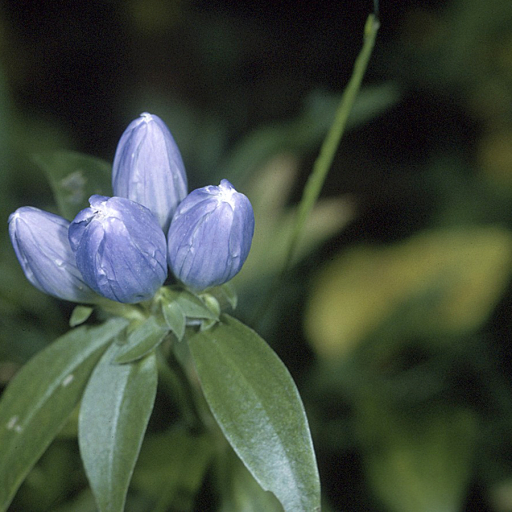
Plant Overview
Known as the Bottle Gentian or Closed Gentian, this wildflower is one of nature’s most charming mysteries. While most flowers unfurl their petals to signal pollinators, the Gentiana clausa keeps its vibrant blue blossoms tightly "zipped" shut, appearing as though it is forever about to bloom but never quite reaching the moment. It is a late-season gem that brings a rare, true-blue pigment to the cooling landscape of late summer and autumn.
🔍 How to Identify
- 🟦 The "Bottle" Bloom: The flowers are 1–2 inches long, shaped like elongated teardrops or bottles. They stay closed at the top, forming a tight cluster at the peak of the stem.
- 🌿 Smooth Foliage: Its leaves are glossy, lance-shaped, and arranged in neat, opposite pairs along a sturdy, unbranched stem.
- 🎨 Royal Hues: The petals are a striking shade of cobalt or violet-blue, often with subtle white or green pleats visible near the base of the "bottle."
🏡 In Your Garden
- 💧 The "Wet Feet" Rule: This plant is a specialist of moist environments. It is the perfect choice for rain gardens, pond edges, or low-lying spots in your yard where the soil stays consistently damp.
- 🪴 Taproot Sensitivity: Like many of its relatives, the Bottle Gentian grows a deep, stubborn taproot. This makes it very hardy against frost but means it absolutely hates being moved. Once you plant it, try to leave it in place for life.
- ☁️ Light Preferences: While it loves sun, it prefers "cool" sun. In hotter climates, it appreciates afternoon shade to prevent its leaves from scorching.
⚠️ Safety & Toxicity
- 🟢 Non-Toxic: This plant is generally considered safe for humans and is not listed as a major threat to pets.
- 👅 Bitter Defense: It contains high concentrations of "gentianin," one of the bitterest substances known in the plant world. While not poisonous, the extreme bitterness usually prevents kids, dogs, and even deer from taking more than one nibble.
✨ Fun Fact
Only the strongest survive here! Because the flower never opens, it relies almost exclusively on Bumblebees for pollination. The bee must be strong enough to use its head to pry the petals apart and crawl entirely inside the "bottle." If you watch closely, you can often see the flower wiggling as a bee struggles to find the nectar hidden deep within!

Detailed Care Instructions
To grow Gentiana Clausa plants, follow these steps:
- Choose a suitable location: Gentiana Clausa plants prefer well-draining soil and partial shade to full sun. Select a spot in your garden that receives sunlight for at least six hours a day.
- Prepare the soil: Gentiana Clausa plants prefer slightly acidic soil with a pH level of around 5.5 to 6.5. Before planting, amend the soil with organic matter like compost or peat moss to improve drainage and fertility.
- Planting: Dig a hole slightly larger than the root ball of your Gentiana Clausa plant. Place the plant in the hole, making sure that the crown (where the stems meet the roots) is level with the ground. Backfill the hole with soil, gently firming it around the plant.
- Watering: After planting, water the plant thoroughly to promote root establishment. Keep the soil consistently moist but not waterlogged throughout the growing season. Mulching around the base of the plant can help retain moisture and prevent weeds.
- Fertilizing: Gentiana Clausa plants do not require heavy fertilization. However, you can apply a balanced, slow-release fertilizer in spring, following the instructions on the packaging. Avoid over-fertilizing, as it may promote excessive leaf growth at the expense of flower production.
- Pruning: Remove any dead or damaged stems to maintain the plant's health and appearance. After the flowering season, you can cut back the stems to prevent self-seeding and promote bushier growth.
- Winter care: Gentiana Clausa plants are hardy perennials, but they may need protection during harsh winter conditions. Apply a layer of mulch around the base of the plant in late fall to insulate the roots against frost.
- Propagation: Gentiana Clausa plants can be propagated through seed or division. Collect mature seeds in late summer, sow them in well-draining soil, and keep them in a cool and shaded area until germination. Division can be done in spring or fall by carefully separating the plant into smaller clumps, ensuring each section has roots attached.
By following these steps, you can grow healthy and beautiful Gentiana Clausa plants in your garden.

Place in a bright room that is sun drenched almost all day. Or directly in a south-facing window.

To properly water Gentiana Clausa, it is important to first understand its habitat and natural environment. This plant thrives in moist, cool, and well-draining soil conditions, typically found in mountainous regions.
When watering this plant, it is recommended to use room temperature and distilled water to prevent any pH imbalances in the soil. It is crucial to allow the soil to dry slightly between waterings to avoid waterlogging the plant's roots.
One effective method is to water the plant deeply and thoroughly until the excess water runs out of the drainage holes at the bottom of the pot. Any excess water should be immediately drained to avoid standing water.
Additionally, it is important to avoid getting water on the foliage, as this can increase the risk of fungal infections and diseases. For best results, water Gentiana Clausa in the morning or early afternoon to allow time for any excess water on the foliage to evaporate before sunset.
- Choose a well-drained soil that is rich in organic matter.
- Before planting, add a slow-release fertilizer to the soil.
- During the growing season, fertilize with a balanced fertilizer every four to six weeks.
- If the plant appears to be suffering or not growing well, apply a foliar fertilizer directly to the leaves.
- Water the plant well after each fertilization to ensure the nutrients are absorbed by the roots.
- Avoid over-fertilizing, as this can lead to nutrient burn and damage to the plant.
- During the dormant season, withhold fertilizer to allow the plant to rest.
The soil that is ideal for Gentiana Clausa plant should be well-draining and slightly acidic. It should have a pH range between 5.5 to 6.5. The best soil mixture for this plant is a combination of sand, perlite, and organic matter like peat moss or compost. This type of soil will provide good aeration and drainage while retaining enough moisture for the plant's roots to thrive. Additionally, the soil should be free from any contaminants such as pesticides or fertilizers as this plant is sensitive to harsh chemicals.
To propagate this specific plant, you will need to take softwood stem cuttings in the spring or early summer. Cut a 4- to 6-inch stem, making sure it has at least one or two leaves. Remove the lower leaves and dip the cut end in hormone rooting powder. Plant the stem cutting in a pot filled with moist, well-draining soil and cover with a plastic bag to create a humid environment. Keep the cutting in a bright, indirect light and mist it regularly. After a few weeks, roots should begin to grow and you can remove the plastic bag. Once the plant has established roots, you can transplant it to a larger pot or into the garden.








