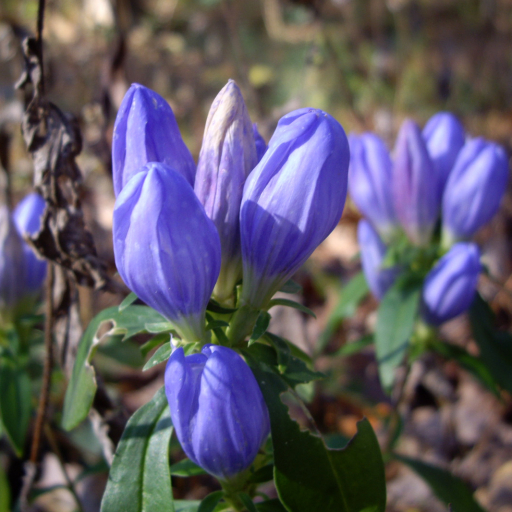
Plant Overview
Often called "Harvestbells" because it signals the arrival of autumn, Gentiana saponaria is a late-season gem native to the moist woodlands and marshes of the Eastern United States. Its species name comes from its leaves, which strikingly resemble those of the Soapwort plant, but its true glory lies in its brilliant, indigo "bottle" flowers. These blooms appear as if they are perpetually waiting to pop open, holding their nectar like a secret for only the strongest visitors.
🔍 How to Identify
- 🌸 The "Bottle" Bloom: The flowers are deep blue to violet and shaped like a closed umbrella; they rarely fully open, remaining "pinched" at the top even at peak maturity.
- 🍃 Soap-like Foliage: The smooth, lance-shaped leaves grow in pairs directly opposite each other along the stem, possessing a waxy sheen.
- 📏 Growth Habit: This perennial typically grows in clumps, reaching 1 to 2 feet in height, often arching gracefully toward the ground.
🏡 In Your Garden
- 💧 Moisture Seeker: This plant thrives in "feet-wet" conditions. It is an ideal candidate for rain gardens or the edges of a pond where the soil stays consistently damp and acidic.
- 🐝 Bumblebee Gym: Because the petals stay mostly closed, only heavy-duty pollinators like large bumblebees have the strength to force their way inside. Watching a bee disappear into the flower and "pry" it open is a delight for nature observers.
⚠️ Safety & Toxicity
- ✅ Low Risk: Gentiana saponaria is generally considered non-toxic to humans and common household pets like dogs and cats.
- 👅 Bitter Defense: Like many in the Gentian family, the plant contains gentiopicrin, an intensely bitter compound. This bitterness acts as a natural deterrent, making it largely deer-resistant and unappealing to curious nibblers.
✨ Fun Fact
In the Victorian "Language of Flowers," Gentians represented "Intrinsic Worth." Because the flower stays closed, it was seen as a symbol of beauty and value that resides on the inside, hidden from the superficial gaze.

Detailed Care Instructions
To grow Gentiana Saponaria plants, you can follow these steps:
- Choose a suitable planting location: Gentiana Saponaria plants prefer full sun to partial shade and well-draining soil. They also require a cool environment, so select a spot with a temperature range of 55-75°F (13-24°C).
- Prepare the soil: Gentiana Saponaria plants thrive in slightly acidic to neutral soil with a pH between 5.5 and 7.0. Improve the soil drainage by adding organic matter such as compost or peat moss. Avoid heavy clay soils.
- Select healthy plants or seeds: You can either purchase already-started plants from a nursery or grow them from seeds. If starting from seeds, follow the instructions on the seed packet for best results.
- Planting:
- For seeds: Sow the seeds in small containers filled with seed-starting mix. Press them lightly into the soil and cover with a thin layer of soil. Keep the soil consistently moist but not waterlogged. Transplant the seedlings to the garden once they have established and the appropriate size.
- For plants: Dig a hole slightly wider and deeper than the plant's root ball. Place the plant in the hole and fill in with soil. Gently firm the soil around the plant.
- For seeds: Sow the seeds in small containers filled with seed-starting mix. Press them lightly into the soil and cover with a thin layer of soil. Keep the soil consistently moist but not waterlogged. Transplant the seedlings to the garden once they have established and the appropriate size.
- Watering: Keep the soil consistently moist but not waterlogged. Water the plants deeply once or twice a week, depending on the weather and soil conditions. Avoid overhead watering, as it can lead to fungal diseases.
- Mulching: Apply a layer of organic mulch around the plants to help retain soil moisture, prevent weed growth, and maintain a cool root environment. Avoid placing mulch directly against the plant's stem to prevent rot.
- Fertilizing: Gentiana Saponaria plants generally do not require heavy fertilization. However, you can apply a balanced, slow-release fertilizer in spring or use a diluted liquid fertilizer every few weeks during the growing season.
- Pruning: After flowering, cut back any spent flowers or damaged foliage. This will help maintain the plant's overall appearance and health.
- Winter care: Gentiana Saponaria plants are typically hardy perennials, but they may need protection in colder regions. Apply a thick layer of mulch around the plant's base in late fall to insulate the roots.
By following these guidelines, you can successfully grow Gentiana Saponaria plants and enjoy their beautiful blooms.

Place in a bright room that is sun drenched almost all day. Or directly in a south-facing window.

Gentiana Saponaria is a stunning plant with deep green foliage and beautiful, vibrant flowers. When watering this plant, it is important to take into account its specific needs in order to ensure its health and longevity.
First, it is important to note that Gentiana Saponaria is a moisture-loving plant. This means that it requires frequent watering, particularly during the active growing season. However, it is important not to over-water the plant, as this can lead to root rot and other problems.
When watering Gentiana Saponaria, it is best to use a watering can or hose with a gentle, even flow. Avoid using a high-pressure spray, which can damage the delicate foliage and flowers. Water the plant thoroughly, making sure that the soil is evenly moist but not saturated.
It is also important to ensure that the soil around the plant has good drainage, as standing water can also be harmful. Check the soil regularly to make sure that it is not waterlogged, and if necessary, add organic matter or perlite to improve drainage.
During periods of hot, dry weather, it may be necessary to water Gentiana Saponaria more frequently to prevent the soil from drying out. However, be careful not to let the soil become too wet during these times, as this can also cause problems.
Overall, watering Gentiana Saponaria requires a delicate balance of providing enough moisture without over-watering. By taking the time to understand the plant's specific needs and monitoring the soil regularly, you can help ensure that your Gentiana Saponaria thrives and continues to provide stunning beauty for years to come.
To provide proper nutrients for the Gentiana Saponaria plant, you should apply a balanced fertilizer with a NPK ratio of 10-10-10. Apply the fertilizer once in early spring and again in mid-summer. Use a light hand to avoid burning the plant, and ensure you water the plant thoroughly after fertilization to prevent the fertilizer from burning the roots. Additionally, you can add organic matter to the soil to provide a slow-release source of nutrients for the plant.
The ideal soil for Gentiana Saponaria should be well-draining and slightly acidic with a pH between 5.5 to 6.5. It should be rich in organic matter and nutrients, but not excessively fertile. A mixture of loam and sand with some peat moss or leaf mold added can provide the right texture and structure for the roots to grow and spread out. The soil should be moist but not waterlogged, and the plant should not be allowed to sit in standing water. Providing some shade or protection from strong sunlight can also help the plant thrive in certain climates.
Propagation of this plant can be done through several methods including division, stem cuttings, and seed propagation. Division involves separating the roots of an established plant into smaller sections and planting them in individual pots or in the ground. Stem cuttings can be taken from the tips of the plant and planted in a well-draining soil medium to form new roots. Seed propagation involves harvesting seeds from the plant and sowing them in a seed-starting mix and ensuring that they receive adequate moisture, light, and warmth to germinate. Once the seedlings have grown big enough, they can be transplanted into larger pots or into the ground. It is important to note that this plant prefers well-draining soil and cooler temperatures and requires regular watering during the growing season.








