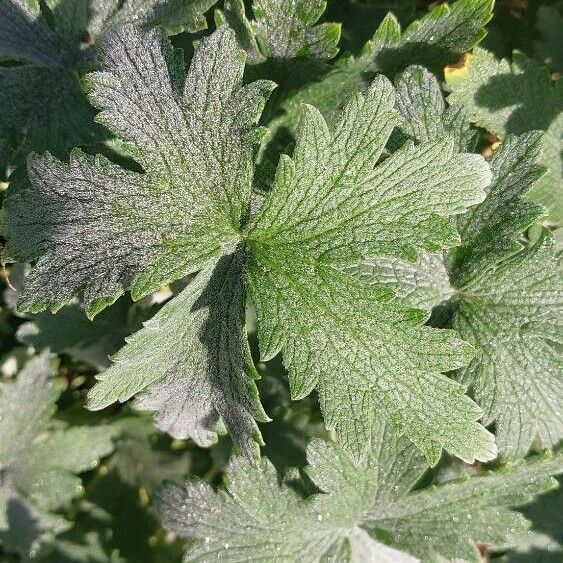
Plant Overview
Often called the "Pretty Cranesbill," Geranium pulchrum is a stunning mountain-dweller hailing from the high-altitude slopes of South Africa. Unlike the common bedding "geraniums" (which are technically Pelargoniums), this is a true Geranium that forms a lush, silvery shrub. It is beloved by collectors for its shimmering foliage that looks as though it has been dusted with moonlight.
🔍 How to Identify
- 🌿 Silvery Foliage: The most striking feature is the deeply lobed leaves covered in fine, silky white hairs. This gives the entire plant a metallic, grey-green sheen that stands out in any landscape.
- 🌸 Veined Blooms: It produces clusters of five-petaled flowers ranging from soft pink to vibrant magenta. If you look closely, you’ll see delicate, darker veins radiating from the center, acting as "landing strips" for pollinators.
- 🌳 Woody Structure: Unlike many low-growing Cranesbills, this species develops a semi-woody base and grows into a rounded, upright bush that can reach up to three feet in height.
🏡 In Your Garden
- ⛰️ Mountain Roots: Because it originates from rocky mountain slopes, this plant demands exceptional drainage. It thrives in gritty, sandy soil and will struggle in heavy clay that stays wet during the winter.
- ☀️ Light & Color: The silver hairs on the leaves are a natural sunscreen. To maintain its bright, metallic luster, it needs a position in full sun; in too much shade, the plant loses its "glow" and becomes leggy.
- ✂️ Pruning Nuance: It is best to prune lightly after the main flowering flush. Avoid cutting back into old, hard wood too drastically, as it may be slow to regenerate from the base.
⚠️ Safety & Toxicity
- 🐾 Mild Caution: While true Geraniums are generally safer than Pelargoniums, they contain essential oils like geraniol that can cause digestive upset or skin irritation in curious cats and dogs if consumed in large amounts.
- 👶 Child Friendly: It is considered non-toxic to humans. The soft, fuzzy texture of the leaves is often a favorite for "sensory gardens," though the scent when crushed can be quite pungent.
✨ Fun Fact
The common name "Cranesbill" refers to the plant's unusual seed pod. After the flower fades, the remaining structure elongates into a sharp, pointed shape that looks exactly like the long beak of a crane. When the seeds are ripe, this "beak" acts like a spring, catapulting the seeds away from the mother plant!

Detailed Care Instructions

Place in a bright room that is sun drenched almost all day. Or directly in a south-facing window.

Some plants require more regular watering than others, which should be done every few days. It's critical to maintain the soil moist all of the time. The water requirements of the same plant placed in pots with varying sizes will differ. Because the water in the smaller pot evaporates faster than the water in the larger pot, it will require more watering. Regardless of pot size, the surface should constantly be maintained moist.







