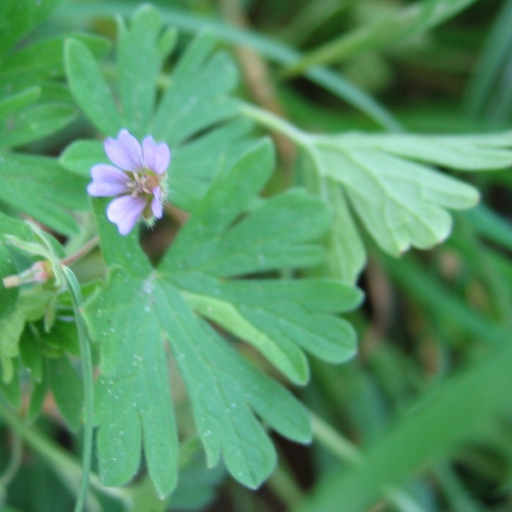
Plant Overview
Often called the Small-flowered Crane’s-bill, this modest traveler is a master of blending in. Its Latin name, pusillum, translates to "very small," which perfectly captures the essence of its delicate, lilac-tinted blooms. While some gardeners might dismiss it as a mere weed, this hardy wildflower acts as a vital early-season banquet for tiny solitary bees and hoverflies.
🔍 How to Identify
- 🌸 The "Micro" Bloom: The flowers are exceptionally tiny (only about 5mm across), with five pale violet or pink petals that are deeply notched at the tips, making each petal look like a miniature heart.
- 🍃 Rounded Foliage: The leaves are circular in outline but deeply divided into 5 to 9 lobes; they are covered in soft, fine hairs that give the plant a velvety, grayish-green appearance.
- 📏 Sprawling Habit: Unlike its taller cousins, this geranium tends to hug the ground, sending out stems that radiate from a central point to form a low-growing mat.
🏡 In Your Garden
- 🌱 The Opportunist: This plant loves "disturbed" ground. If you’ve recently tilled a bed or have a gravel driveway, the Small-flowered Crane’s-bill will likely be the first to move in. It thrives in well-drained, sandy soils where competition is low.
- ☀️ Explosive Seeds: It has a fascinating way of spreading; when the "beak" (the seed pod) dries out, it acts like a spring-loaded catapult, flinging seeds several feet away to ensure the next generation finds a fresh patch of dirt.
⚠️ Safety & Toxicity
- 🐾 Pet Friendly: Generally, Geranium pusillum is considered non-toxic to dogs, cats, and horses. It lacks the essential oils found in scented "Pelargoniums" that can sometimes cause skin irritation.
- 👶 Kid Safe: There are no known toxic properties for humans, though its fuzzy stems can occasionally trap dust or pollen, which might bother those with high hay fever sensitivity.
✨ Fun Fact
The name "Crane's-bill" refers to the long, pointed seed pod that remains after the flower drops. It looks exactly like the long beak of a crane, a feature that helped botanists name this entire family of plants centuries ago!

Detailed Care Instructions
To grow Geranium pusillum plants, follow these steps:
- Choose a location: Geranium pusillum plants thrive in full sun to partial shade. Select a spot in your garden that gets at least 6 hours of sunlight each day.
- Prepare the soil: Geranium pusillum prefers well-draining soil. Till the soil to a depth of 8-10 inches and remove any rocks or debris. Add compost or organic matter to improve the soil's fertility and drainage.
- Planting seeds: Geranium pusillum can be propagated from seeds. Sow the seeds directly into the prepared soil, providing enough space between each seedling to allow for growth. Lightly cover the seeds with soil, about 1/4 inch deep. Water gently but thoroughly.
- Watering: Regular watering is important for the establishment of Geranium pusillum. Water the plants immediately after planting and then provide regular irrigation, maintaining moist soil without overwatering. Avoid waterlogged conditions, as it may lead to root rot.
- Fertilization: Apply a balanced, slow-release fertilizer once a month during the growing season to promote healthy growth. Follow the package instructions for application rates.
- Mulching: Place a layer of organic mulch around the base of the plants to help retain moisture, regulate soil temperature, and prevent weed growth. Keep the mulch a few inches away from the plant stems to avoid stem rot.
- Pruning: Regularly prune Geranium pusillum to encourage bushier growth and maintain its shape. Pinch back the stems and remove any dead or diseased branches. This will also help promote more flowering.
- Pest and disease control: Keep an eye out for common pests such as aphids, spider mites, and whiteflies. If any infestation occurs, treat the plants with appropriate insecticides or natural remedies. Avoid overhead watering to prevent fungal diseases.
- Winter care: Geranium pusillum is a perennial plant, but it is not very cold hardy. If you live in a region with freezing winters, consider providing winter protection by covering the plants with mulch or moving them indoors.
By following these steps, you can successfully grow Geranium pusillum plants and enjoy their beautiful flowers throughout the growing season.

Place in a bright room that is sun drenched almost all day. Or directly in a south-facing window.

To water this type of plant, it is recommended to keep the soil moist but not waterlogged. It is important to water the plant at the base, avoiding getting the foliage wet, as this can promote disease. The frequency of watering will depend on various factors such as the size of the plant, the pot size, and the level of humidity in the environment. It is suggested to check the soil regularly by sticking your finger into the soil to check for moisture levels. If the soil feels dry to the touch, it is time to water. When watering, it is best to use room temperature water, and avoid letting the plant sit in standing water. During periods of high heat or low humidity levels, it may be necessary to increase watering frequency to prevent drying out.
To fertilize Geranium Pusillum plant, mix a balanced fertilizer with equal parts of nitrogen, phosphorus, and potassium. Use a liquid or water-soluble fertilizer, and apply it to the soil once a month during the growing season. Use a tablespoon of fertilizer per one-gallon pot size. Ensure that the soil is moist before applying the fertilizer. Avoid fertilizing during the plant's dormancy period.
Geranium pusillum is a plant that prefers a well-draining soil with a slightly acidic pH level. The soil should be rich in organic matter and have good moisture retention properties to ensure proper hydration of the plant. It is recommended to use a mixture of peat moss, perlite, and coarse sand to achieve the ideal soil type for this plant. It is important to avoid heavy, compacted soils as they can suffocate the roots and hinder plant growth. Additionally, it is important to maintain proper drainage to prevent any pooling of water around the plant roots which can lead to root rot and other diseases.
To propagate this plant, you will need to take stem cuttings. Select a healthy stem that is at least a few inches in length and has a few sets of leaves. Use sharp, clean scissors or pruning shears to make a clean cut just below a node (where leaves grow from the stem).
Remove any lower leaves from the stem, leaving only one or two sets of leaves at the top. Dip the cut end into a rooting hormone powder or gel, which will help promote root growth. Then, plant the cutting into a pot filled with well-draining potting soil. Water the soil lightly, and cover the pot with a plastic bag to create a mini greenhouse environment for the cutting.
Place the pot in a bright, indirect light location, and keep the soil moist but not waterlogged. After a few weeks, check for signs of new growth, which indicate that the cutting has rooted successfully. You can then remove the plastic bag and continue to care for the new plant as you would a mature Geranium Pusillum.








