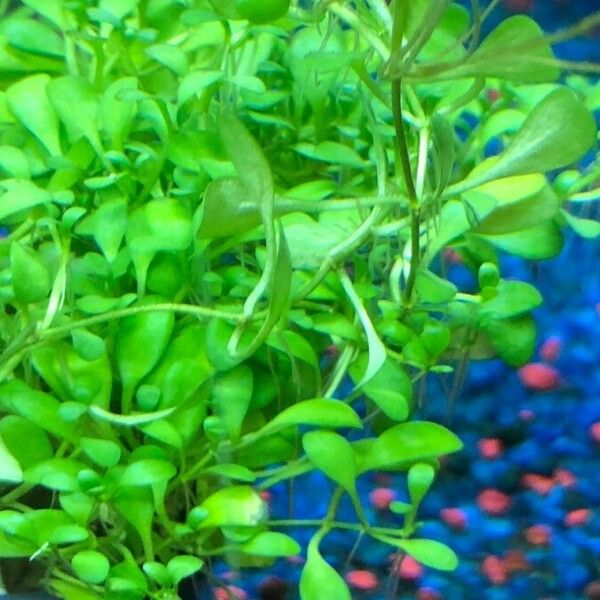
Plant Overview
Often called simply "Glosso," this Australian native is the holy grail for aquarium enthusiasts looking to create a lush, rolling green meadow underwater. It was popularized by the legendary aquascaper Takashi Amano, who used it to redefine the "Nature Aquarium" style. While it looks like a soft moss from afar, it is actually a tiny, flowering plant that grows with impressive speed when its high demands are met.
🔍 How to Identify
- 🍃 Leaf Shape: Small, bright green leaves shaped like tiny paddles or "spatulas." They usually grow in opposite pairs along a very thin, creeping stem.
- 📏 Growth Habit: It is a prostrate (low-growing) plant. In ideal conditions, it stays under 1 inch tall, spreading horizontally to form a dense mat.
- 🌱 The "Reach": If the plant isn't getting enough light, it will abandon its carpet form and start growing vertically, looking more like a tiny beanstalk than a meadow.
🏡 In Your Garden (Aquarium)
- 💡 The Light Struggle: Glosso is a notorious "light hog." To keep it from growing tall and leggy, it requires intense illumination. This mimics its natural habitat in shallow, sun-drenched marshes and riverbanks.
- 🧪 Fueling the Carpet: Because it grows so rapidly, it requires supplemental CO2 and a nutrient-rich substrate. Without these, the leaves will quickly turn yellow (chlorosis) and the carpet will thin out.
- ✂️ Pruning Nuance: It can grow so quickly that it begins to grow on top of itself. Regular trimming is essential; if the top layer gets too thick, it will shade the bottom layer, causing the entire carpet to "lift" off the soil and float away.
⚠️ Safety & Toxicity
- 🐾 Pet Safety: Completely safe for fish, shrimp, and snails. In fact, it provides a vital playground and hiding spot for tiny shrimplets and fry.
- 👶 Human Safety: Non-toxic to humans. However, as an aquatic plant, it can sometimes harbor water-borne bacteria, so always wash your hands after maintenance.
✨ Fun Fact
The name "Glossostigma" is derived from the Greek words glossa (tongue) and stigma, referring to the unique, tongue-like shape of the female part of its tiny, white flowers that occasionally bloom when the plant grows above the water line.

Detailed Care Instructions
To successfully grow Glossostigma Elatinoides (also known as Glosso), you can follow these steps:
- Lighting: Provide the plant with bright lighting. Use a light fixture that produces at least 2 watts per gallon of water. Ensure that the light is evenly distributed across the tank to avoid shaded areas.
- Substrate: Use a fine-grained substrate like aquasoil or sand. Glosso needs a nutrient-rich substrate to grow well. The substrate should be around 2-3 inches deep to allow roots to anchor properly.
- CO2 Injection: Carbon dioxide (CO2) injection is recommended for optimum growth. Glosso is a demanding plant that benefits from a consistent supply of CO2. Use a CO2 system to add carbon dioxide to the water.
- Nutrient Supplement: Glosso requires regular nutrient supplementation. You can use a liquid fertilizer specifically designed for aquarium plants or root tabs containing essential nutrients. Follow the product instructions for dosage and frequency.
- Water Parameters: Maintain stable water parameters. Glosso prefers slightly acidic to neutral water with a pH range of 6.5-7.5. The temperature should be kept between 72-82°F (22-28°C). Ensure proper filtration and water circulation to prevent stagnant water.
- Planting: Before planting Glosso, trim the plant's roots and remove the rockwool or cotton surrounding its base. Divide the main plant into several small portions and plant them 1-2 cm apart in the substrate using tweezers. Place each portion horizontally on the substrate, ensuring good contact with the substrate.
- Maintenance: Regularly trim Glosso to promote horizontal growth and prevent it from growing too tall. This will help create a dense carpet effect. Maintain good water quality by performing regular water changes and removing any decaying leaves or debris.
- Patience: Be patient, as Glosso is a slow-growing plant. It can take several weeks for it to fully establish and spread. Ensure that you provide consistent care to encourage healthy growth.
Following these steps should help you grow a beautiful carpet of Glosso in your aquarium.

To water this plant, it is best to use a watering can or a gentle stream of water. Do not pour the water directly onto the leaves, but rather pour it around the base of the plant. It is important to ensure that the soil is evenly moist, but not waterlogged. Allow the top layer of soil to dry out slightly before watering again. It is recommended to water this plant every 2-3 days, depending on the climate and humidity.
To fertilize this plant, use a specialized aquarium fertilizer with a high concentration of macro and micronutrients. It is important to adjust the dosage according to the size of the aquarium and the plant's growth rate. Ideally, fertilize once or twice a week after a water change, distributing the fertilizer evenly throughout the aquarium. Be mindful not to over-fertilize as it can lead to algae growth and harm other aquatic organisms.
The best type of soil to use with this particular plant is one that is rich in nutrients, but also has good drainage. It should not be too compacted or dense, as this can prevent the roots from spreading out properly and can also lead to waterlogging. It can also benefit from having some organic matter added to it, such as leaf litter or compost, to help provide additional nutrients. A pH range of between 6 and 7 is ideal for this plant. Overall, it is important to choose a soil that will provide the right balance of nutrients, drainage, and texture to support healthy growth.
Glossostigma Elatinoides plant can be propagated by two different methods, namely vegetative propagation and sexual propagation. In vegetative propagation, individual plantlets can be separated from the mother plant and planted separately to grow into independent plants. This method is particularly useful for creating a mass of Glossostigma Elatinoides in a confined area.
To propagate Glossostigma Elatinoides through vegetative propagation, first, select a healthy and mature mother plant from which individual plantlets can be separated. Once the mother plant is identified, carefully remove the rooted runners and carefully cut each individual plantlet from the mother plant. Make sure to leave enough roots on the individual plantlet to ensure it can survive on its own. Once the individual plantlet is separated, it can be transplanted into a new area where it can establish itself as an independent plant.
In sexual propagation, the Glossostigma Elatinoides plant reproduces by releasing seeds that can grow into new plants. This method is more time-consuming and requires more patience than vegetative propagation. In order to propagate Glossostigma Elatinoides through sexual propagation, it is important to let the plant flowers.
Once the flowering process is complete, you can collect the seeds that are produced. Spread the seeds in a tray filled with potting soil, and keep the tray moist and in a warm place. After a few weeks, the seeds will sprout and grow into new plants.
Overall, both methods of propagation can be effective ways to increase the number of Glossostigma Elatinoides plants in your collection. However, vegetative propagation tends to be a faster and more efficient method for increasing the number of plants in a single area.








