Plant Overview
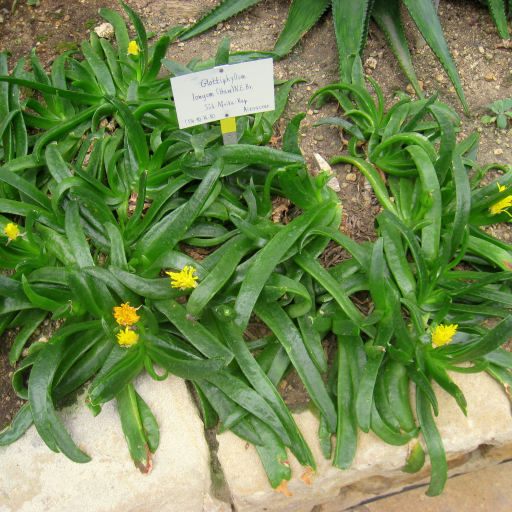
Often called the Long Tongue Plant or simply Tongue-leaf, Glottiphyllum longum is a quirky, low-growing succulent native to the dry regions of South Africa. Its name is derived from the Greek words glotta (tongue) and phyllon (leaf), perfectly describing its fleshy, strap-like appearance. It is a favorite among collectors for its "creeping" personality and its habit of producing surprisingly large, brilliant yellow flowers that look like fallen stars.
🔍 How to Identify
- 👅 The Leaves: Long, flat, and tongue-shaped. They are bright green, very fleshy, and usually grow in pairs, often overlapping in a messy, sprawling heap.
- 🌼 Golden Blooms: It produces large, daisy-like yellow flowers that can almost hide the plant itself. Interestingly, these flowers typically open in the afternoon and close at dusk.
- 📏 Growth Habit: This is a "prostrate" grower, meaning it crawls along the ground rather than growing tall. Over time, it forms a dense, succulent mat that spills beautifully over the edges of containers.
🏡 In Your Garden
- 🏜️ The "Less is More" Rule: Because it hails from the arid Eastern Cape, this plant has adapted to survive in poor, rocky soil. If you give it soil that is too rich or moist, it will become "bloated" and lose its compact, tongue-like shape.
- 🧤 Brittle Nature: Be careful when repotting! The leaves of the Long Tongue Plant are surprisingly brittle and can snap off with a crisp "pop" if handled roughly. It is best to place it in a permanent spot where it won’t be bumped by foot traffic.
- ☀️ Light Seekers: To keep the leaves vibrant and ensure those golden flowers appear, it needs bright light. In lower light, the "tongues" will stretch out and become pale, a sign that the plant is searching for the sun.
⚠️ Safety & Toxicity
- ✅ Non-Toxic Status: Glottiphyllum longum is generally considered non-toxic to humans and common household pets like cats and dogs.
- 🐕 Pet Precautions: While it isn't poisonous, the leaves are very watery and crunchy, which might tempt a curious puppy to use it as a chew toy. Eating large amounts of any succulent can still cause a mild stomach upset or a messy cleanup for the owner.
✨ Fun Fact
The Glottiphyllum family is famous for being "opportunistic growers." Unlike many plants that have strict growing seasons, these succulents will happily grow whenever they receive water and warmth, regardless of the time of year!

Detailed Care Instructions
Here are some tips on how to grow Glottiphyllum Longum plant:
- Choose the right location: Glottiphyllum Longum prefers bright, indirect sunlight. Place it near a window where it can receive bright, filtered light.
- Planting medium: Use fast-draining soil for Glottiphyllum Longum. A soil mix made with sandy soil and perlite or pumice works well. It should be well-draining to prevent waterlogged roots.
- Watering: Glottiphyllum Longum plants are drought-tolerant and prefer to dry out slightly between waterings. Wait until the soil is completely dry before watering again. Overwatering can lead to root rot.
- Temperature and humidity: Glottiphyllum Longum prefers average room temperatures between 65-75°F (18-24°C). It can tolerate slightly cooler temperatures but should be protected from frost. It does well in average household humidity, but appreciates some occasional misting during hot, dry periods.
- Fertilizer: Feed Glottiphyllum Longum every two to three weeks during the growing season (spring and summer) with a balanced houseplant fertilizer diluted to half strength. Reduce or stop fertilizing in winter when the plant is resting.
- Propagation: Glottiphyllum Longum can be propagated through stem cuttings or by division. To propagate through stem cuttings, let the cut ends callus over for a few days, then plant them in a well-draining soil mix. For division, carefully separate the offsets from the main plant and plant them in their own pots.
- Pruning: Remove any dead or yellowing leaves to keep the plant looking neat and healthy. Glottiphyllum Longum can also be pruned to control its size or shape.
Remember to monitor your plant regularly for any signs of pests or diseases. Treat any issues promptly to keep your Glottiphyllum Longum plant thriving.

Place in a bright room that is sun drenched almost all day. Or directly in a south-facing window.

The best way to water this plant is to ensure that the soil is completely dry before watering again. It is recommended to water deeply but infrequently, allowing excess water to drain away from the roots. Overwatering can lead to the root system becoming waterlogged, which can cause the plant to rot. When watering, apply water directly to the soil and avoid getting water on the leaves or stem. This plant prefers well-draining soil that is rich in nutrients, and it benefits from regular fertilization during the growing season.
- Choose a fertilizer with a high nitrogen concentration to promote healthy foliage growth.
- Dilute the fertilizer to half strength and apply it to the soil around the base of the plant.
- Water the plant thoroughly after fertilizing to ensure the nutrients are absorbed by the roots.
- Fertilize once a month during the growing season (spring and summer) and reduce frequency to once every two months during the dormant season (fall and winter).
- Watch for signs of overfertilization such as leaf burn or stunted growth, and adjust your fertilization schedule accordingly.
The Glottiphyllum Longum plant is best grown in well-draining soil that is rich in organic matter. The soil should be slightly acidic with a pH level between 6 and 6.5. It is recommended to use a mixture of sandy loam and peat moss along with perlite or vermiculite to improve drainage. The soil should also contain a balanced mix of nutrients such as nitrogen, phosphorus, and potassium to support the plant's growth. Regular fertilization is recommended using a balanced NPK fertilizer or a specialized succulent/cactus fertilizer. It is important to avoid overwatering the plant and allow the soil to dry out completely between watering sessions to prevent root rot.
To propagate this plant, you will need to carefully select a healthy mother plant with robust leaves that are not damaged or diseased. Once you have selected your mother plant, you can take a cutting by gently removing a stem or leaf cutting from the main plant.
Next, you should allow the cutting to dry out for a few days to prevent the risk of rotting. Once it has dried out, you can plant it in well-draining soil and provide it with plenty of sunlight and water.
It is essential to be patient during the propagation process, as it can take several weeks for the cutting to take root and establish a new plant. However, with the right conditions and care, your new plant can thrive and grow into a beautiful specimen.








