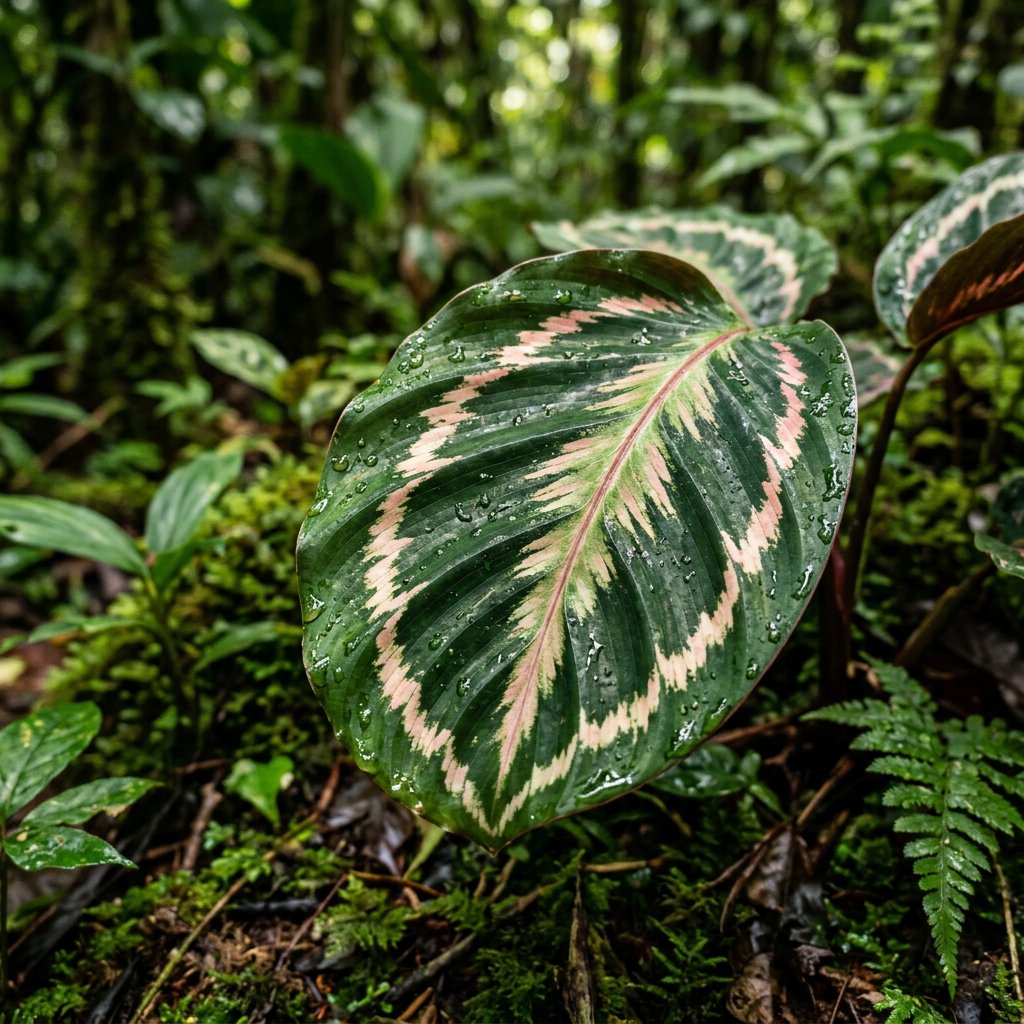
Plant Overview
Often called the "Rose-painted Calathea," Goeppertia roseopicta is a true crown jewel of the Amazonian rainforest. This plant is a "living artwork," boasting leaves that look as if they were hand-painted with intricate pink brushes. As a member of the Marantaceae family, it is a "Prayer Plant," meaning it performs a graceful dance every day, lifting its leaves toward the heavens as the sun sets.
🔍 How to Identify
- 🍃 The Leaf Pattern: Broad, rounded leaves featuring a dark emerald center surrounded by a striking inner border of rosy pink or creamy white.
- 🎨 The Underside: If you flip a leaf over, you’ll find a stunning contrast of deep burgundy or royal purple—a natural adaptation to capture low-intensity light on the forest floor.
- 📏 Growth Habit: It grows in a compact, bushy clump, rarely exceeding 20 inches in height, making it an ideal statement piece for a bookshelf or side table.
🏡 In Your Garden
- ☁️ Humidity is Essential: Coming from the humid tropics, this plant will protest with "crispy" brown leaf edges if the air is too dry. It thrives best when grouped with other plants or placed near a humidifier.
- 💧 Water Sensitivity: This species is a bit of a "diva" regarding tap water. It is sensitive to chlorine and fluoride, which can cause chemical burns on the foliage. It much prefers rainwater or distilled water.
- ⛅ The "Dappled Sun" Rule: In the wild, it lives under a thick tree canopy. Direct sunlight will bleach its vibrant pink patterns and scorch the leaves, so keep it in bright, indirect light.
⚠️ Safety & Toxicity
- 🐾 Pet Friendly: Good news for furry friends! Goeppertia roseopicta is non-toxic to cats and dogs.
- 👶 Child Safe: It is also completely safe for curious children, though its delicate leaves are easily bruised by rough handling.
✨ Fun Fact
The movement of its leaves is called nyctinasty. A specialized "joint" called a pulvinus, located at the base of the leaf, changes pressure throughout the day. This allows the plant to follow the sun to maximize photosynthesis and then fold up at night to conserve moisture!

Detailed Care Instructions
| Humidity | High |
| Lighting | Part Sun |
| Toxicity | Non-Toxic |
| Difficulty | Medium |
| Hibernation | Cold Period |
| Temperature | 18°C - 25°C |
| Hardiness Zones | 10A - 11B |
To grow a Goeppertia Roseopicta plant, also known as a Calathea plant, there are several steps you can follow:
- Choose a suitable location: Calathea plants prefer bright indirect light. Avoid placing them in direct sunlight, as it can scorch their leaves. They also thrive in moderate humidity, so consider placing a small humidifier nearby or grouping them with other plants.
- Provide the right temperature: These plants prefer temperatures between 60-75°F (15-24°C). Avoid exposing them to cold drafts or sudden temperature changes.
- Use well-draining soil: Choose a well-draining potting mix that retains some moisture but doesn't become waterlogged. A mix of peat moss, perlite, and potting soil can be suitable.
- Water properly: Water your Calathea plant when the top inch of soil feels dry. Avoid overwatering, as this can cause root rot. Ensure proper drainage by placing a saucer or tray beneath the pot.
- Maintain high humidity: Mist the leaves regularly to increase humidity around the plant. Alternatively, you can place the pot on a tray filled with water and pebbles, ensuring the water level doesn't touch the bottom of the pot.
- Fertilize occasionally: During the growing season (spring and summer), feed your Calathea plant with a balanced, water-soluble fertilizer once a month. Dilute the fertilizer to half the recommended strength.
- Prune and remove yellow leaves: Regularly remove any yellow or dead leaves from your Calathea plant to promote healthy growth.
- Repot when needed: Calathea plants may require repotting every 1-2 years to provide fresh soil and space for root growth. Choose a pot that is slightly larger than the current one and use fresh potting soil.
By following these steps, you can provide a conducive environment for your Goeppertia Roseopicta plant to thrive and grow.

Place in a window with dappled sun or a spot in the middle of a room. Or directly in a window facing west or east.

To water this plant, you should check the moisture level of the soil by sticking your finger about 1-2 inches deep into the soil. If it feels dry, it's time to water. Use room temperature water and pour it slowly into the soil until it starts draining out of the bottom of the pot. Avoid letting the plant sit in standing water, as this can lead to root rot. Allow the soil to dry out slightly before watering again, which usually means watering every 1-2 weeks depending on the environment and humidity levels.
To fertilize this type of plant, use a balanced fertilizer with equal parts nitrogen, phosphorus, and potassium. During the growing season, fertilize every two weeks, using a water-soluble fertilizer at half the recommended strength. In the winter months, reduce fertilization to once a month. Make sure to water the plant before and after fertilizing. Avoid overfertilization as it can cause damage to the plant.
The recommended type of soil to use with this plant is high quality, well-draining soil that is rich in organic matter. It is important to avoid using heavy or compact soil that can retain too much water and lead to root rot. Therefore, it is recommended to mix the soil with perlite or sand to improve drainage. The pH level of the soil should be slightly acidic to neutral, with a range of 5.5 to 7.0. The plant prefers loose, airy soil that allows for good airflow and healthy root development. Fertilizer can be added during the growing season, but it is important not to over-fertilize as this can cause damage to the plant.
To propagate this plant, first identify a healthy, mature leaf that is free from damage or disease. Using a clean, sharp knife or scissors, carefully cut the leaf along the main vein in the middle of the leaf. Make sure that the cutting is at least 2-3 inches long, with a healthy tip and base.
Next, prepare a clean pot filled with moist soil mixed with perlite or sand to enhance aeration and drainage. Create a hole in the soil and gently insert the cutting, making sure that the base is firmly planted in the soil. Cover the cutting with a plastic bag or plastic wrap to create a humid environment that will encourage root growth.
Place the pot in a warm, bright location, but avoid direct sunlight to prevent the cutting from drying out. Check the soil regularly to ensure that it remains moist, but not waterlogged. After a few weeks, gently tug on the stem to see if the cutting has rooted. Once roots have developed, remove the plastic covering and gradually increase exposure to light.
When the new plant is large enough, you can transplant it to a larger pot or into your garden. With proper care, your propagated Goeppertia Roseopicta plant will thrive and grow into a beautiful addition to your plant collection.
Common pests of the rose-painted calathea include Mealybugs, spider mites, thrips. Make a habit of checking your rose-painted calathea frequently for pests so that any infestations can be caught and managed early.








