Plant Overview
Often called the Sumatran Ru or Noble She-oak, this elegant evergreen is a master of disguise. While it looks remarkably like a delicate pine tree or a weeping conifer, it is actually a flowering plant more closely related to oaks and birches. Originating from the rainforests and coastal regions of Southeast Asia, it is a "living fossil" that brings a prehistoric, architectural beauty to modern gardens and bonsai collections.
🔍 How to Identify
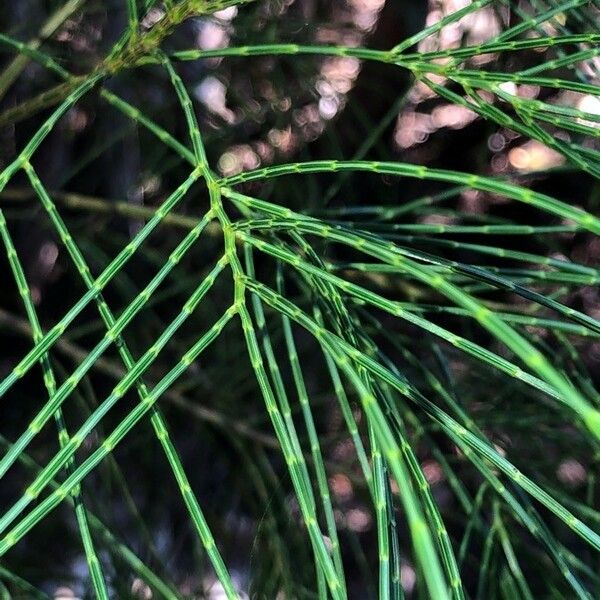
- 🌿 The "Needles": What look like needles are actually thin, green, jointed branchlets called cladodes. They perform photosynthesis, while the true leaves are reduced to microscopic scales at the joints.
- 📐 Geometric Form: In its youth, it maintains a perfect, symmetrical "Christmas tree" or pyramidal shape without the need for pruning.
- 🥥 Woody Cones: It produces small, rounded, woody fruits that resemble miniature pinecones. These are actually specialized clusters of flowers that have hardened.
🏡 In Your Garden
- 🧪 Nitrogen Power: Like many in its family, this plant has a special partnership with soil bacteria to "fix" nitrogen. This means it can thrive in poor, sandy, or degraded soils where other plants might struggle.
- ☀️ Sun & Stability: It craves full sun and high humidity. Because it develops a deep taproot, it is highly wind-resistant but extremely sensitive to being moved. Once you plant it, it’s best to let it stay put for life.
- 🪴 Bonsai Potential: Due to its fine texture and naturally small "leaves," it is a highly prized species for bonsai enthusiasts looking to create miniature forest scenes.
⚠️ Safety & Toxicity
- ✅ Status: Generally considered non-toxic to humans and common household pets.
- 🌵 Physical Touch: While not poisonous, the tips of the branchlets and the woody cones can be quite stiff and "pokey." Curious pets might find the fallen cones tempting to chew, which could pose a mild choking hazard.
✨ Fun Fact
Despite its name Gymnostoma (which sounds like "Gymnosperm," the group containing pines), it is an Angiosperm. It is a botanical "imposter" that evolved to look like a pine tree to better survive in windy, coastal, or nutrient-poor environments where thin needles are more efficient than broad leaves.

Detailed Care Instructions








