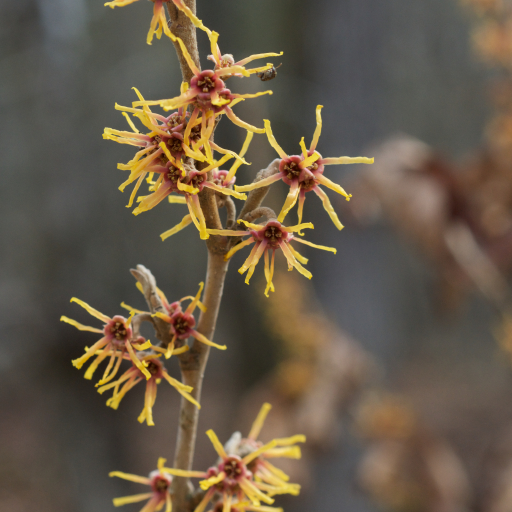
Plant Overview
Often called the "Ozark Witch Hazel," Hamamelis vernalis is the brave herald of the new year, blooming when snow is often still on the ground. Native to the rocky streambanks of the Ozark plateau, this resilient shrub is beloved for its spicy, citrus-like fragrance that can drift across a cold winter garden. It’s the perfect plant for those who find the gray days of February a bit too long and need a sign that spring is secretly on its way.
🔍 How to Identify
- 🌼 Ribbon Petals: The flowers consist of four thin, strap-like petals that look like tiny pom-poms or spiders clinging to the bare branches.
- 🍂 Wavy Leaves: The foliage is broadly oval with wavy, "scalloped" edges. In the fall, these leaves transform into a brilliant, buttery yellow before dropping.
- 🪵 Multi-Stemmed Habit: It typically grows as a dense, rounded thicket of several grayish-brown trunks, reaching about 6 to 10 feet in height.
🏡 In Your Garden
- 💧 Moisture Lover: Unlike its cousin, the Common Witch Hazel, the Ozark variety loves a bit of "wet feet." It excels in rain gardens or near low-lying spots where the soil stays consistently moist.
- 🛡️ Winter Protection: One of its most magical traits is "thermometry." When temperatures drop below freezing, the flower petals curl up into tight spirals to protect themselves, unfurling again the moment the sun warms the bark.
- ✂️ Sucker Control: It has a habit of "suckering," or sending up new shoots from the base. If you want a tidy look, you’ll need to prune these away; otherwise, it will happily create a privacy screen or thicket.
⚠️ Safety & Toxicity
- ✅ Safe Status: Hamamelis vernalis is generally considered non-toxic to humans, cats, and dogs.
- 🌿 Skin vs. Stomach: While witch hazel extract is a famous astringent for skin, the raw plant material contains tannins that can cause mild stomach upset if ingested in large quantities. It’s best to keep curious puppies from chewing on the woody stems.
✨ Fun Fact
Early settlers and "water dowsers" believed that the forked branches of Witch Hazel had mystical properties. They used them as "divining rods," claiming the wood would twitch or bend in the hand to lead the way to hidden underground water sources!

Detailed Care Instructions
To grow Hamamelis Vernalis, also known as Ozark Witch Hazel, follow these steps:
- Choose a suitable location: Hamamelis Vernalis prefers partial shade to full sun and well-draining soil. Choose a spot in your garden that receives adequate sunlight and has soil that does not stay waterlogged.
- Planting: Plant your Hamamelis Vernalis in the spring or fall. Dig a hole that is slightly larger than the root ball of the plant and plant it at the same level as it was in the container. Water the plant thoroughly after planting.
- Watering: Keep the soil consistently moist but not waterlogged. Water your Hamamelis Vernalis regularly, especially during dry periods. Consider mulching around the base of the plant to help retain moisture.
- Fertilizing: Hamamelis Vernalis does not require much fertilizer. You can apply a balanced fertilizer in the spring, but be careful not to over-fertilize as this can lead to leaf burn.
- Pruning: Prune your Hamamelis Vernalis after it has finished blooming in the late winter or early spring. Remove any dead or damaged branches and shape the plant as desired.
- Propagation: Hamamelis Vernalis can be propagated through seeds, cuttings, or layering. Seeds can be collected from the plant in the fall and sown in a well-draining soil mix. Cuttings can be taken in the summer and rooted in a moist, sandy soil mix.
By following these steps, you can successfully grow and cultivate Hamamelis Vernalis in your garden.

Place in a bright room that is sun drenched almost all day. Or directly in a south-facing window.

To water this plant, it is important to thoroughly saturate the root zone, which is typically the top 12-18 inches of soil. Water deeply, allowing the soil to dry out slightly between waterings to prevent waterlogging. Use a watering can or hose to water at the base of the plant, avoiding wetting the foliage to prevent disease. During hot weather, be sure to water more frequently to keep the plant hydrated. Consider using a soaker hose or drip irrigation system for more controlled and efficient watering.
To fertilize the plant, apply a balanced fertilizer in early spring before new growth begins. Use a slow-release fertilizer to provide nutrients gradually over time without overwhelming the plant. Follow the manufacturer's instructions for proper dilution and application. Water the plant thoroughly after fertilizing to help the nutrients reach the roots. Avoid over-fertilizing, as this can harm the plant. Repeat the fertilizing process annually in early spring to support healthy growth and flowering.
Hamamelis Vernalis plants thrive in well-draining, acidic soil. They prefer a slightly acidic pH level between 5.5 and 6.5. The soil should be moist but not waterlogged, as these plants do not tolerate very wet conditions. A mix of organic matter such as compost or peat moss can help improve the soil's structure and fertility. Additionally, adding a layer of mulch around the base of the plant can help retain moisture and regulate soil temperature. It is important to avoid using heavy or clay-like soils, as these can lead to poor drainage and root rot.
Hamamelis Vernalis plants can be propagated through both seed and cutting methods. To propagate through seeds, collect ripe seeds in the fall and plant them in a pot filled with well-draining soil. Keep the soil consistently moist and place the pot in a warm, sunny location. Seeds should germinate within a few weeks.
To propagate through cuttings, take 4-6 inch cuttings from the plant in the spring or early summer. Remove the lower leaves and dip the cut end in rooting hormone. Plant the cuttings in a pot filled with a mix of peat moss and sand, keeping the soil moist but not waterlogged. Place the pot in a warm, sunny location and the cuttings should root within a few weeks.
Both seed and cutting propagation methods can be successful with proper care and attention to detail.








