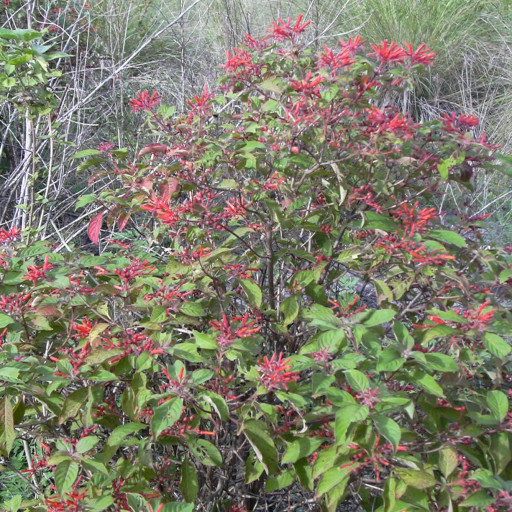
Plant Overview
Known as the "Firebush" or "Scarlet Bush," Hamelia patens is a vibrant, sun-loving shrub that acts as a neon sign for local wildlife. Native to the subtropical and tropical reaches of the Americas, this hardy plant is beloved for its year-round "flaming" appearance. Whether it's the fiery orange-red flowers or the leaves that turn bronze in the sun, this plant brings a tropical energy to any landscape.
🔍 How to Identify
- 🍃 The Foliage: Look for elliptical leaves that grow in "whorls" (circles) of three to seven around the stem. They often feature distinct reddish veins and a soft, velvety texture on the underside.
- 🔥 The Flowers: The plant produces clusters of elongated, tubular blossoms. These flowers are typically a brilliant reddish-orange or scarlet and do not have wide-spreading petals, making them look like tiny unlit firecrackers.
- 🫐 The Fruit: After flowering, small oval berries appear. They transition through a beautiful color palette—starting green, turning a glossy red, and finally maturing into a deep, juicy black.
🏡 In Your Garden
- ☀️ Sun-Driven Color: While the Firebush is incredibly drought-tolerant once established, its visual "fire" depends on the sun. In full sun, the leaves develop a stunning bronze or reddish tint; in the shade, they remain a simple deep green.
- 🦋 The Pollinator Magnet: This is arguably the best plant for attracting hummingbirds and butterflies (like the Zebra Longwing). Because the flowers are tubular, they are perfectly designed for the long beaks of hummingbirds, who will often claim a single bush as their personal territory.
⚠️ Safety & Toxicity
- ✅ Status: Generally considered non-toxic and safe for home gardens.
- 🐾 Pets & People: The berries are technically edible for humans (though often described as bland or slightly acidic) and are a favorite snack for birds. There are no known major toxicity concerns for cats or dogs, making it a "worry-free" choice for family backyards.
✨ Fun Fact
In indigenous Mayan medicine, the Firebush is known as Ix-canan, which translates to "Guardian of the Forest." It has been used for centuries in traditional remedies to treat everything from skin rashes to stings due to its natural anti-inflammatory properties.

Detailed Care Instructions
| Humidity | Normal |
| Lighting | Full Sun |
| Difficulty | Medium |
| Hibernation | Cold Period |
| Temperature | 28°C - 38°C |
| Hardiness Zones | 9 - 12 |
To grow Hamelia patens plants, also known as firebush or hummingbird bush, follow these steps:
- Selecting a suitable location: Firebush plants require full sun to partial shade. Choose an area that receives at least 6 hours of direct sunlight per day. Ensure the soil is well-draining and fertile.
- Planting: Dig a hole in the ground that is twice as wide and deep as the root ball of the plant. Place the plant in the hole and backfill it with soil, gently firming it around the roots. Leave a slight depression around the plant to hold water.
- Watering: Water the plant thoroughly after planting to settle the soil and encourage root establishment. Water the plant regularly to keep the soil evenly moist, especially during the hot summer months. Avoid overwatering, as it may lead to root rot.
- Mulching: Apply a layer of organic mulch such as wood chips or leaf molds around the base of the plant. Mulching helps retain moisture, suppress weeds, and regulate soil temperature.
- Fertilizing: Apply a balanced slow-release fertilizer in spring and summer to provide the necessary nutrients. Follow the manufacturer's instructions for application rates.
- Pruning: Prune the plant in early spring to remove dead or damaged branches. You can also shape the plant to your liking. Regular pruning will promote bushier growth and more blooms.
- Protecting from frost: If you live in a region with frost or freezing temperatures, protect the plant during winter by covering it with a frost blanket or moving potted plants indoors.
- Pest and disease control: Hamelia patens is generally resistant to pests and diseases. However, occasional infestations of aphids, spider mites, or whiteflies can occur. Monitor your plants regularly and use appropriate pest control measures if necessary.
- Propagation: You can propagate firebush plants through stem cuttings or by collecting and planting their seeds. Cuttings should be taken in late spring or early summer and planted in well-draining soil with appropriate rooting hormone.
By following these steps, you can successfully grow and enjoy the beautiful blooms of the Hamelia patens plant in your garden.

Place in a window with dappled sun or a spot in the middle of a room. Or directly in a window facing west or east.

To water this particular plant, you should first determine the moisture level of the soil. This can be done by sticking your finger into the soil to about one inch deep. If the soil feels dry, it is time to give it water. To water the plant, slowly pour water around the base of the plant until the soil is saturated. Be careful not to allow the water to pool, as this can lead to root rot. It is important to water the plant deeply but infrequently, rather than giving it small amounts of water frequently. This will encourage the plant's roots to grow deeper in search of water, which can ultimately make the plant more resilient in dry conditions. During periods of intense heat or drought, it may be necessary to water the plant more frequently.
To fertilize the plant, use a balanced fertilizer with a ratio of 10-10-10 or 20-20-20. Apply the fertilizer during the growing season, which is typically in the spring or summer. Mix the fertilizer into the soil around the base of the plant. Be careful not to over-fertilize as this can lead to excessive growth and weaken the plant. Water the plant thoroughly after fertilization. Monitor the plant for any signs of nutrient deficiencies and adjust the fertilization schedule accordingly.
The soil for Hamelia Patens plant should be rich, well-draining, and slightly acidic in nature. A loamy soil with a pH value ranging from 6.0 to 7.0 is considered ideal. The soil should have good moisture retention capacity and should not become waterlogged, as this can lead to root rot. Adding organic matter such as compost, peat moss, or aged manure can improve the soil's texture and nutrient content. Additionally, fertilizing the plant with a balanced fertilizer during the growing season can help promote healthy growth and flowering.
To propagate this plant, select a healthy stem with several leaves that is approximately 4 to 6 inches long. Cut it just below a node, which is where a leaf attaches to the stem. Remove any leaves from the bottom half of the stem. Dip the cut end in rooting hormone and plant it in a pot with moist soil. Keep the soil moist and place the pot in a warm, bright location but out of direct sunlight. It may take several weeks for the plant to root and begin to grow new leaves. Once the new growth appears, gradually acclimate it to brighter light and pot it up into a larger container or transplant it to a suitable outdoor location.
Common pests of the fire bush include Scale insect, mealybugs, spider mites, aphids, thrips. Make a habit of checking your fire bush frequently for pests so that any infestations can be caught and managed early.








